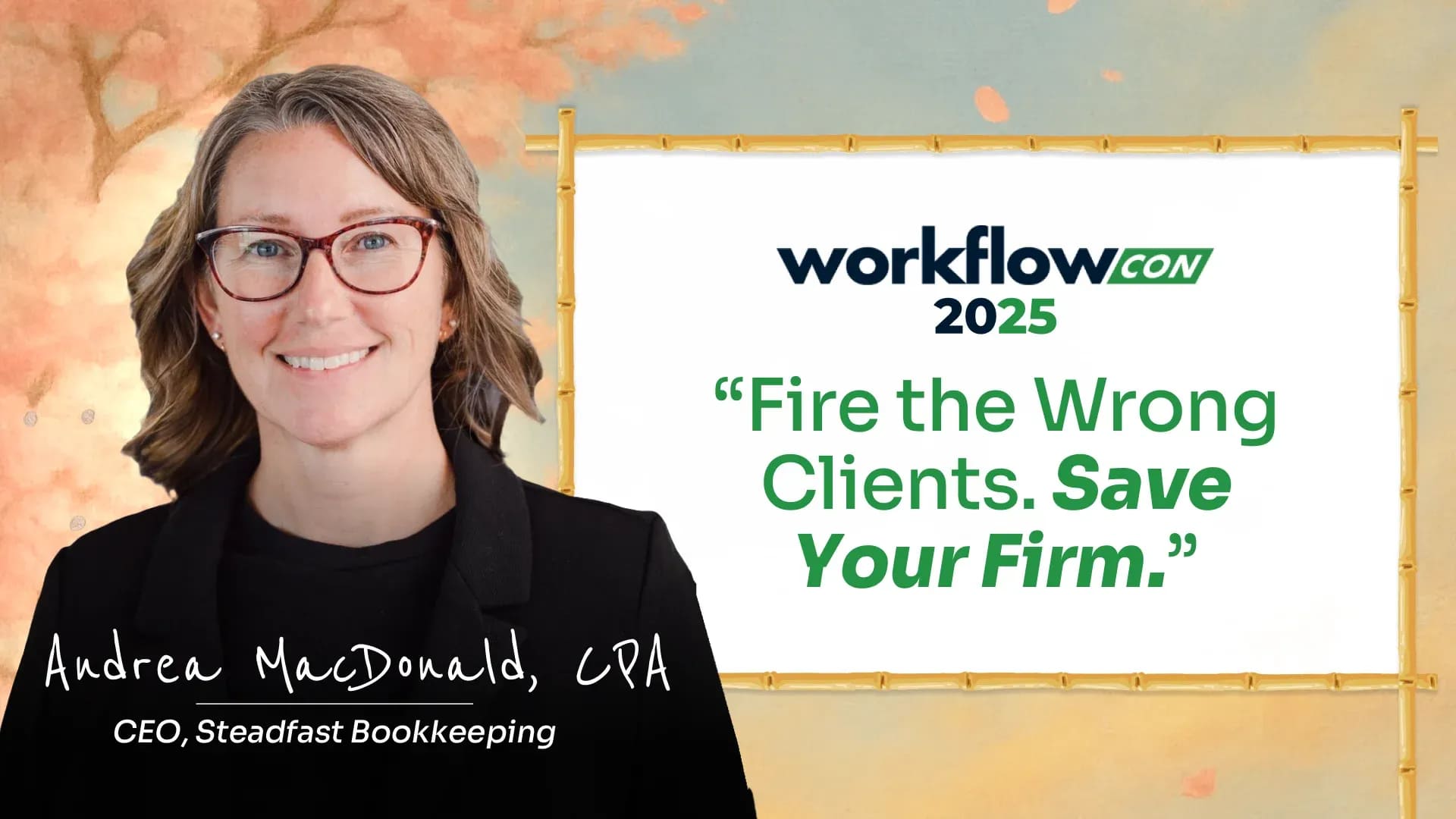
Intentional Client Design: How Andrea MacDonald Aligned Her Firm with Joy and Growth
At WorkflowCon, Andrea MacDonald, founder of Steadfast Bookkeeping, delivered a candid, deeply personal workshop on how accounting firm owners can radically change the trajectory of their business by choosing clients with intention. MacDonald’s session stood out not for technical talk, but for its honesty about burnout, difficult clients, and the heavy toll that running a firm out of alignment can take on one’s life and team. She described her own journey from the brink of quitting, dreading emails, struggling to make payroll, and enduring toxic stress—to building a practice where both she and her staff actually enjoy their work.
MacDonald’s central message was clear: if your client list is driving your firm, instead of the other way around, it is time to step back and redesign not just your services, but the very foundation of your business. Her session was packed with stories, practical ranking systems, and permission to take bold steps, from raising prices to “releasing” clients who no longer fit. She challenged every attendee to do one thing this week to move closer to a practice that brings joy and sustainable growth.
Understanding the Cost of Serving the Wrong Clients
Andrea MacDonald’s workshop began with a blunt look at the reality many practitioners face: too many clients, too little joy, and a sense that the business is running them ragged. She described the early years of her firm as “a whole entire dumpster fire,” recounting how saying yes to anyone with “a pulse and a wallet” left her overworked and underpaid. “I was working too many hours, I was getting paid little to nothing, and I was barely hanging on,” she admitted.
The cost of serving the wrong clients, MacDonald noted, is measured in more than just dollars. It shows up in stress, staff burnout, and an office culture where nobody wants to show up. She recalled a critical moment when her most loyal team member experienced a health scare from overwork, and she herself considered walking away from the firm altogether. “If anyone on here is independently wealthy and still choosing to do this, let’s meet up offline because I want to learn your ways. I’m here because I’ve got bills to pay,” she said, highlighting how the wrong client mix can threaten both morale and a firm’s future.
How to Define and Rank Your Ideal Clients
The turning point for MacDonald came when she realized that client selection was not just a marketing exercise but the heart of her firm’s happiness and performance. She advocated for a rigorous, team-based approach to identifying ideal clients, involving both feelings and hard metrics.
MacDonald’s process began with listing the characteristics of her favorite clients and involving her team in ranking clients on factors like industry, service package, responsiveness, and “good client” status. She explained, “We spent a session and a half talking about our ideal clients. This is not a one-and-done discussion. This is a discussion we have at least once a year. If we need to pivot and refocus, we can.” She emphasized the value of input from all staff—especially those who work on the front lines with clients.
Each client was assigned a score in categories such as niche fit, package type, and subjective enjoyment. These scores were then averaged and assigned a letter grade from A to F, just like a school report card. The goal, MacDonald said, was to keep only A and B clients in the long run and systematically offboard the lowest-ranked clients. She reminded attendees, “If you’re solo, your opinion is the only one that matters. But if you have staff and have handed off client work, it’s who your staff likes working with that counts.”
Systematically Releasing Clients Who Do Not Fit
Having ranked her clients, MacDonald described the next steps as “freeing,” not fear-inducing. She advocated for direct, unapologetic offboarding of F and D clients, using short and simple messages such as, “We’re changing direction here at Steadfast Bookkeeping, and unfortunately, we don’t believe we’re the best fit to help you anymore.” She was adamant that practitioners owe no lengthy justification, only clarity and, if appropriate, referrals to other providers. “Don’t overcomplicate it. You don’t have to explain yourself to anyone except your staff. You all have come to this decision,” she said.
MacDonald acknowledged that for many firm owners, letting go of clients can be a source of anxiety. She recommended starting with those who make work unpleasant or are disrespectful to staff. “I have a standing rule that if people are mean to my staff, they are immediately fired. I don’t care how good they are,” she said. She also shared that in some cases, simply raising fees for less-than-ideal clients can encourage them to self-select out.
Redesigning Your Service Offering to Support Joyful, Sustainable Growth
Intentional client design is not just about who you work with, but what you offer. MacDonald explained that her firm moved away from one-off tax prep to focus on bundled services, such as bookkeeping plus tax, which brought in more predictable revenue and stronger client relationships. She structured packages with clear priorities: the stickiest, most profitable services received top attention, while once-per-year tax clients were deprioritized or phased out.
MacDonald stressed that service design must also reflect the firm’s desired culture and lifestyle. In her firm, that meant a maximum of thirty-six hours per week, unlimited paid time off, and no nights or weekends—even during tax season. “We actually monitor PTO throughout the year so that if I see people aren’t taking it, I can ping them to take some time off. That’s an important metric to me,” she shared. The move toward intentional packages and boundaries allowed her firm to afford better pay and benefits, reinforcing the positive cycle of client and team happiness.
Maintaining Alignment as Your Firm Grows and Evolves
MacDonald emphasized that intentional client design is not a “set it and forget it” task. As her firm grew, acquiring and merging with other practices, she and her team revisited the client ranking and service design process regularly. Team retreats, annual reviews, and honest conversations ensured that the firm’s client roster and service offerings continued to match its core values and culture.
She encouraged others to treat client design as a living process, adaptable to new markets, team changes, and personal growth. “We’re all rowing in the same direction,” she said, highlighting the power of collective buy-in for lasting change.
Build a Firm You and Your Team Love
Andrea MacDonald’s workshop was both a blueprint and a call to action for firm owners who are tired of feeling trapped by their client list. By taking the time to identify, rank, and release the wrong clients, and by intentionally designing service offerings that support both joy and financial health, MacDonald proved that sustainable growth is not only possible, but within reach. The real work is not in chasing every opportunity, but in building a practice where everyone, from the owner to the newest staff member, looks forward to coming to work. As MacDonald said, the greatest reward is not just a better bottom line, but a business that finally feels like your own
Summary:
Kenji Kuramoto, founder of Acuity, shares his journey of scaling an accounting firm from startup chaos to structured clarity. He recounts three critical phases: aggressive growth that led to unsustainable churn and layoffs, misguided scaling attempts that copied tech company processes without considering firm culture, and finally achieving clarity through systems that aligned with their values.
Andrea MacDonald’s Intentional Client Design workshop provided a candid blueprint for accounting firm owners to combat burnout and achieve sustainable growth. It detailed a rigorous, team-based system for ranking and releasing non-ideal clients, and redesigning service offerings to build a firm that brings joy to both staff and owner.
WorkflowCon 2026 Waitlist is open!
Now we are already building the next chapter.
The Practice Management Hub




Get Started Today