Workflows That Work: Standardization + KPIs for Firm Success
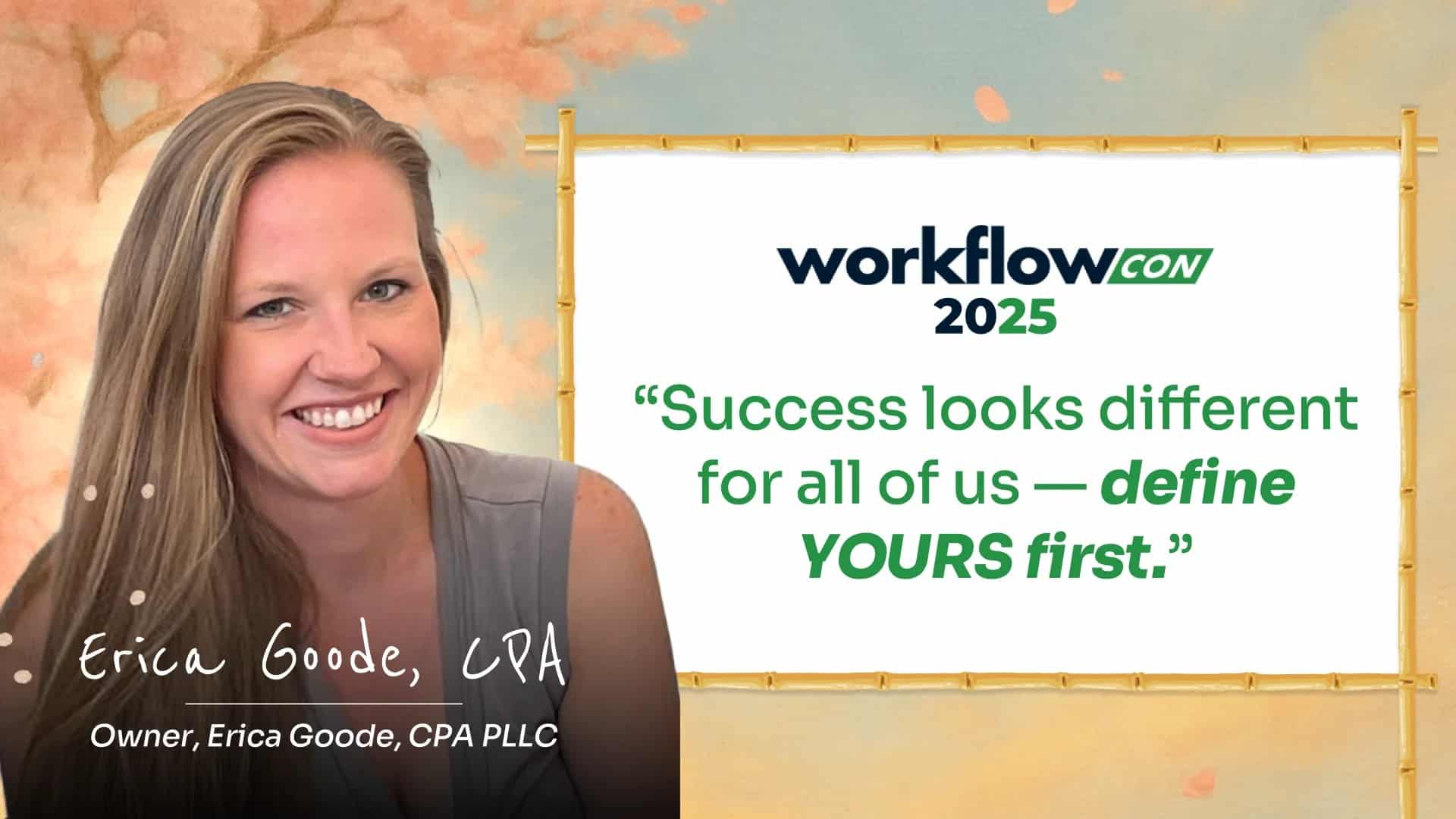
Erica Goode stepped on the WorkflowCon 2025 virtual stage with a simple premise: you cannot build the right workflows, choose the right KPIs, or grow the right kind of firm until you define the right version of success for yourself. Everything else is downstream from that.
“There could very well be 50 versions of success in this room. We have to be careful that we’re not trying to chase after somebody else’s version of success.”
From that foundation, she delivered one of the most grounded KPI sessions of the conference, practical, candid, and rooted in real data pulled straight from her own firm.
Success Must Be Self-Defined Before It Can Be Measured
Goode began with the premise that most firm owners adopt someone else’s definition of success without realizing it. High revenue. Headcount. A million-dollar exit. But for many accountants, those goals are either irrelevant or incompatible with their real lives.
To illustrate the gap between universally used words and individually understood meanings, she drew an unexpected comparison from her rural Idaho town. Locals often use the phrase “clear over there,” she explained, but it refers to distances that could range from fifty yards to nearly the Wyoming border.
“Success is the same as ‘clear over there.’ What I’m saying is successful might not be what you’re saying is successful.”
She urged attendees to strip their definition down to the essentials:
- What does a “good” business look like for you?
- What constraints matter?
- What season of life are you in?
- What tradeoffs are you unwilling to make?
Only then can a KPI actually indicate something.
How Your KPIs Change When Your Definition of Success Changes
Goode walked through several examples demonstrating how different goals demand different metrics.
1. Success = Replacing a W-2 Within 12 Months (Under 45 Hours/Week)
KPIs:
- Monthly profit
- Hours worked per week
- Discovery calls booked
- Networking events attended
- Marketing activities completed
This owner’s KPIs revolve around speed and financial replacement.
2. Success = Selling the Firm for $2M
KPIs:
- Annual revenue
- Monthly recurring revenue
- MRR as a percentage of total revenue
- Revenue per employee / LER
- Percentage of clients on standardized workflows
These metrics are driven by valuation theory, not personal lifestyle constraints.
3. Success = Goode’s Own Model
Her definition was simple and season-specific:
“After-tax take-home pay is at least half of my family’s expenses while I work less than fifteen hours per week.”
So her KPIs reflect that reality:
- Monthly profit
- Total hours worked
- Profit per client per hour (her custom metric)
- Marketing metrics that matter for her niche (podcast downloads, newsletter performance)
- CPE hours (for compliance)
By anchoring everything to a defined outcome, her metrics actually guide the business, rather than becoming a disconnected dashboard.
Her Signature Metric: Profit per Client per Hour
Goode introduced the KPI she is most known for and believes more solo and fractional firms should adopt.
“If you’ve never heard anybody talk about this, it’s because I’m pretty sure I made it up.”
She calls it Profit per Client per Hour (PCH), and it measures exactly what it sounds like:
PCH = (Client Revenue – Client-Specific Costs) ÷ Hours Spent on the Client
It is, she argued, the most honest representation of efficiency and sustainability for small, capacity-constrained firms. Here’s how she calculates it:
Revenue:
- Monthly recurring fees or hourly billables
Direct costs:
- Client-specific software
- Contractor hours associated with that client
- GL subscriptions, reporting tools, or per-client apps
Hours:
- Tracked ruthlessly, but not because she bills hourly
- Tracked for internal truth, not client visibility
“I am not a huge fan of billing hourly, but I am a huge fan of tracking hours.”
She emphasized that the point is not to punish yourself or staff, it’s to discover the truth about efficiency.
How to Build KPIs into Your Workflow (So You Actually Track Them)
Most firm owners struggle with defining KPIs and integrating them into the actual rhythm of the business. A KPI is only as valuable as the system that captures it. Goode emphasized that tracking cannot depend on “remembering,” bursts of motivation, or sporadic year-end cleanups. It must be structurally embedded inside the work itself.
“We can define them and then forget them in a desk drawer. They do us no good if we don’t track them.”
She presented a practical framework for building KPIs directly into a workflow so tracking becomes automatic rather than aspirational.
1. Reduce Your KPIs to a Core Set That Actually Drives the Firm
The first operational step is ruthless simplification. Goode warned that an overbuilt KPI library becomes self-defeating; the owner ends up maintaining reports instead of running the firm.
“I would max them out at five.”
Five is not an arbitrary limit, but a recognition of cognitive and operational capacity. The essential KPIs should:
- Tie directly to the firm’s definition of success.
- Cascade into multiple areas of performance (e.g., hours worked influences profitability, client load, and hiring decisions).
- Be measurable on a monthly or weekly basis, not annually.
This constraint forces clarity. When limited to five, owners choose metrics that matter.
2. Embed KPI Collection Into Workflows You Already Perform
Goode’s most important insight is that KPI tracking must “ride along” with existing habits.
Drawing on James Clear’s concept of habit coupling, she argued that the easiest way to adopt a new behavior is to attach it to a behavior already happening.
For most firms, the natural anchor is the monthly close, either for clients or for the firm itself. She demonstrated how she includes herself as a client on her own workflow checklist:
- Close books
- Review financials
- Update KPI tracker
- Review drivers (lead gen, hours, efficiency metrics)
Because the workflow already exists, KPI tracking becomes a line item. This avoids the most common failure point: creating a beautifully designed KPI dashboard that is used only at tax time.
3. Build a Dedicated KPI Tracking System That Is Easy to Maintain
Goode stressed that KPI tracking should be “clear, boring, and repeatable.” Whether a firm uses Excel, a Google Sheet, or practice management software, the tool must be:
- Standardized: same KPIs, same placement, same cadence.
- Lightweight: fast to update, requiring minimal navigation.
- Maintained monthly: the cadence matters more than the sophistication.
“I don’t think you need to overcomplicate this. Once the format is set up, I can’t imagine this takes me more than five to ten minutes.”
This discipline is why her KPI data becomes strategic over time. The uniformity turns month-over-month comparisons into meaningful insight instead of noise.
4. Convert Tracking Into Decision-Making Through Scheduled CEO Time
The final step is the one even disciplined owners skip: analysis.
Goode warned that owners often track numbers without creating time to interpret them. This leaves KPIs inert, data without action.
“It’s really hard to see the forest for the trees when you’re constantly looking at the trees.”
Her prescription:
- Schedule recurring CEO time, monthly at a minimum
- Treat it as client work: protected, immovable, and revenue-critical
- Use KPI trends to evaluate:
- Client profitability
- Workload and hours
- Pricing gaps
- Workflow breakdowns
- Capacity decisions
- Marketing effectiveness
- Alignment with the firm’s definition of success
The point of tracking it is intervention. The KPI becomes a signal, and the CEO’s time becomes the response.
Final Takeaway: Success and KPIs Are Personal and Must Stay That Way
As Goode closed her session, she challenged one of the most persistent assumptions in the accounting profession: that success is objective, universal, and measurable by standard benchmarks like revenue, headcount, or growth rate. In her view, nothing could be further from the truth.
“Success and KPIs are specific to you and you alone, and we want to be so careful that you don’t accidentally start chasing somebody else’s version of success.”
In an industry saturated with comparison—top-line numbers posted on LinkedIn, firm growth stories amplified at conferences, efficiency metrics shared without context—Goode encouraged firm owners to reconsider whose goals they are running toward.
The most dangerous trap, she argued, is building a firm optimized for an outcome you never wanted.
Summary:
Kenji Kuramoto, founder of Acuity, shares his journey of scaling an accounting firm from startup chaos to structured clarity. He recounts three critical phases: aggressive growth that led to unsustainable churn and layoffs, misguided scaling attempts that copied tech company processes without considering firm culture, and finally achieving clarity through systems that aligned with their values.
Erica Goode’s practical, grounded WorkflowCon 2025 session challenged firms to first define their own version of success, then choose aligned KPIs. She shared real-firm data, a framework for embedding KPIs into workflow, and introduced her custom “Profit per Client per Hour (PCH)” metric.
WorkflowCon 2026 Waitlist is open!
Now we are already building the next chapter.
The Practice Management Hub


Get Started Today