AI in Accounting EP 2: Fast Transaction Categorization, The Thrive Roll-Up, Machine Learning & More!
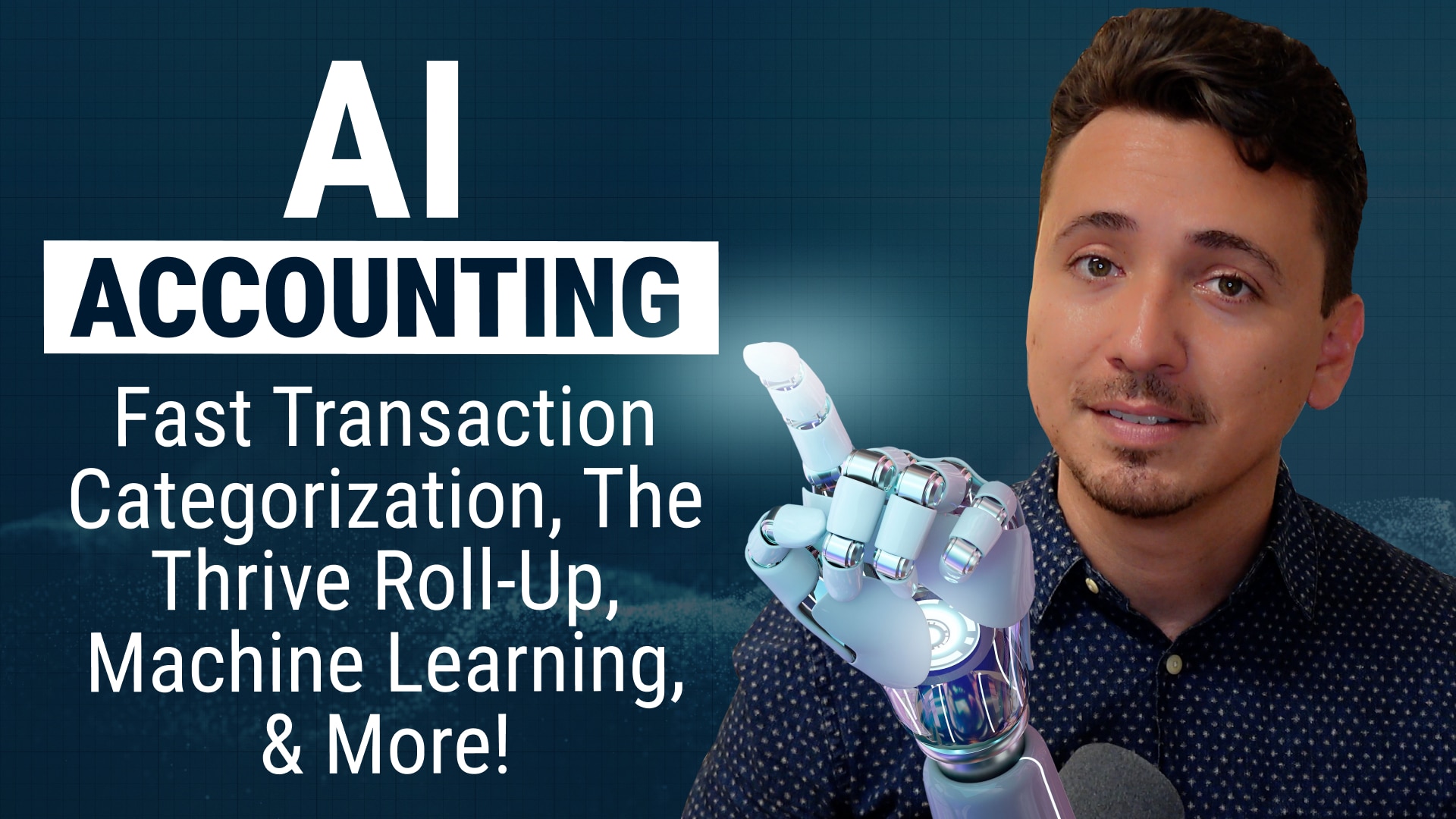
AI in accounting isn’t one thing — it’s a dozen different tools solving a dozen different problems, plus a wave of venture capital money betting the whole industry is about to change shape. Here’s what’s actually happening right now, broken into three parts: a practical tool you can use today, the biggest industry news, and the fundamentals you need to understand before you trust any of it.
AI Transaction Categorization: The Unglamorous Tool That Saves the Most Time
If you’ve ever stared at a bank export trying to figure out whether a $47 charge from “SQ *RIVERSIDE LLC” is a meal, an office supply, or a contractor payment, you already understand the problem this solves.
Every transaction — every payment in, every payment out — needs a category: rent, payroll, software, cost of goods sold. Getting it right matters because P&L reports, tax returns, and cash flow statements are all built on top of how transactions get coded. Done manually at scale, it’s slow and error-prone, especially when a client sends 500 transactions a month with cryptic merchant names.
Here’s how AI categorization actually works under the hood. The model is trained on millions of already-categorized transactions, so it learns patterns: Delta Airlines usually means Travel, ADP usually means Payroll, Adobe subscriptions usually mean Software. When a new transaction comes in, the AI doesn’t just look at the merchant name — it weighs the description, amount, transaction type, timing, client industry, and how similar transactions from that vendor were coded in the past. It makes a prediction and attaches a confidence score. High confidence, it categorizes automatically. Low confidence, it flags the transaction for human review.
What separates a good system from a mediocre one is whether it learns your firm’s specific patterns over time. If you keep recoding a vendor from “Meals” to “Client Entertainment,” a well-built system picks that up and applies it automatically going forward. That’s reinforcement learning from corrections — every override makes the model smarter about that specific client.
The workflow difference is significant. The old process: a client sends a bank statement, and an accountant manually codes every transaction — two to three hours for a client with 300 transactions a month. The new process: bank feeds connect automatically, AI categorizes 85–90% of transactions instantly, and the accountant spends 20–30 minutes reviewing flagged items. Across 20 clients generating 200–400 transactions each, that adds up to dozens of staff hours freed up every month — hours that can go toward advisory work or taking on more clients without adding headcount.
It’s not flawless. AI struggles with vendors it hasn’t seen before, vague merchant descriptions, and business context that requires actual judgment. That’s exactly why human review isn’t optional — it’s the quality control layer. AI handles volume; the accountant handles judgment. The firms getting real value out of this are using it to remove repetitive work, not to remove accountants from the process.
A Billion Dollars From Silicon Valley Is Betting on Accounting Roll-Ups
According to Reuters and Yahoo Finance, there’s roughly a billion dollars moving into accounting right now — and it’s not coming from a bank or traditional private equity. It’s coming from Thrive Capital, the venture firm behind early bets on Stripe, OpenAI, and Databricks.
Thrive’s vehicle for this is Crete Professionals Alliance, and the strategy is a roll-up: instead of building software and selling it to firms, Crete is buying accounting firms outright and equipping them with OpenAI-powered tools. Crete plans to deploy more than $500 million to acquire U.S. accounting firms over the next two years. Since founding in 2023, it’s already grown to over $300 million in annual revenue across more than 20 firms and 900 employees.
Thrive’s tech team has been building custom tools with OpenAI specifically for accounting work — data mapping, memo writing — and some users report saving hundreds of hours a month. Worth noting: those users are also employees of the firms Thrive owns, so take that endorsement with appropriate context.
The roll-up structure lets Crete take majority stakes while original owners keep a minority position, so the accountants who built these firms stay involved rather than walking away entirely. And Crete isn’t alone — General Catalyst, another major venture firm, is running a similar playbook. When multiple top-tier VC firms make the same bet simultaneously, it’s worth paying attention to.
Crete co-founder Jake Sloane has said the goal isn’t replacing accountants with AI — it’s using technology to improve service quality while humans handle the relationship and trust side of the work. That framing matters, but the bigger picture is still significant: a billion dollars of Silicon Valley money betting that AI-powered firm structures can outperform traditional practices is a strong signal the competitive landscape is shifting. Whether these roll-ups actually deliver the above-market returns venture capital expects is still an open question — analysts say that will take time to prove out. But if it works, every firm competing against a Crete-owned practice will feel the pressure to adopt similar tools just to keep pace.
An AI Detour: Fighting Wildlife Crime With Camera Traps
Away from spreadsheets for a second — the World Wildlife Fund recently detailed how it’s using AI for conservation. Programs like Forest Foresight combine satellite imagery with AI to catch early signs of deforestation and wildfires before they spread. WWF and Google also built Wildlife Insights, an AI platform that processes camera trap footage from around the world to track changes in animal populations. And at airports and shipping docks, AI-powered detection systems are being trained to flag illegal wildlife products, helping inspectors catch smugglers before animals are trafficked. Same underlying technology as transaction categorization — pattern recognition at scale — applied to a completely different problem.
The Fundamentals: What Machine Learning Actually Is
If you’re going to use AI tools in your firm, it’s worth understanding what’s actually happening under the hood — because it changes how much you should trust the output.
Traditional software runs on hand-written rules: “if the email contains ‘free money,’ mark it as spam.” A programmer writes every rule and every exception. Machine learning flips that entirely. Instead of writing rules, you feed the system thousands of labeled examples — spam and not-spam — and it finds the patterns itself. Nobody writes “free money equals spam.” The system figures that out from the data.
Three ingredients make this work:
- Data — lots of it. A model is only as good as what it’s trained on. Want it to recognize cats in photos? You need thousands of labeled cat photos.
- A model — the structural framework the system uses to find patterns. Different model types are suited to different jobs: images, text, sequential decisions like chess.
- Training — the model makes a prediction, gets told if it was right or wrong, and adjusts. Repeat that millions of times and it gets accurate.
None of this is new — the concepts go back decades. What changed is the cost: training used to require months on hardware costing millions of dollars, and now you can train useful models in hours on rented cloud servers. That drop in cost is why AI is suddenly everywhere, not because the underlying idea is new.
Here’s the part that matters most for how you use it. Machine learning is excellent at pattern matching when the future looks like the past and there’s a clear right answer to learn from. It struggles the moment you push it outside its training data — and it has no actual understanding of what it’s doing. It’s matching patterns, not reasoning. That’s why AI can produce confident, plausible-sounding answers that are simply wrong. It’s not lying to you; it’s doing exactly what it was built to do, applied to a situation it wasn’t necessarily built for.
Knowing that distinction — where a tool is reliable versus where it’s guessing — is what separates firms that get real value from AI from firms that either over-trust it or write it off entirely.
Where Financial Cents Fits In
If transaction categorization and machine learning fundamentals feel relevant to your day-to-day, the same pressure point — month-end close — is where a lot of firms are feeling the most pain right now.
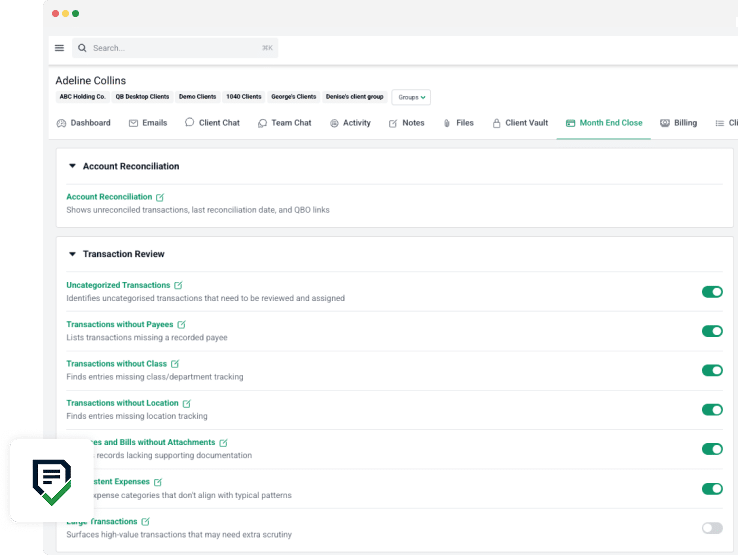
Financial Cents’ Month-End Close solution is built to cut down the stress and back-and-forth that usually comes with closing out a client’s books. Your team can flag errors faster, ask clients questions once instead of in five separate emails, and push corrections directly into QuickBooks Online. Everything happens in one modern review hub built specifically for accounting firms, instead of scattered across email threads and spreadsheets.
It’s one of the reasons more than 10,000 accountants, bookkeepers, and CPAs use Financial Cents to run their firms.

Tools, templates, and stories built for small and growing firms.