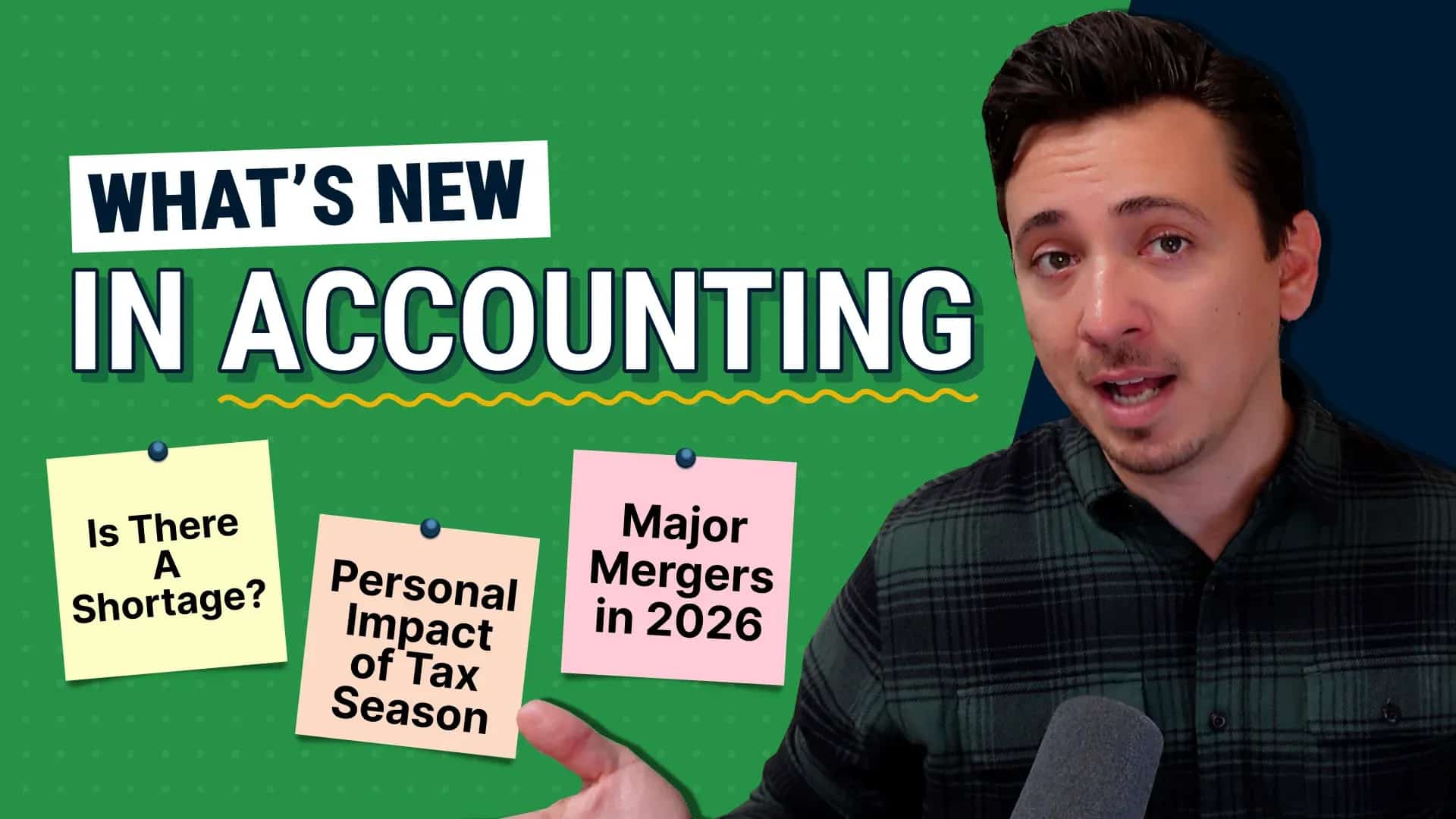
What’s New in Accounting? The Accountant Shortage, Merger Mania in 2026 & More!
The accounting industry is having a moment — and not always a comfortable one. Firms are short on people, tax season keeps getting harder on the people they do have, and mergers are reshaping the competitive landscape faster than most firms can keep up with. Here’s what’s actually happening, based on the latest data.
Is There Really an Accountant Shortage?
Yes — and the numbers back it up. According to CPA Practice Advisor, the U.S. has a real accountant shortage, and it’s hitting workload, demand, and burnout hard. Nevada, for example, has just 1.75 accountants for every 1,000 residents, and that ratio isn’t improving.
A few things are driving it:
- Retirements are outpacing new entries. More accountants are leaving the workforce than are coming into it.
- CPA certification is expensive, which discourages a lot of younger candidates.
- Perception problems. Heavy workload, job stress, and fear that AI will eat entry-level accounting jobs are all keeping people away from the profession.
The practical effect: open CPA roles now take an average of 73 days to fill — almost double the time it takes to fill non-CPA roles. That’s a long time for a firm to run understaffed during a critical hire.
The industry’s response? Make it easier to become a CPA, and pay people more to do it.
Several states have lowered the credit-hour requirement from 150 to 120. The AICPA and NASBA also approved a new licensure path: a bachelor’s degree, two years of professional experience, and a passing CPA exam score is now enough in many states.
At the same time, the biggest firms are throwing money at the problem. Ernst & Young doubled its CPA exam bonus for early-career hires who pass all four exam parts within a year, bringing the total to $10,000 — the firm’s first bonus increase in over two decades. PwC matched that move, raising its own bonus to $10,000 effective June 1.
The takeaway: the barrier to entry is lower than it’s been in years, but real skill and experience are still what firms are actually competing for. If you’ve been sitting on the fence about getting your CPA, there’s more support and more money on the table right now than there has been in a long time.
The Real Toll of Tax Season
Every accountant knows tax season is brutal. What’s less talked about is exactly how brutal — and a recent CPA Practice Advisor survey put real numbers on it.
The survey used something called the Tax Season Survival Index, scoring 438 U.S. accountants from 0 (no impact) to 100 (complete disaster) on how tax season affected their health and lifestyle. The average score: 55.6 out of 100. That put 78% of respondents in the “survived” tier or worse — meaning most accountants aren’t thriving during tax season, they’re just getting through it.
Some of the specifics:
- 44% said tax season strained personal relationships badly enough that they needed repairing afterward.
- 50% dealt with caffeine withdrawal once the season ended.
- 58% were stuck handling late documentation from clients.
- 70% made — or nearly made — errors in the final 48 hours before the deadline.
- Half of respondents got less than 6 hours of sleep a night during peak season.
- Half rated their stress at 8 out of 10 or higher in the final 72 hours before April 15.
The most common pressure points were deadline-week panic, client chaos, and what respondents called “life suspension” — basically putting your entire personal life on hold to get the work done.
Here’s the interesting part: larger firms reported less stress than small firms. That suggests the problem isn’t really the amount of work — it’s the systems firms use to manage it. Tax season will always be intense. But firms that tighten up how they collect client documents, track deadlines, and manage workflow clearly come out the other side in better shape than firms still running things ad hoc.
If any of those stressors sound familiar, and you already know what caused the worst of it this year, now — right after tax season, while the pain is fresh — is the best time to actually fix it.
A Quick Detour: How Accountants Took Down Al Capone
Small break from the data. Al Capone, one of the most notorious gangsters in U.S. history, wasn’t taken down by cops or detectives — he was taken down by accountants.
Federal investigators couldn’t make any charges against Capone stick during his years running a Chicago crime syndicate in the 1920s and early ’30s. The break came when agents realized that despite his obviously lavish lifestyle, Capone wasn’t paying taxes on any of his illegal income — and a recent Supreme Court ruling had confirmed that illegal income was still taxable.
In 1931, Capone was charged with 22 counts of tax evasion and thousands of Volstead Act violations. He was ultimately convicted on 5 counts of tax evasion and sentenced to 11 years. The most feared criminal in the country, taken down by tax law.
Merger Mania Is Just Getting Started
If 2026 needs a nickname, “Merger Mania” fits. Accounting firms and industry groups are consolidating at a pace that’s hard to overstate.
The biggest recent example: the state CPA societies of Maine, Massachusetts, New Hampshire, Rhode Island, and Vermont merged into a single organization — the New England Society of CPAs — effective July 1. Each state’s board and members approved the move, aiming to build a stronger, unified voice for the profession across the region.
This isn’t happening in a vacuum. Anxiety about the accountant shortage, fear of AI disruption, and growing demands on firms are all pushing organizations toward consolidation as a way to protect their members’ careers and well-being.
Private equity is accelerating the trend even further. According to CPA Trendlines, PE firms see accounting practices as platforms for growth, and acquiring or merging smaller firms is the fastest way to build that platform. The numbers make the shift obvious: there were 78 accounting mergers in the U.S. in the first four months of 2026, compared to just 44 in the same period in 2025 — a massive jump in a single year.
From state societies down to individual firms, the accounting landscape is moving fast. Nobody knows exactly what it’ll look like by the end of 2026, but one thing is clear: uncertainty isn’t slowing the industry down. It’s speeding it up.
Where Financial Cents Fits In
With a talent shortage, brutal tax seasons, and firms racing to consolidate, it’s easy to feel like you’re just reacting to whatever comes next. That’s exactly the kind of pressure Financial Cents is built to relieve.
More than 10,000 firms use Financial Cents to manage workflows, collaborate with clients, and collect payments — all in one place. One feature clients consistently love is the Client Portal: instead of chasing documents over email or unsecured messages, you get a single, secure, professionally branded hub for requests, documents, and transactions. Clients access it through a secure magic link, so there’s no username or password for them to forget.
It also shortens the client chase with automated reminders, making it easier for clients to get you what you need — on time, without the back-and-forth.
If any of the stress points above sound familiar, it might be worth seeing what Financial Cents can take off your plate.
Join 10,000+ accounting professionals who get workflow tips every week.
Subscribe



Tools, templates, and stories built for small and growing firms.