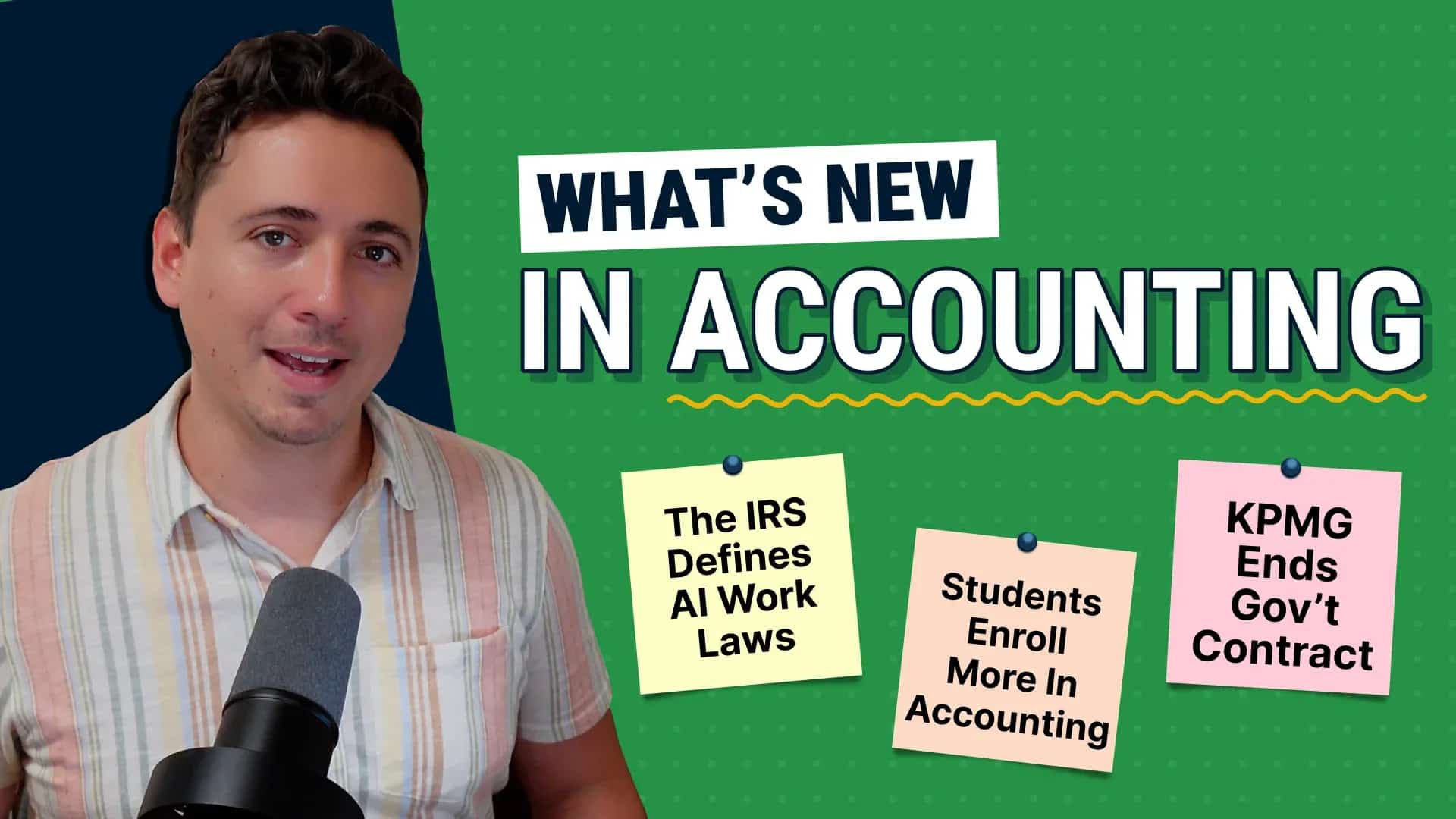
What’s New in Accounting? IRS AI Regulations, Accounting Enrollment, KPMG Ends Contract & More!
Three big stories are shaping accounting right now: the IRS just told every tax pro how AI fits into their ethics rules, accounting enrollment is climbing for the third year straight, and KPMG is walking away from federal government audit work entirely. Here’s what you actually need to know.
The IRS Just Set the Rules for AI in Your Firm
If your firm uses AI for anything — research, drafting, client memos — this affects you, regardless of how much or how little you’re actually using it.
The IRS Office of Professional Responsibility, the group that enforces ethics rules for anyone practicing before the IRS, just issued guidance on how AI fits into Circular 230. That’s the federal regulation governing attorneys, CPAs, and enrolled agents, and it’s been on the books since 1921. It’s not a suggestion — it’s codified regulation covering due diligence, competence, confidentiality, and fair billing.
The IRS put it plainly: technology is a tool, not a substitute for professional judgment. Final decisions still rest with the practitioner. AI can draft and summarize. It can’t sign off on anything.
Four things the guidance actually requires:
1. You still have to check the work. AI output is a starting point, not a finished product. If AI drafts a memo or runs a calculation, you’re responsible for verifying every fact and number before it reaches a client or the IRS. The bulletin is direct about this: human scrutiny and editing are essential.
2. Competence now includes understanding the tool. You’re expected to know not just tax law, but how your AI tool generates answers and where it tends to go wrong. The IRS specifically flagged fabricated outputs and bias as known risks — and warned that not understanding those risks could lead to improper advice or flawed filings.
3. Watch what you upload. Client data is federally protected, and dropping Social Security numbers or return details into a free public chatbot is a real confidentiality problem. Use secure, enterprise-approved tools only. Worth knowing: a federal judge ruled this year that a defendant’s chat logs with an AI about legal strategy weren’t protected by attorney-client privilege. That logic could extend to tax matters too — what you type into a chatbot isn’t automatically private.
4. Billing has to reflect reality. If AI cuts your prep time in half, you can’t bill as though you did it manually. The IRS warned that charging full fees for AI-assisted work that took a fraction of the time could count as an “unconscionable fee” under Circular 230.
The IRS didn’t pull this out of thin air — they pointed to Deloitte Australia, which submitted a 230-plus page government report full of AI-generated fabrications: invented quotes, references to reports that don’t exist, books credited to the wrong authors. Deloitte ended up refunding part of their fee once it was caught.
What this means for your firm: you don’t need to stop using AI. You need a written policy — what tools are approved, what data can go into them, who reviews the output before it’s final — and firm leaders own that responsibility, not just individual preparers. Treat every AI output like a junior staffer’s first draft: useful, but not client-ready until a human checks it.
Accounting Enrollment Is Up for the Third Year Running
Last time, I covered the very real data behind the accountant shortage. This time, there’s a genuinely encouraging counter-trend.
According to an AICPA analysis of National Student Clearinghouse data, accounting enrollment at four-year colleges rose 8.9% from spring 2025 to spring 2026 — 205,180 students. This isn’t a one-off: enrollment climbed 4.8% in 2024, 12.7% in 2025, and now 8.9% in 2026. Three straight years of growth.
Zoom out to total undergraduate accounting enrollment (four-year plus community college), and it hit 281,992 students this spring, up 5.7% from last year. Compare that to business majors overall, which grew just 1.3% — accounting is outpacing general business enrollment by roughly four times.
Sue Coffey, the AICPA’s CEO of Public Accounting, credits the momentum to a few things:
- The CPA Exam itself changed, and first-time candidates hit their highest level since 2018, with pass rates for all four sections hitting their highest level since 2017.
- Entry-level pay is rising, after firms spent years losing junior talent to tech and consulting. The career math is starting to work again for students.
- AI anxiety might actually be helping. When a career feels replaceable, people avoid it. When a career requires a license and human judgment that software can’t replicate, people move toward it. A CPA license doesn’t get automated away.
One exception: two-year and community college accounting programs fell 3.2% this year — but that’s likely a correction after a 24% spike last year, not a new downward trend. If your firm hires bookkeeping or entry-level staff out of local community college programs, that’s the number worth watching, not the four-year figure.
None of this fixes your hiring problem today — these students are years from being licensed. But it changes the multi-year outlook. The 19- and 20-year-olds picking majors right now are choosing accounting at the highest rate in years, and that’s your 2028–2030 hiring pool. The AICPA’s Profession Ready Initiative is also actively studying what early-career CPAs need to succeed in an AI-driven workplace, so the training pipeline is trying to keep pace with where the actual work is heading.
KPMG Is Walking Away From Federal Government Audits
Who audits the government? For a while, KPMG did — and now they’re stepping back.
KPMG announced it’s winding down its federal audit contracts, including work for the Departments of Justice, Labor, Transportation, and Energy, plus the U.S. Treasury, with the relationship ending when the contract terminates in 2030. Earlier this year, KPMG also lost a $64 million-a-year contract auditing the U.S. Army’s financial records — this after nearly a decade of the Department of Defense failing to complete an independent audit of its $840 billion annual budget, with the government now demanding one be completed by 2028.
Defense Secretary Pete Hegseth framed the shift as cutting bureaucratic bloat: ending agency-by-agency audits and reducing the number of separate audits by two-thirds to get faster results for taxpayers.
KPMG’s own statement was corporate-speak for “this wasn’t worth it anymore” — the firm said it’s been prioritizing advisory services over federal audit work, and is redeploying the roughly 450 employees from its federal audit business into other roles across the firm.
So who picks up this work? Ernst & Young is already the prime auditor for the Air Force, Navy, and Marines, making them an obvious contender. Or it could go to a firm that hasn’t done this work before. An $840 billion budget getting properly audited is a big opportunity for whoever steps in.
A Quick Detour: The First CPA Exam Was in 1896
The first CPA license exam happened in New York City on December 15–16, 1896 — more than a century and a quarter of certified public accountants. The profession’s infrastructure dates back further, to 1882, when the Institute of Accountants and Bookkeepers of the City of New York was founded. A New York law in 1896 formally created the CPA title.
The first licensed CPA, Frank Broaker, got his license based on prior experience — no exam required. The first person to actually pass the exam was Joseph Hardcastle, who went on to become an NYU accounting professor.
That original exam covered three sections: theory, practical accounting, and auditing. Candidates needed at least 75 out of 100 on each to pass. From there, CPA regulation spread across the rest of the country — though New York remains, appropriately, the epicenter of the profession it created.
Where Financial Cents Fits In
Between new AI compliance requirements, a hiring pipeline that’s years from paying off, and a shifting competitive landscape, it’s a lot to manage on top of actually running client work.
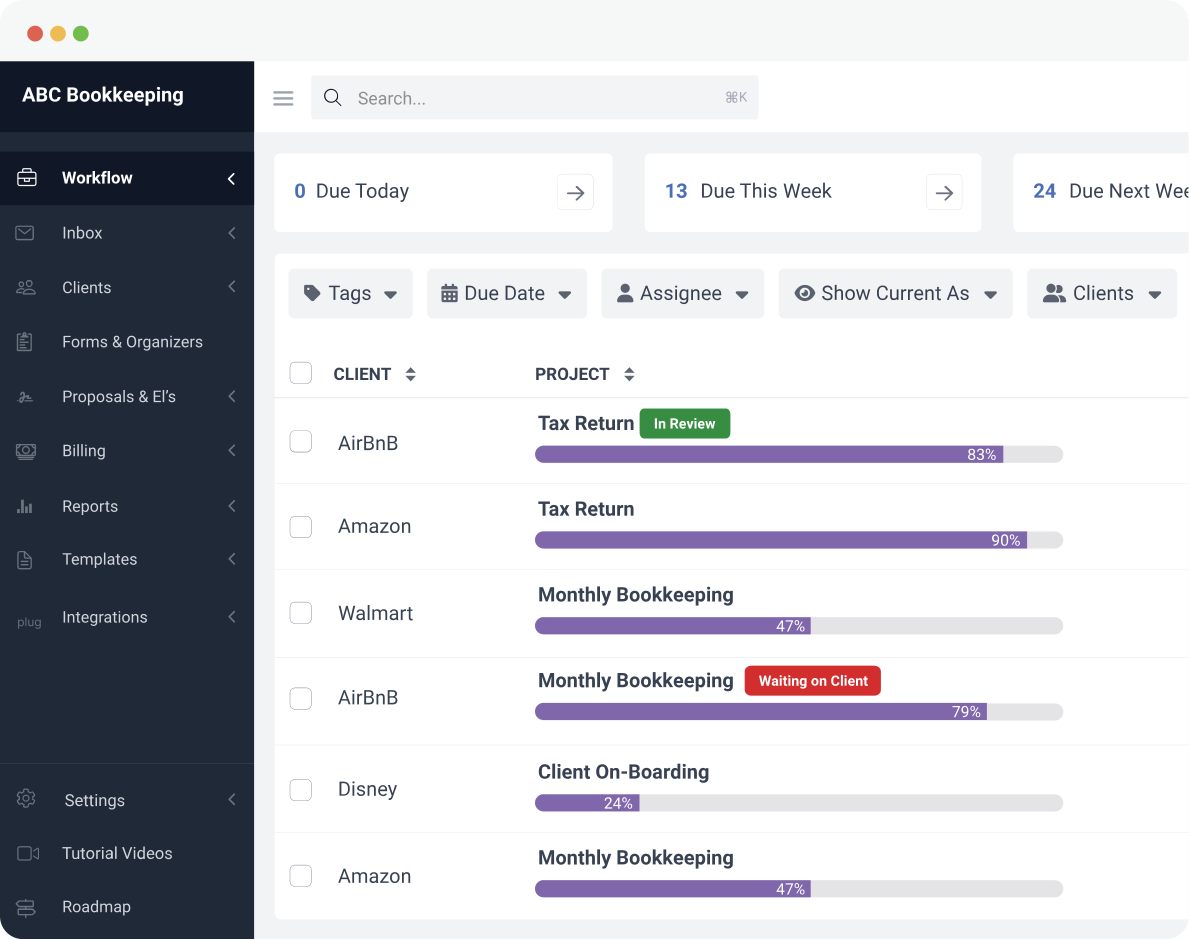
Financial Cents is built to take some of that off your plate. More than 10,000 accounting and bookkeeping firms use it to manage workflows, collaborate with clients, and collect payments in one place. One feature firms consistently lean on: workflow templates.
Standardizing how your firm gets work done doesn’t have to mean building everything from scratch. Financial Cents gives you a library of hundreds of pre-built templates designed by experienced accountants, the option to customize your own, or the ability to upload templates for your team to reuse. You can even generate new templates with Financial Cents AI in seconds. Whichever route you take, templates keep every engagement following a clear, repeatable process — saving hours you’d otherwise spend reinventing the wheel.
Tools, templates, and stories built for small and growing firms.