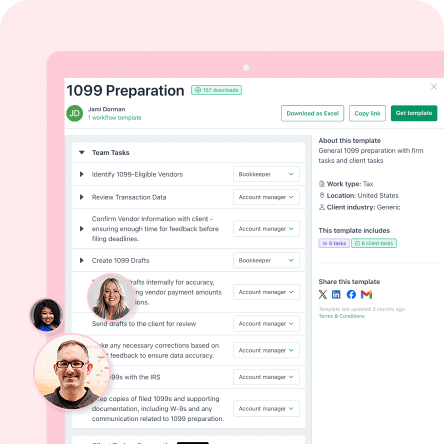
When you look at the average firm struggling with client management, you get the picture that strong client relationships aren’t built by effort alone. A client might email a question that gets answered, but the follow-up is recorded in a sticky note. Their documents live in a standalone portal, contact details sit in a spreadsheet, and the context from their last conversation is buried in an employee’s inbox.
Strong relationships depend on the team’s ability to find client information, act on it, and carry context from one interaction to the next.
In the 2025 State of Accounting Workflow & Automation Report, 73.9% of firms said a centralized dashboard was among the software capabilities they wanted most, followed by client reminders at 69.3% and an accounting client portal at 60.6%.
These are only a few of the capabilities a CRM built for accountants provides to help you connect the client relationship to the work behind it: client requests, compliance deadlines, and ongoing service delivery.
By the end of this guide, you’ll understand how accounting-specific CRM differs from general sales CRM. Here are the 10 best accounting CRMs and how to pick the right one for your firm.
TL;DR
- Financial Cents is a strong fit for small and growing accounting firms that want client management, communication, client requests, recurring workflows, and broader practice management in one platform.
- TaxDome and Canopy suit tax and accounting firms that prioritize client portals, document collection, deadlines, workflow automation, and practice management.
- Liscio is an excellent choice for firms that want to centralize client communication, secure document exchange, and client requests in a dedicated tool.
- HubSpot, Salesforce, and Pipedrive are general-purpose CRMs with deeper sales and marketing capabilities, which makes them most useful for firms focused on lead generation, pipeline management, and business development.
- Insightly, Zoho CRM, and Method offer general-purpose CRM capabilities with different strengths in project management, customization, or QuickBooks connectivity.
When evaluating any CRM, consider how well it connects pre-sale lead management with post-sale client work, including documents, deadlines, recurring workflows, and integrations with tools like QuickBooks Online and Xero.
The Best CRM for Accountants Compared
← Scroll to see more →
| Tool | Best for | Accounting-specific? | Client portal | Standout CRM capability | Starting price | Free trial | Rating |
|---|---|---|---|---|---|---|---|
| Financial Cents | Small & growing accounting, bookkeeping, CPA & tax firms | ✓ | ✓ | Client management connected to recurring workflows | Solo $19/mo | 14 days | 4.8 Capterra · 4.7 G2 |
| Insightly | CRM + project management | No | ✓ | Turning closed opportunities into post-sale projects | Plus $29/user/mo | 14 days | 4.0 Capterra · 4.2 G2 |
| Pipedrive | Sales pipeline & business development | No | No native client portal | Visual lead & deal pipeline | Lite $14/seat/mo | 14 days | 4.5 Capterra · 4.3 G2 |
| HubSpot | Sales & marketing teams | No | ✓ | Lead nurturing & marketing automation | Starter $7/seat/mo | Free tier | 4.5 Capterra · 4.4 G2 |
| Salesforce | Large firms with complex CRM needs | No | ✓ | Deep customization & enterprise CRM | Starter Suite $25/user/mo | 30 days | 4.4 Capterra · 4.4 G2 |
| Canopy | Tax & accounting firms | ✓ | ✓ | Client management tied to tax-practice workflows | Standard $74/user/mo | Requires demo | 4.5 Capterra · 4.6 G2 |
| TaxDome | All-in-one tax & accounting practice management | ✓ | ✓ | CRM, portal, documents, workflow & billing in one | Essentials $800/seat/yr | No | 4.7 Capterra · 4.7 G2 |
| Zoho CRM | Firms wanting affordable customization | No | ✓ | Flexible CRM customization & automation | Standard $14/user/mo | Free plan | 4.3 Capterra · 4.1 G2 |
| Liscio | Client communication & document exchange | ✓ | ✓ | Secure client communication & document collection | Intelligent Files $19/user/mo | No | 4.6 Capterra · 4.6 G2 |
| Method | QuickBooks-centric firms needing customization | No | ✓ | Custom CRM connected to QuickBooks | QuickStart $27/user/mo | 10 days | 4.7 Capterra · 4.4 G2 |
What Is an Accounting CRM?
An accounting CRM (client relationship management) system is software that gives your firm a centralized record of each client and prospect relationship. It organizes client information, tracks communication and follow-ups, and shows the team what to do next.
An accounting CRM is not just a regular sales CRM with an accounting label attached. The right CRM for accountants provides a unique system to manage client relationships in the context of the work the firm performs for the client.
That is where it overlaps with the practice management software. The CRM focuses on the relationship, while the practice management software situates that relationship in the context of the work, team, billing, and everything else. In other words, getting a good practice management solution is a common way for firms to get the CRM capabilities they need to manage their client relationships.
Accounting CRM vs. General CRM vs. Practice Management Software
| General CRM | Accounting CRM | Practice Management Software | |
|---|---|---|---|
| Primary purpose | Manage leads, sales relationships, and customer interactions | Manage accounting-firm client relationships alongside accounting-specific needs | Manage the firm’s client work, workflows, team, and operations from end to end |
| Typical users | Sales, marketing, customer success, business development teams | Accountants, bookkeepers, firm owners, client-service teams | Firm owners, accountants, bookkeepers, operations managers, administrators, and client-service teams |
| Typical features | Contact management, lead tracking, sales pipelines, email automation, deal management, reporting | Client/prospect records, communication tracking, follow-ups, onboarding, reminders, client portals, accounting integrations | Workflow management, recurring work, task and deadline tracking, client management, time tracking, billing, reporting, document management, client portals, automation |
| Accounting workflows | Usually limited or requires customization and integrations | Often connected to accounting-specific workflows and client service | Designed around recurring, deadline-driven accounting work |
| Client portal/document handling | May require add-ons or integrations | Includes a client portal and document collection tools | Usually includes portals, document management, requests, and client collaboration |
| Sales pipeline | Strong; often a core feature | Available, but typically simpler than a sales-focused CRM | May include lead/prospect tracking, but sales isn’t always the primary focus |
| Time & billing | Usually requires integrations or separate tools | May include basic billing capabilities or integrations | Often includes time tracking, billing, invoicing, or integrations with those systems |
| Best-fit firm | Firms prioritizing lead generation, sales, and business development | Firms that want CRM capabilities tailored to accounting clients | Firms that want to manage client relationships and the recurring work behind those relationships in one place |
General CRMs are built mainly to handle lead generation, marketing, and sales pipelines. They’re powerful for winning new clients, but using them for accounting clients requires extensive configuration and integrations with separate systems for recurring workflows, document collection, time tracking, billing, and team capacity.
Accounting-specific CRMs connect the client records with the ongoing work associated with that relationship and, in most cases, it’s part of a practice management platform.
With a general CRM, the firm is likely building an accounting workflow around their CRM, while the accounting CRM is designed around the way accounting firms operate.
Another way to think about the three categories is:
- A general CRM manages the sale.
- An accounting CRM manages the client relationship.
- A practice management software manages the client relationship alongside the work delivered to that client.
Practice management is therefore the broadest of the three, with CRM functionality serving as one component of a larger system for the firm’s operations.
The 10 Best Accounting CRM Systems in 2026 (Detailed Reviews)
1. Financial Cents
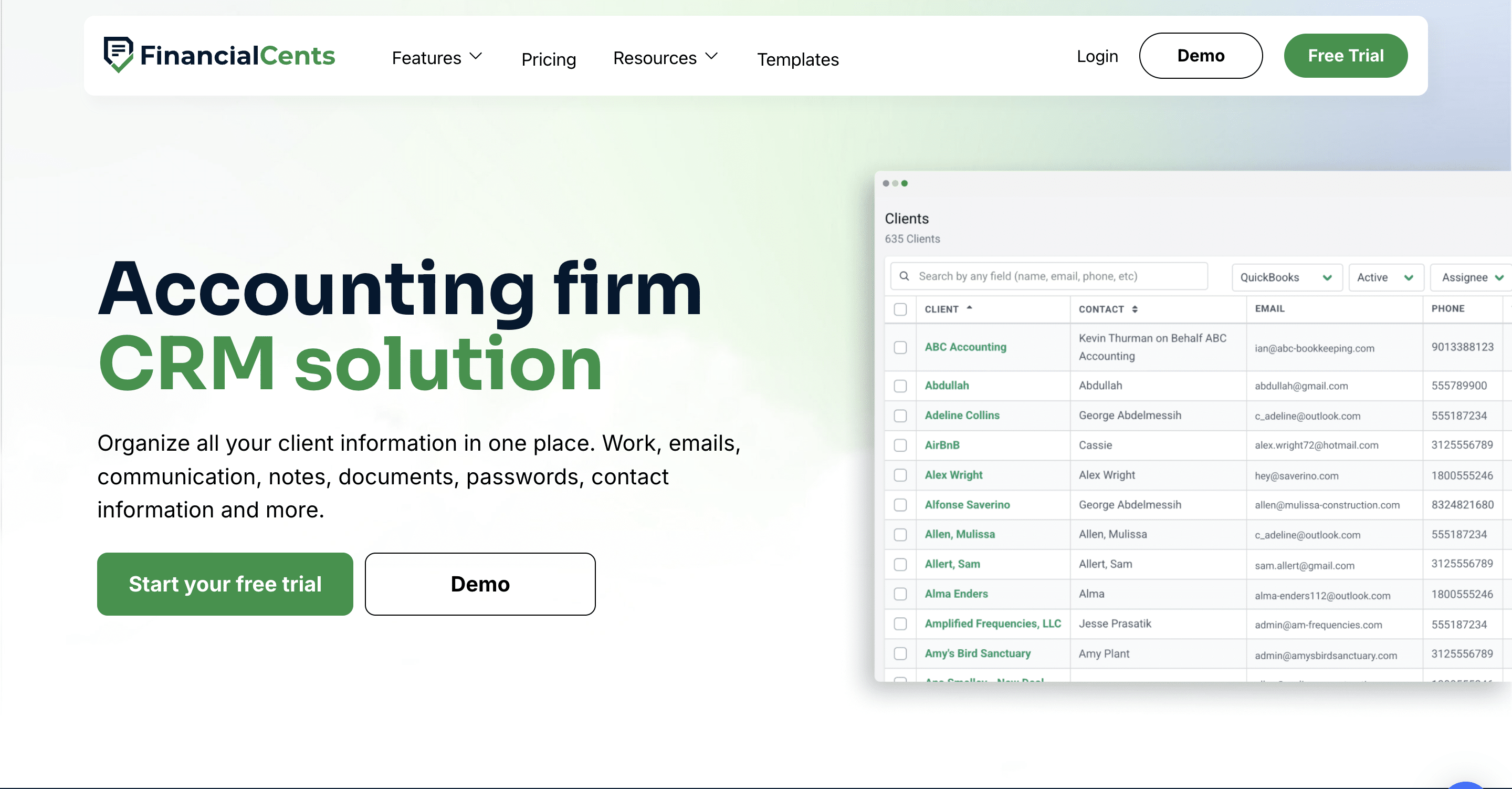
Financial Cents is an accounting practice management platform that combines client management with workflow, collaboration, client portal, billing, and reporting capabilities.
Its CRM capabilities support the journey from prospect and onboarding through ongoing client work, connecting client information to the work your team performs for that client.
Financial Cents CRM features include:
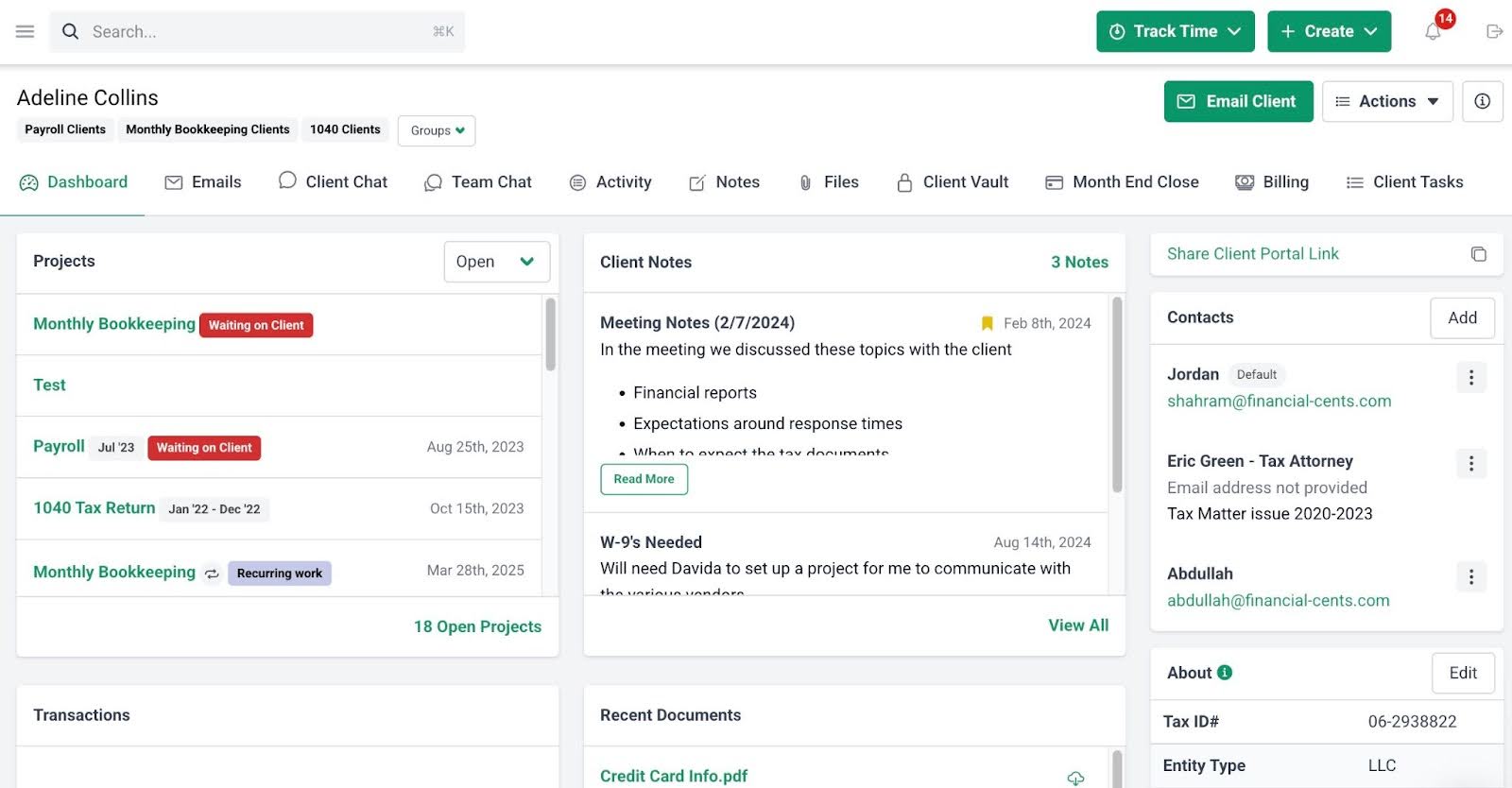
- Client and prospect profiles: Centralized records for client and prospect information, including activity and relationship history.
- Custom fields and client groups: Organize and segment client records around the information and categories that matter to your firm.
- Email integration: Keep relevant client emails connected to the relationship and work.
- Client requests and automated reminders: Request documents or information from clients and automate follow-ups for outstanding items.
- Client portal: Give clients a secure place to submit documents, respond to requests, and communicate with your team.
- Secure client vault and file management: Store and organize sensitive client information, like passwords and credit card details.
- Proposals, engagement letters, and e-signatures: Manage key steps from prospect through signed engagement.
- Workflow templates and recurring work: Standardize and automate recurring client processes.
- Team collaboration: Give team members shared visibility into client work and responsibilities.
- Billing and payments: Manage invoicing, payments, and related client financial information.
- AI features: Automatically rename uploaded client files using your firm’s naming convention, draft client emails and reusable response templates, and generate customizable workflow checklists for client projects.
Accounting integrations
Financial Cents integrates with QuickBooks Online, Zapier, Gmail, Google Drive, Outlook, OneDrive, SharePoint, SmartVault, Adobe Sign (e-signature), etc.
Best For
Small and midsize accounting, bookkeeping, CPA, and tax firms that want client information and communication connected to their tasks, workflows, and deliverables.
Pricing
- Solo: $19/month (single-user firm)
- Team: $49/month per user
- Scale: $69/month per user
- Enterprise: custom pricing
Free Trial
Financial Cents offers a 14-day free trial.
Rating
| Pros | Cons |
|---|---|
| Accounting-specific CRM and practice management in one platform | Not as deeply customizable as enterprise CRMs like Salesforce |
| Client portal, requests, and automated reminders | Does not include built-in tax resolution modules |
| Ease of implementation and use |
2. Insightly
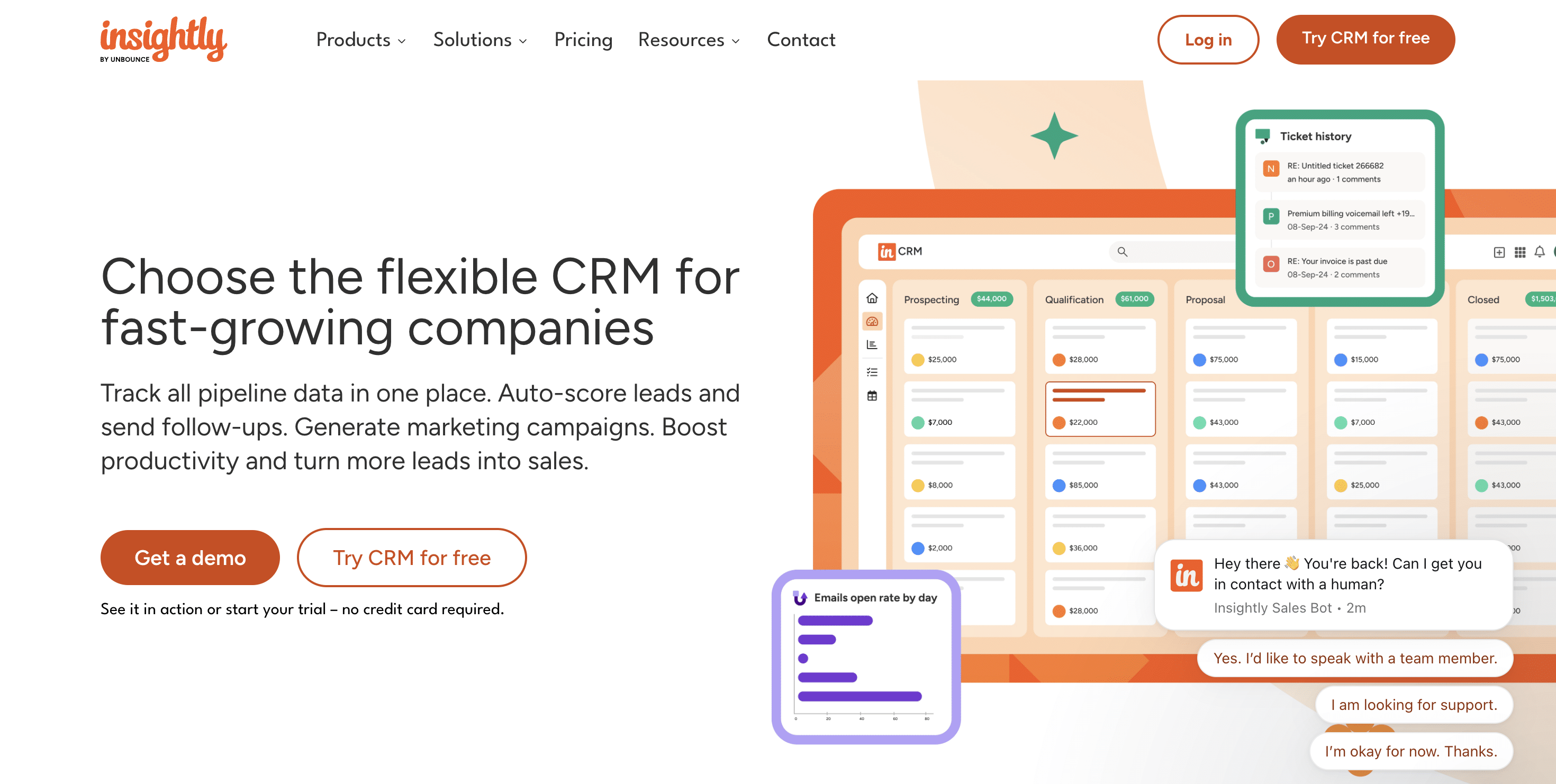
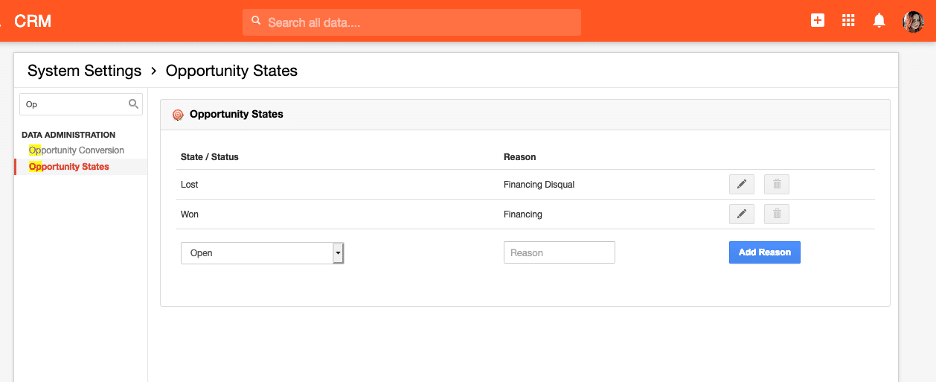
Insightly combines CRM with project management to enable firms to move a closed opportunity into a project instead of ending the relationship at the sales stage.
Its linked records and workflow capabilities can work for growing financial practices, but it is largely a general-purpose CRM and may require additional tools or configuration for recurring and document management.
Insightly’s CRM features include:
- Lead Capture & Distribution: Automatically capture details and assign leads based on custom criteria such as geography and company size.
- Customizable Sales Pipelines: Track and manage opportunities through customizable, visual pipeline stages.
- Opportunity-to-Project Conversion: Convert closed-won opportunities into active projects, copying over task details, linked records, and requirements.
- Process & Workflow Automation: Build automated triggers for repetitive tasks, reminders, email alerts, and stage progressions.
- Validation Rules & Permissions: Set rule validation and granular access permissions to maintain data integrity and security.
- Custom Fields & Configuration: Configure record fields, pipelines, and layouts to mirror specific firm workflows without third-party development.
Accounting integrations
Insightly integrates with QuickBooks Online, Xero, Gmail, Outlook, Slack, DocuSign, Sage Intacct, etc.
Best For
Firms that want traditional sales pipeline capabilities alongside project tracking without moving to a dedicated accounting practice management platform.
Pricing
- Plus: $29/month per user
- Professional: $49/month per user
- Enterprise: $99/month per user
Free Trial
Insightly offers a 14-day free trial.
Rating
| Pros | Cons |
|---|---|
| Combines CRM and project management | Not purpose-built for accounting workflows |
| Strong contact and relationship management | Can involve a learning curve as customization increases |
| Broad integration ecosystem |
3. Pipedrive
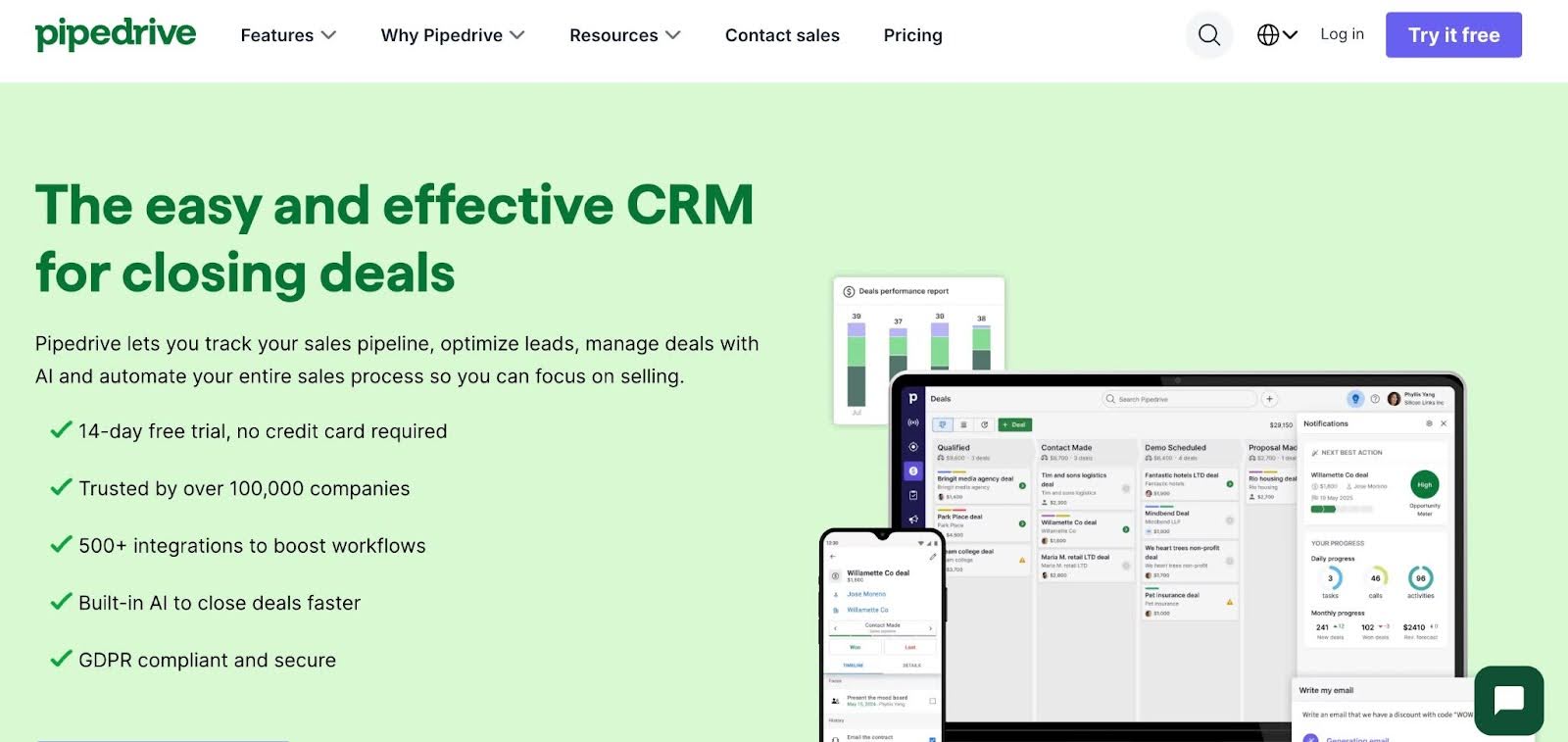
Pipedrive is a sales-focused CRM built around a visual pipeline for organizing leads and deals, tracking activities, scheduling follow-ups, and monitoring sales performance.
Its straightforward approach can help accounting firms bring structure to referrals and new-business opportunities, but its sales-first design means firms may need additional workflow tools for ongoing accounting work.
Pipedrive’s CRM features include:
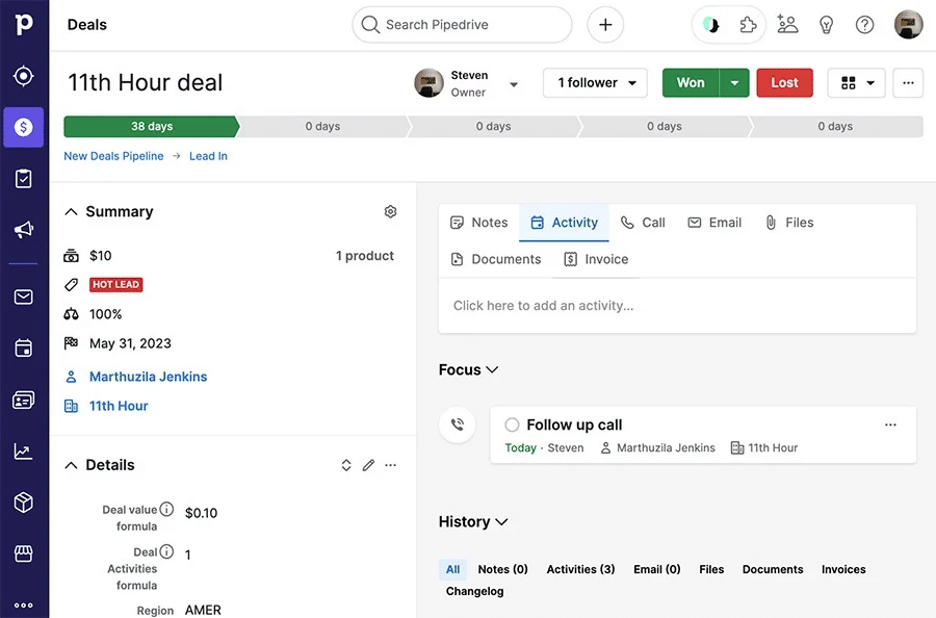
- Pipeline Management: A drag-and-drop board that tracks deals through custom sales stages.
- Lead Management: A unified inbox that organizes inbound leads and contacts before they become active deals.
- Sales Automation: Automatically handles repetitive tasks, emails, and stage updates based on custom rules.
- Projects: Post-sale tool that converts won deals into active projects with tasks, milestones, and deliverables.
- Pipedrive AI: An AI assistant that summarizes communications, predicts close probabilities, and recommends next-best sales actions.
- LeadBooster: A lead capture add-on featuring interactive chatbots, live chat, web forms, and a B2B prospecting database.
Accounting integrations
Pipedrive integrates with QuickBooks, Xero, Outlook, Microsoft Teams, MailChimp, DocuSign, etc.
Best For
Accounting firms focused on new-client acquisition that want a highly visual sales pipeline to manage and track a high volume of leads and inquiries.
Pricing
- Lite: $14/month per seat
- Growth: $39/month per seat
- Premium: $59/month per seat
- Ultimate: $79/month per seat
Free Trial
Pipedrive offers a 14-day free trial.
Rating
| Pros | Cons |
|---|---|
| Intuitive visual sales pipeline | Primarily sales-oriented |
| Strong lead and activity management | Recurring accounting work requires additional tools or configuration |
| Broad integration ecosystem |
4. HubSpot
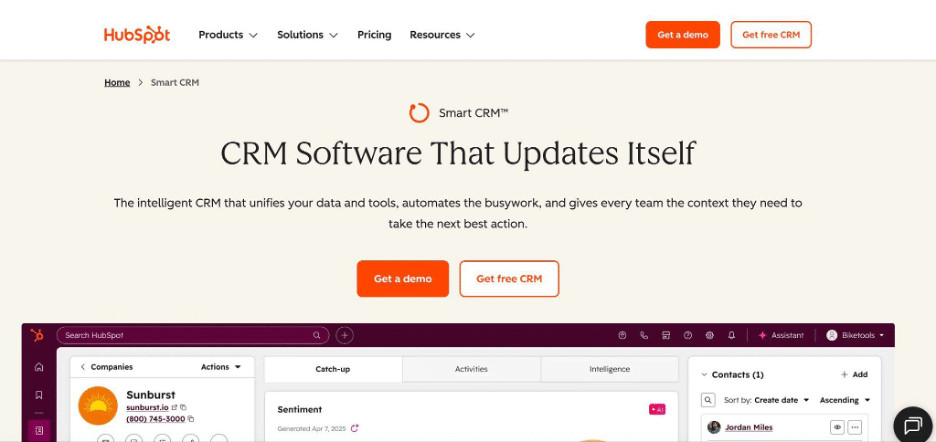
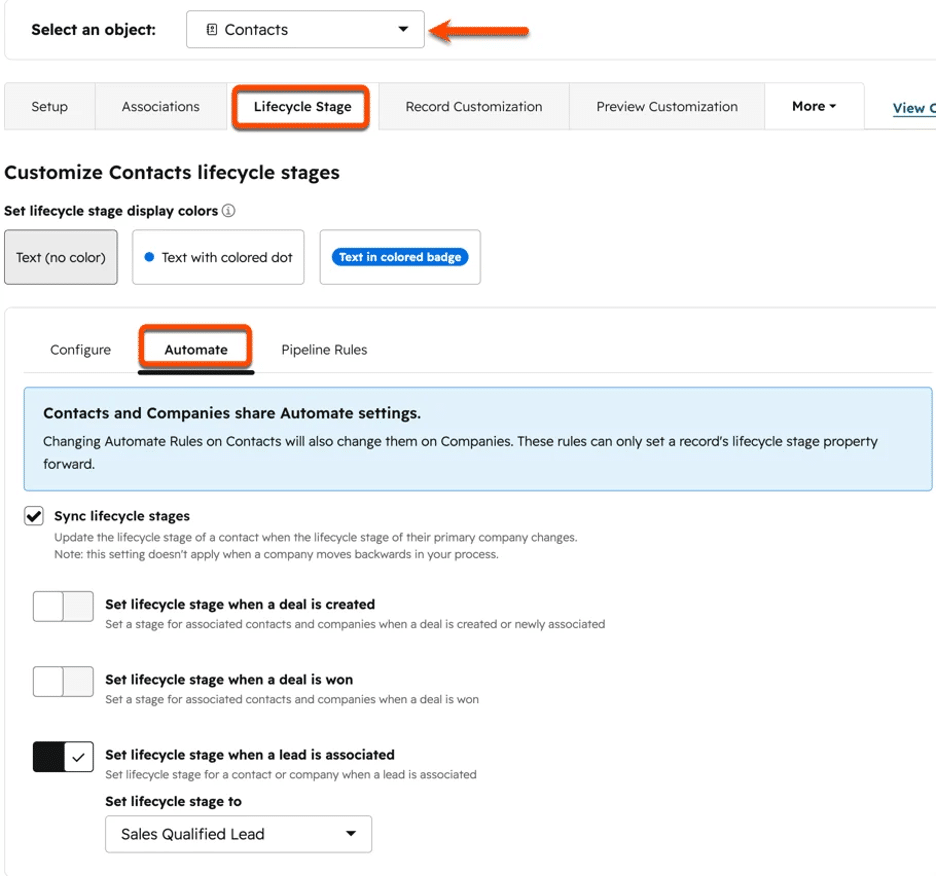
HubSpot combines CRM, marketing, sales, customer service, and other business functions within one ecosystem. Its CRM gives accounting firms visibility into prospects and clients while supporting lead capture, email campaigns, automated follow-ups, pipeline management, and reporting.
HubSpot’s accounting-relevant CRM features include:
- Custom Data Model: Store custom objects, tracking events, lead/deal scoring, and calculated properties in the CRM.
- Data Agent: Natural-language AI search that queries contacts, calls, emails, files, and the web to pull quick answers.
- AI Insights: Highlights critical deal context, flags data inconsistencies, and surfaces key customer insights across records.
- Workflows: Builds visual, automated actions and outreach sequences triggered by customer behavior.
- Team Governance: Protects system integrity with precise role permissions, 2FA, SSO, and SOC 2 compliance standards.
- Centralized Audit Log: Tracks every action performed across the workspace by users, automations, integrations, and AI.
Accounting integrations
HubSpot integrates with QuickBooks Online, Xero, Gmail, Outlook, Typeform, PandaDoc, Slack, Google Meet, etc.
Best For
Mid-market accounting firms with active inbound marketing and business-development programs that need strong lead nurturing, marketing automation, and sales pipeline management.
Pricing
- Free: $0/month
- Starter: $7/month per seat
- Professional: $90/month
- Enterprise: $150/month
Free Trial
HubSpot offers a free tier.
Rating
| Pros | Cons |
|---|---|
| Extensive integration ecosystem | Firms may need separate practice management tools |
| Automation capabilities for email nurturing and prospective lead tracking | Cost scales exponentially as your active client contact list expands |
| Comprehensive reporting dashboards |
5. Salesforce
Salesforce is an enterprise CRM built around sales management, customer relationships, automation, analytics, and extensive customization.
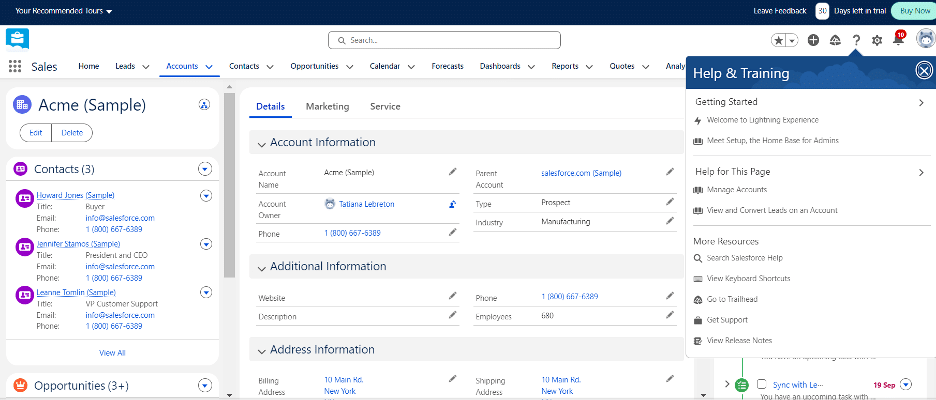
Large and multi-office accounting firms with sophisticated CRM requirements can configure it to manage prospects, clients, opportunities, activities, custom fields, permissions, and complex business processes.
Salesforce’s accounting-relevant CRM features include:
- Opportunity & Deal Tracking: Monitors deals through visual pipeline stages, tracking progress, probabilities, and sales milestones.
- Account & Contact Management: Provides a 360-degree view of every customer, including past communications, key contacts, and deal history.
- Sales Forecasting: Predicts future revenue trends and team performance using real-time deal data and historical analytics.
- Salesforce Flow: Builds complex, step-by-step business processes and automated guided workflows for team members.
- Einstein AI: Delivers predictive lead scoring, automated deal insights, and next-best-action recommendations directly on customer records.
- Agentforce (AI Agents): Deploys autonomous AI agents to assist with lead qualification, customer inquiries, and routine administrative tasks.
Accounting integrations
Salesforce integrates with QuickBooks Online, Google Workspace, Dropbox, DocuSign, etc.
Best For
Larger accounting firms with sophisticated sales operations, complex workflows, and extensive customization requirements, as well as the resources to manage a highly configurable CRM and its integrations.
Pricing
- Starter Suite: $25/month per user
- Pro Suite: $100/month per user
Free Trial
Salesforce offers a 30-day free trial.
Rating
| Pros | Cons |
|---|---|
| Extremely customizable | Significant setup and administration requirements |
| Deep enterprise sales functionality | Not designed for recurring accounting work |
| Advanced reporting and analytics |
6. Canopy
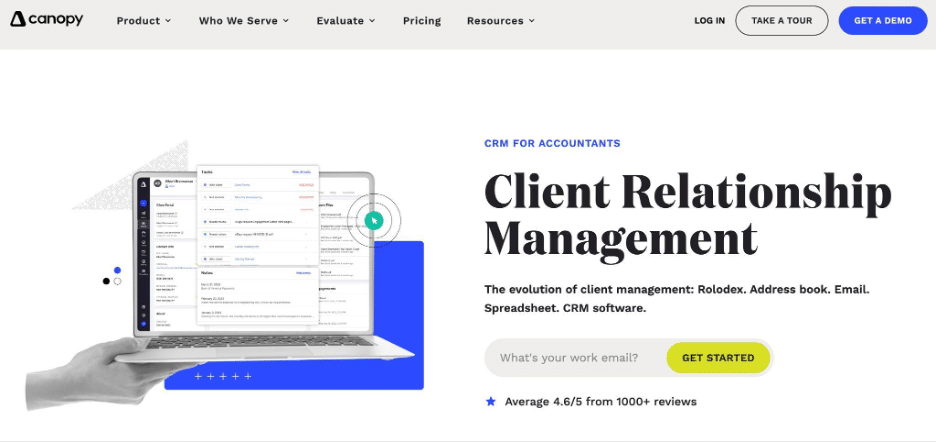
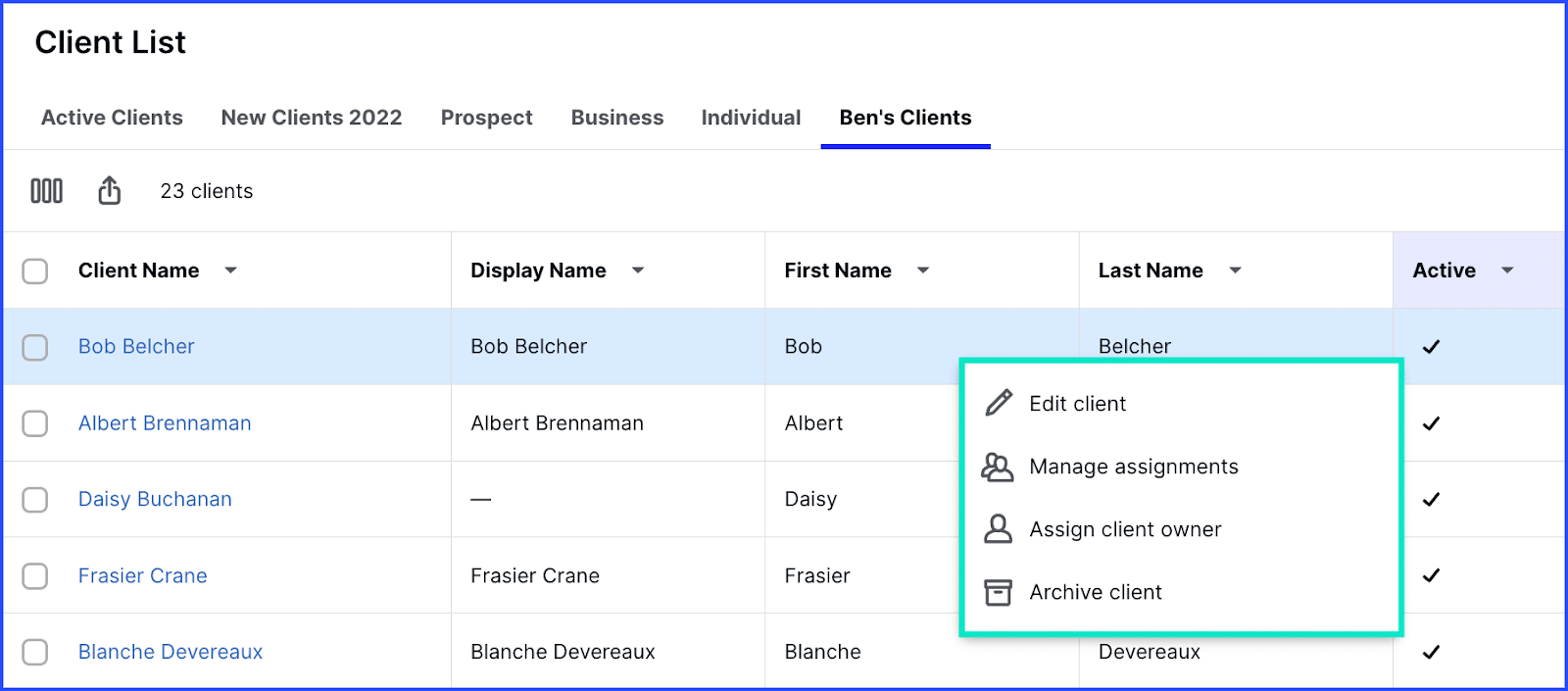
Canopy is a practice management platform designed specifically for accounting and tax professionals. Its client management capabilities sit alongside workflow, document management, billing, time tracking, and other practice-management tools to give firms a broader system for managing client relationships and the work associated with them.
Canopy’s CRM features include:
- Unified Client Profiles: Centralizes contacts, files, email threads, invoices, and tasks into a single record.
- Bulk Client Operations: Applies global filters by industry, service type, or tag to execute multi-client updates and outreach simultaneously.
- Lists, Dashboards & Visual Reports: Generates real-time visual dashboards and scheduled data alerts across client records, contact lists, and client group segments.
- Engagement & Proposal Automation: Builds standardized proposal templates that trigger automated task creation and staff assignments upon acceptance.
- Standardized Record & Email Templates: Uses pre-built record types and email templates to maintain operational consistency across all new client entries and routine communication.
- Workflow Management: Standardizes recurring client engagements using automated job templates, subtasks, task dependencies, and automated stage triggers.
- Client Portal: Delivers a secure, custom-branded portal where clients can upload files, e-sign engagement letters, and download tax returns.
Accounting integrations
Canopy integrates with QuickBooks Online, Xero, Gmail, Outlook, IRS Transfer, Drake Tax, Typeform, etc.
Best For
Tax and accounting firms that want client management, document collection, workflow, and tax-practice capabilities in one platform, especially those that handle significant tax resolution and IRS notice work.
Pricing
- Standard: $74/month per user
- Plus: $109/month per user
- Premium: $149/month per user
- Enterprise: custom
Free Trial
Free trial requires completing a demo.
Rating
| Pros | Cons |
|---|---|
| Built specifically for accounting and tax firms | Setup has a learning curve |
| Strong client portal and document capabilities | Total costs increase quickly as growing firms scale usage |
| Practice management and CRM capabilities are connected |
Explore:
7. TaxDome
[IMAGE: taxdome-crm-homepage.png] — alt: “TaxDome accounting CRM software homepage”
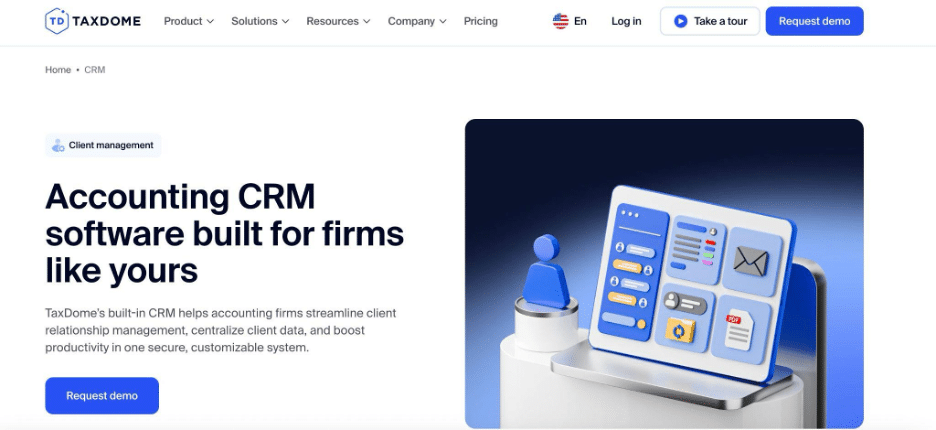
TaxDome is an accounting and tax practice management platform built around a centralized client portal and workspace.
It brings client management, document storage, communication, e-signatures, billing, and workflow automation into one ecosystem, so it is most useful for firms looking to consolidate client-facing and practice-management functions.
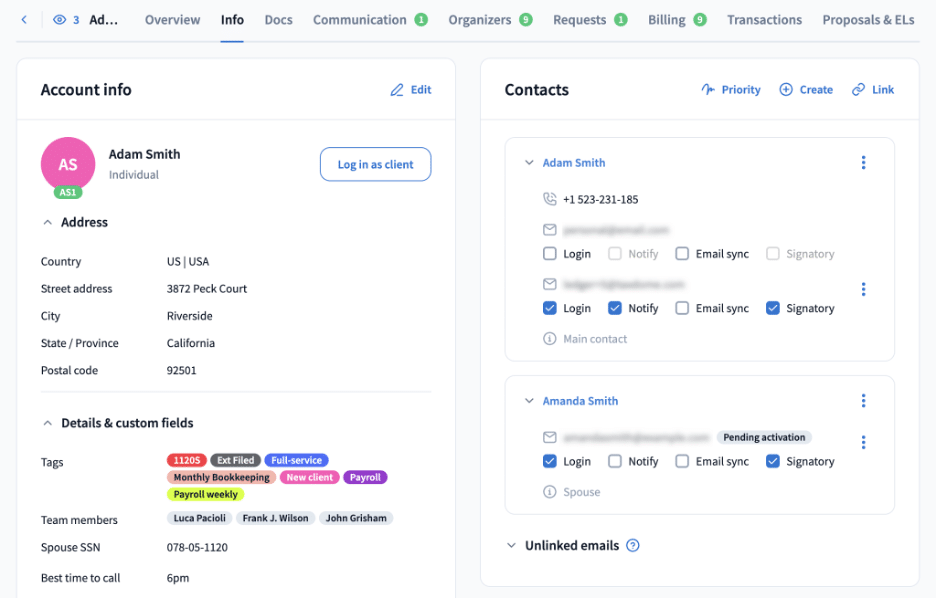
TaxDome’s accounting-relevant CRM features include:
- Client Portal: Provides a white-labeled web and mobile environment for clients to sign documents, pay invoices, and review tasks.
- Email: Syncs firm-wide email threads directly to client profiles for full communication history.
- Document Management: Centralizes cloud storage with customizable folder hierarchies, tags, and firm-wide access controls.
- Tax Organizers: Collects client data through dynamic, customizable digital questionnaires using conditional logic.
- Client Requests: Sends automated notifications and reminders to chase clients for outstanding documents or missing details.
- Proposals and Engagement Letters: Generates standardized engagements with automated billing and signature workflows.
Accounting integrations
TaxDome integrates with QuickBooks Online, Gmail, Outlook, Tax Act, Lacerte, CCH Axcess, IRS, etc.
Best For
Tax, accounting, and bookkeeping firms looking to consolidate CRM, client portals, documents, workflows, billing, and client communication in one platform.
Pricing
- Essentials: $800/year, per seat
- Pro: $1,000/year, per seat
- Business: $1,200/year, per seat
Free Trial
Not available for US firms.
Rating
| Pros | Cons |
|---|---|
| Strong client portal and document workflow | Large feature set takes time to learn |
| Combines CRM with practice management | Less suited to firms wanting a purely sales-focused CRM |
| Extensive client-facing automation |
Explore:
8. Zoho CRM
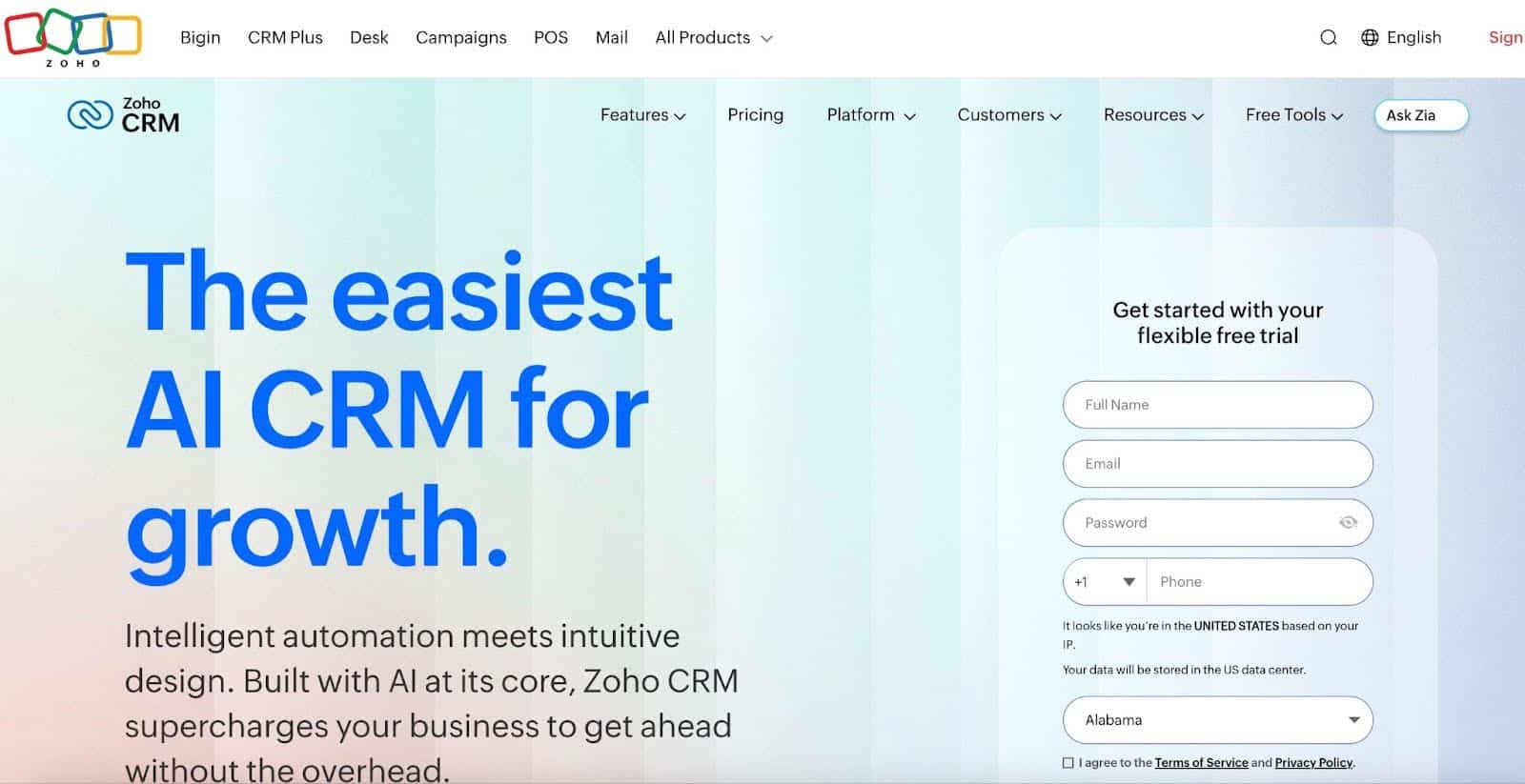
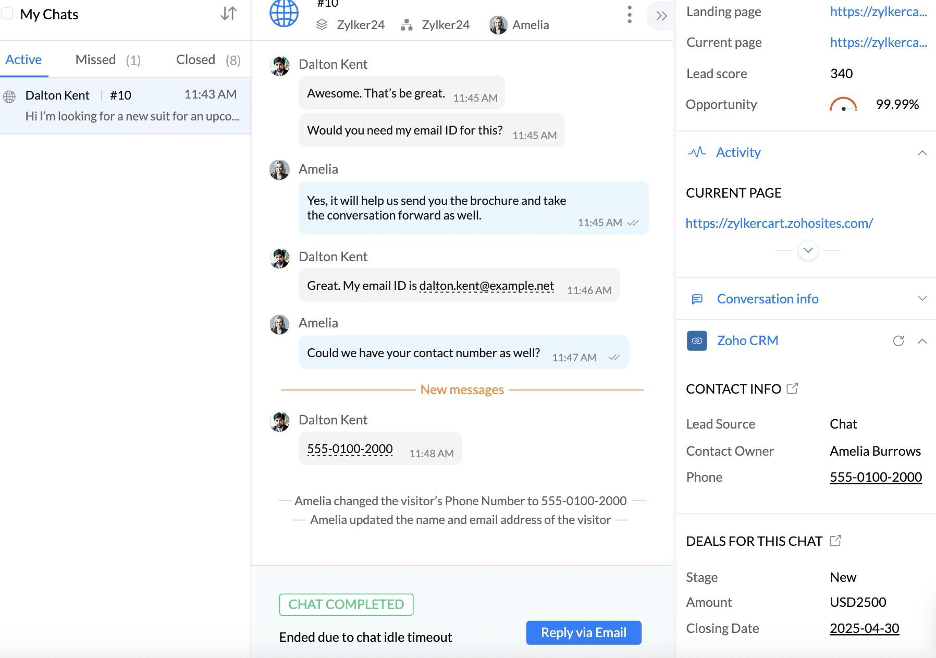
Zoho CRM is a general-purpose CRM that supports lead management, contact management, sales pipelines, automation, reporting, and customization.
Its flexibility allows accounting firms to customize sales and client-management processes, although firms may need additional Zoho applications or third-party tools to support accounting-specific workflows and ongoing client work.
Zoho CRM’s accounting-relevant CRM features include:
- Generative AI & Sales Agents: Uses conversational AI to read emails, recommend next steps, and deploy autonomous agents for lead qualification.
- Pipeline & Forecasting: Tracks deal progression across custom pipelines while forecasting revenue and sales performance metrics.
- Lead Management: Guides prospects through capture, enrichment, scoring, and automated nurturing cycles.
- Journey Orchestration: Maps and automates end-to-end customer journeys across multiple communication touchpoints.
- Canvas Design Studio: Drag-and-drop UI customization tool to redesign record layouts without writing code.
- Portals: Creates secure, dedicated web portals for clients, vendors, and partners to collaborate directly with your firm.
Accounting integrations
Zoho CRM integrates with QuickBooks Online, Xero, Zoho Books, Microsoft OneDrive, Teams, etc.
Best For
Firms that want a flexible, cost-effective general-purpose CRM and are willing to invest time configuring it around their processes and extending it through the broader Zoho ecosystem.
Pricing
- Free: $0
- Standard: $14/month per user
- Professional: $23/month per user
- Enterprise: $40/month per user
Free Trial
Zoho offers a free plan.
Rating
| Pros | Cons |
|---|---|
| Strong customization | Not designed specifically around accounting workflows |
| Broad automation capabilities | Recurring accounting work may require other Zoho products or integrations |
| Built-in macro capabilities to automate repetitive internal admin steps |
9. Liscio
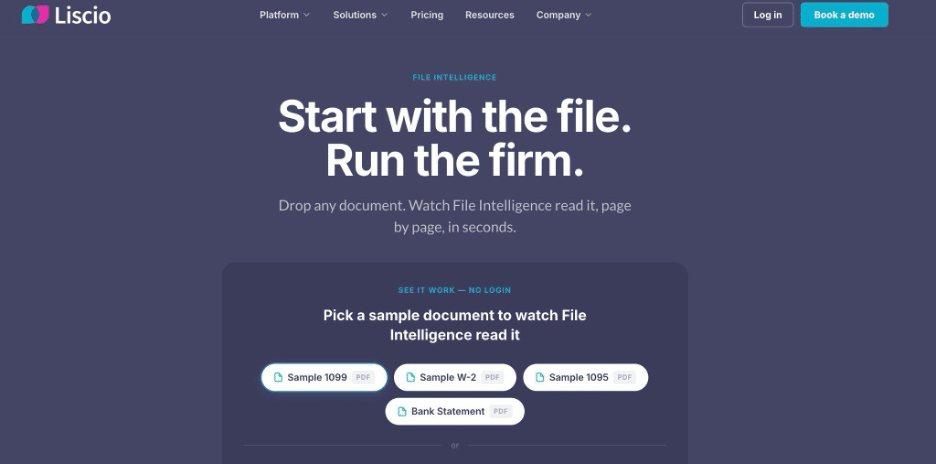
Liscio is an accounting client management platform focused on client communication, secure document exchange, and client experience.
Its secure messaging, document requests, task updates, and client collaboration tools are helpful to firms that already have accounting and workflow systems but need a more structured way to communicate with clients and collect information.
Liscio’s accounting-relevant CRM features include:
- Secure File Sharing: Provides encrypted, two-way file transfers up to 5GB per file between staff and clients.
- Client Portal: Offers a white-labeled, secure web and native mobile application (iOS/Android) for clients to exchange messages, upload documents, and track tasks.
- Smart Client Requests: Sends clients automated document checklists and task requests with recurring reminders to complete outstanding items.
- Tax Organizers: Collects intake information using mobile-friendly digital organizers and questionnaire templates.
- Email Integration: Connects two-way with Outlook and Gmail to route client email threads directly into centralized Liscio account records.
- Document Management: Centralizes cloud file storage with granular firm access controls, search capabilities, and third-party storage integrations.
![[IMAGE: liscio-client-timeline.png] — alt: "Liscio client timeline of requests, emails, files, and tasks"](https://financial-cents.com/wp-content/uploads/2025/07/liscio-client-timeline.png)
Accounting integrations
Liscio integrates with QuickBooks Online, SmartVault, Gmail, Adobe Sign, Google Drive, etc.
Best For
Accounting and bookkeeping firms that prioritize structured client collaboration and want to centralize client communication, secure document exchange, and client requests in an accounting-specific platform.
Pricing
- Intelligent Files: $19/month per user
- Liscio Platform: $49/month per user
- Tax Team: $99/month per user
Free Trial
Not available.
Rating
| Pros | Cons |
|---|---|
| Built specifically for accounting firms | Firms will need additional software for broader practice management |
| Strong client communication capabilities | Requires firms to fully shift clients away from traditional email to maximize value |
| Focuses on accounting client experience |
10. Method
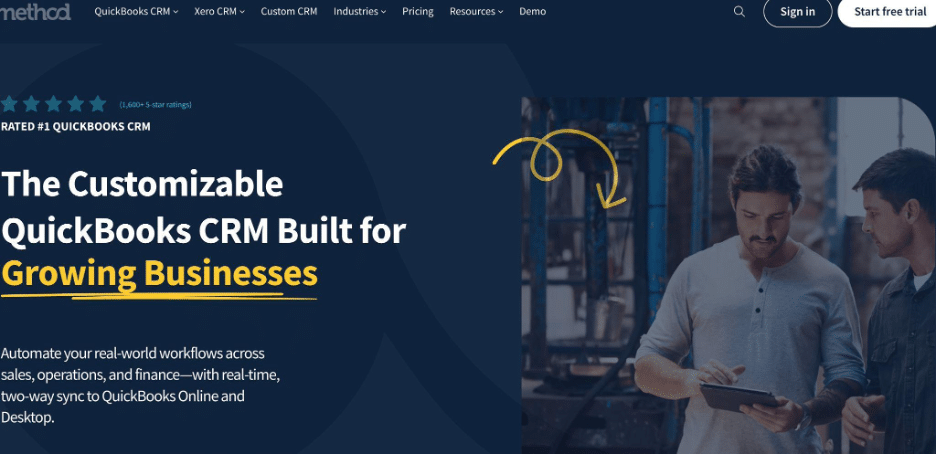
Method is a customizable CRM and business-management platform with a strong QuickBooks connection.
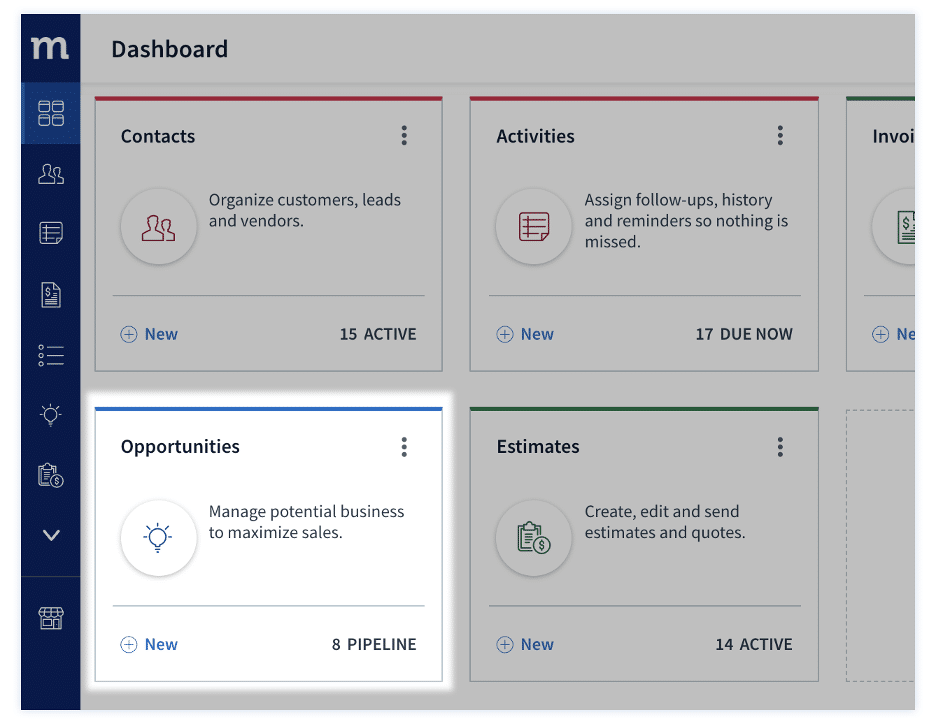
It allows accounting firms to connect leads, estimates, customer interactions, and business workflows with their accounting data in QuickBooks. Firms can also customize client records, workflows, forms, portals, and other processes around how they operate.
Method’s accounting-relevant CRM features include:
- Contact & Lead Management: Automatically captures inbound leads from customizable web forms, syncing details directly with email and QuickBooks records.
- Opportunities & Pipelines: Tracks sales deals and pipelines from initial lead contact through estimate generation and final payment.
- Engagement Letters & Proposals: Generates customized proposal templates and engagement letters using custom fields to auto-populate client details.
- E-Signatures: Captures legally binding electronic signatures via desktop or mobile to approve proposals and estimates.
- Customer Portals: Branded client portals where customers can review proposals, sign documents, access job details, and pay outstanding invoices online.
Accounting integrations
Method integrates with QuickBooks Online, Xero, MailChimp, InSync, etc.
Best For
Accounting practices whose processes don’t fit neatly into a standard CRM and want a customizable CRM and workflow platform with a strong QuickBooks connection.
Pricing
- CRM QuickStart: $27/month per user
- CRM Pro: $45/month per user
- CRM Enterprise: $73/month per user
- CRM Multi-entity: custom
Free Trial
Method offers a 10-day free trial.
Rating
| Pros | Cons |
|---|---|
| Strong QuickBooks connection | Customization requires more setup than a ready-made accounting platform |
| CRM and business-management capabilities | Interface can feel visually dated compared to more modern, design-forward platforms |
| Customer portal functionality |
Why Accounting Firms Need CRM Software
The CRM for an accounting firm is a tool for acquiring clients, standardizing onboarding, and ensuring no billable opportunity is lost in the process of client service.
Creates one source of truth for client and prospect data
When client information is scattered across spreadsheets, drives, inboxes, and separate systems, everyone will look in different directions for what they need: a partner might check a spreadsheet for a client’s EIN, a staff accountant might search a local drive for its articles of organization, while an admin digs into QuickBooks for the billing address.
A CRM brings that information into a single client profile to give all authorized team members the context they need without hunting across systems.
Makes communication history visible across the team
Client’s messages get siloed when communication is locked in individual inboxes. If a client emails their primary accountant about a payroll issue while they’re out of the office, another team member would have to ask the client to repeat themselves just to get up to speed.
An accounting CRM centralizes all interactions, notes, and follow-ups so team visibility never depends on one person’s inbox or memory.
Tracks leads, proposals, onboarding, and renewals
A CRM also gives firms visibility into the status of client engagements and the necessary action.
Its visual pipelines track prospects from initial inquiry through proposal delivery and signed engagement. Once a client signs, automated workflows launch onboarding tasks and queue up future renewal reminders to ensure recurring engagements never slip through the cracks.
Automates client requests, reminders, and follow-ups
A CRM can automate routine client requests, reminders, and follow-ups instead of relying on someone to remember them.
For example, after sending a proposal, the system can automatically schedule a follow-up reminder if the prospect hasn’t responded. The same thing applies to recurring accounting work, where firms typically chase clients for bank statements, payroll records, and missing tax documents.
Personalizes service using client data
Centralizing client information gives your team the context to tailor communication and service to each client’s accounting needs. Their client record shows which services they receive, which entities are involved, and what issues have come up previously.
That context helps firms avoid sending irrelevant updates. Filters and tags can also segment clients by entity type, industry, or deadline, so firms can send relevant updates to the clients who actually need them.
That personalization is also what keeps clients from drifting; there’s more on this in four ways firms use an accounting CRM to retain clients.
Improves continuity when someone is absent or leaves
Centralizing interactions, internal notes, and open tasks within a shared CRM prevents service disruptions when a team member is unavailable.
Combined with standardized templates that show how to deliver each client service, this shared visibility prevents operational disruption, as Lori Hawkins, President of L&L Bookkeeping, explains:
Reduces repeat questions and duplicate data entry
Disconnected systems make it easy for one team member to ask a client for information another employee already has or re-enter the same data across multiple systems.
A centralized client record reduces this duplication by giving the team a shared source of information and, where integrations are available, allowing data to flow between connected systems without human intervention.
Connects the client relationship to the work behind it
Knowing that a client has an outstanding follow-up is useful. But knowing that the follow-up is tied to a specific engagement, recurring workflow, deadline, team member, or outstanding document is far more useful.
Accounting-specific CRM ensures the client relationship doesn’t sit apart from the work your firm performs. It shows what your firm is doing for each client and whether that work is moving forward, so you can make timely decisions.
Features to Look for in Client Relationship Management Software for Accountants
Every feature of a CRM for accountants should point to four things: to improve visibility, reduce manual follow-up, connect communication to ongoing work, and integrate with the systems you already use.
These features should help with that:
Centralized client database
A centralized client database stores contact details, entities, services, notes, relationship history, important dates, and other information the team needs to serve clients and convert prospects. It can also sync data with other systems to reduce duplicate data entry.
Client portal and secure document collection
Accounting client relationships generate a steady stream of documents and requests. Your CRM should make it easy for clients to share the files and information your team needs without relying on insecure email attachments.
A client portal gives them a secure place to upload documents, respond to requests, and communicate with your firm, while keeping those interactions connected to the client record.
Email and communication audit trail
The email and communication audit trail feature keeps client messages from being locked away in individual inboxes.
By integrating with email platforms such as Gmail and Outlook, the CRM can log relevant emails, notes, and other interactions in the client’s record to give authorized team members a shared history of the relationship.
Billing, payments, and client profitability
These features connect the client relationship to its financial impact on the firm through invoicing, payment tracking, client revenue, and realization.
This is where an accounting CRM that operates within a practice management platform is more helpful. A sales CRM might tell you what a client generates in annual revenue, but a CRM in an accounting practice management platform will also show how much time and effort it takes to earn that revenue.
Integrations with the tools your firm already uses
A CRM that connects with the systems your firm already uses reduces data silos and manual data entry. Depending on your service mix, you may need integrations with QuickBooks Online, Xero, Drake, Lacerte, email, document management and storage, and payment platforms.
In any case, don’t stop at whether an integration exists. Check what it actually does, whether it syncs client information, keeps data updated across systems, or triggers subsequent workflows.
Recurring work and engagement tracking
One of the biggest differences between a sales-focused CRM and an accounting-specific platform is what happens after the client signs.
Traditional CRMs are organized around deal stages (lead, qualified opportunity, proposal, closed won). But accounting CRMs also track the recurring work that follows, such as monthly closes, payroll cycles, and annual tax filings.
These additional features keep those deliverables visible and help teams manage ongoing client work alongside the relationship.
Automation and client reminders
Repetitive follow-up is one of the clearest opportunities for automation in an accounting CRM. Common automations can handle onboarding steps, status updates, client tasks, and proposal follow-ups. Together, these automations improve visibility into client work while freeing your team from routine administrative tasks.
Client document management
Document management helps organize, find, secure, and retrieve the documents that come into the firm.
For accounting firms handling tax documents, financial records, statements, and other client files, useful features include centralized client folders, search, version control, permissions, and secure file-sharing. The accounting CRM should keep documents connected to the relevant client and work.
Pricing model and setup time
To understand the true cost of a tool, consider both the subscription cost and the cost of getting your firm up and running.
Compare per-user versus firm-wide pricing, plan restrictions, implementation or onboarding fees, integration costs, additional client or storage fees, contract requirements, and expected setup time.
A highly customizable CRM may offer more flexibility but require significant configuration and administration. An industry-specific platform may be less customizable but get a small or midsize firm operational much faster.
Which CRM Software for Accountants Is Best for Your Firm?
The right choice of a CRM for any firm depends on what they need the system to accomplish. That means evaluating your options against your firm’s service offerings, client types, workflows, and biggest operational bottlenecks.
If you’re a small or growing firm that needs CRM plus workflow and client collaboration
An accounting-specific platform that combines client management, communication, recurring workflows, and collaboration will enable your team to manage prospects and clients alongside the work associated with them.
Financial Cents offers a simple way to centralize client information, email history, requests, and task tracking without the complexity of a large enterprise CRM.
The tradeoff is less sales and marketing customization than platforms such as Salesforce, and for a growing firm focused on serving existing clients (rather than building a sophisticated sales operation), that is just fine.
If you’re a bookkeeping firm managing recurring monthly clients
The right platform should help keep monthly work moving, from requesting missing receipts and documents to reviewing transactions and tracking outstanding tasks.
Financial Cents is also a strong fit because of its ability to connect client management with recurring workflows, automated document requests and reminders, task tracking, communication, and QuickBooks Online integrations. This allows bookkeeping teams to manage the relationship and the recurring work in the same system.
If you’re a tax firm focused on document requests, deadlines, and seasonal volume
These firms need a system with a secure client portal, automated document requests and reminders, e-signatures, organizer or bulk-request capabilities, and deadline tracking to help with handling high client volumes without adding manual coordination during tax season.
TaxDome and Canopy are strong fits for firms that want these capabilities built into an accounting-specific platform. TaxDome emphasizes automated client workflows, document collection, e-signatures, and billing, and Canopy combines client management with tax workflow, document management, and tools for practices handling IRS notices and tax resolution.
If you have a dedicated sales or marketing team
If your firm has dedicated business-development staff managing large prospect volumes, running campaigns, nurturing leads, and reporting on sales performance, a sales-focused CRM such as HubSpot, Salesforce, or Pipedrive may provide the depth you need.
These platforms support multi-touch email sequences, sales call tracking, pipeline management, conversion reporting, and marketing attribution to enable your team to track prospects throughout the sales process and understand which activities are contributing to new business.
If you’re heavily invested in QuickBooks Online or QuickBooks Desktop
If your firm relies heavily on QuickBooks, prioritize a CRM or practice management platform with a well-documented QuickBooks integration. Don’t stop at whether an integration exists. Verify exactly what data can be synchronized and in which direction.
Method CRM offers a highly customizable integration with both QuickBooks Online and QuickBooks Desktop. Financial Cents also integrates with QBO to connect client and financial information.
If you’re a large firm that needs deep customization and enterprise governance
Large firms often need capabilities that smaller practices don’t: complex organizational structures, granular permissions, advanced reporting, custom workflows, multiple business units, and extensive integrations. At that scale, customization and governance matter more than simplicity.
Platforms like Salesforce can accommodate complex firm structures and offer extensive customization and integration capabilities.
If you’re replacing spreadsheets and want easy adoption
If your firm tracks clients, prospects, follow-ups, and recurring work in spreadsheets, the best CRM may not be the most elaborate. It will likely be the one your team can understand and adopt without months of configuration.
The goal at this point is to replace fragmented processes with a system your team will actually use.
Financial Cents gives small and growing firms a straightforward way to centralize client information, manage recurring work, and track follow-ups without the configuration burden of a highly customizable CRM.
Simplicity vs. Customization
More customization doesn’t automatically make a better CRM. Salesforce, for example, can be configured extensively, but that flexibility can also produce a greater implementation and administration burden.
Accounting-specific platforms usually offer fewer customization options in exchange for prebuilt workflows and faster adoption.
Choose simplicity when your processes are relatively straightforward and ease of adoption is the priority. Choose customization when your firm has complex processes that genuinely require more flexibility.
Consolidation vs. Best-of-breed tools
An all-in-one platform reduces the number of systems your team has to manage, while specialized tools usually offer greater depth in individual functions.
A consolidated accounting platform might combine CRM, workflow, document management, client portal, and billing, but a best-of-breed approach pairs a general CRM with separate tax, document, billing, and workflow tools.
You’d have to determine how much value your firm gets from having these capabilities connected as opposed to a patchwork of apps. For most mid-sized firms, the efficiency of a consolidated system far outweighs the benefits of using the strongest standalone tools for each function.
Per-user pricing vs. flat or client-based pricing
A per-user model is straightforward when only a few people need to use the tool. Adding employees or even part-time staff increases your subscription costs substantially. Flat-rate or client-based pricing is more predictable when firms need many staff to access it.
When comparing prices, calculate the total cost at your expected team size, not just the advertised starting price. Also check whether client portals, integrations, storage, automation, or other important features are restricted to higher tiers.
Pricing based on active client count or tier levels provides predictable costs regardless of internal seat count, which is ideal for firms scaling up staff during tax season.
Lead-generation depth vs. client-service depth
General-purpose CRMs are extremely good at showing how to turn more prospects into clients. But an accounting CRM or practice management platform delivers a more consistent client experience.
If your firm is investing heavily in marketing and business development, prioritize lead-generation depth. If your biggest operational challenge is keeping recurring client work, communication, documents, and follow-ups organized, prioritize client-service depth.
How to Choose the Right Accounting CRM for Your Firm
It’s hard to go wrong on your choice of a client relationship management software if you match your firm’s profile to the type and size of firm the tool was designed for:
- IF: you are a solo practitioner or small team (1–5 staff) who tracks work on spreadsheets and needs something that works out of the box. THEN: choose Financial Cents. It gives you a single client view, automates your document collection, and has zero software learning curve.
- IF: you are a fast-growing bookkeeping firm (1–10 staff) whose entire business model revolves around monthly QuickBooks Online closeouts and transactional queries. THEN: choose Financial Cents. Its QuickBooks Online integration connects client and financial information with the workflows you need to manage ongoing bookkeeping work.
- IF: you are a mid-sized to large tax-heavy firm (5–20+ staff) needing deep client document automation, custom logic, and electronic signatures to survive seasonal capacity spikes. THEN: choose TaxDome or Canopy. Both platforms combine accounting practice management with tax-focused capabilities. TaxDome provides tax workflow automation alongside client portals, document management, and e-signatures, while Canopy combines tax workflow with document management, client management, time and billing, and tools for tax resolution and IRS notice work.
- IF: you run a scaling firm (10–20+ staff) where work gets stalled because internal communication is trapped inside separate, non-collaborative partner inboxes. THEN: choose Financial Cents. Its focused email folder enables the team to turn client emails into team-wide actionable tasks.
- IF: your primary bottleneck is sales conversion. You have a dedicated marketing budget, and you need to track a high volume of outbound prospective client leads. THEN: choose HubSpot or Zoho CRM. They provide robust tools for lead capture, pipeline management, automated follow-ups, email nurturing, segmentation, and sales reporting, and give your marketing and business-development teams greater control over how prospects move from initial inquiry to signed engagement.
Manage Client Relationships and the Work Behind Them With Financial Cents
The best CRM for an accounting firm is one that keeps client relationship context connected to the work your firm has promised to deliver. These tools show who the client is, what they’ve asked for, what you’ve discussed, which documents are outstanding, what deadlines are approaching, and what should be done next.
That’s why Financial Cents’ approach of combining CRM capabilities with a broader practice management platform is so suitable for small and growing accounting, bookkeeping, CPA, and tax firms that want to manage client relationships without adding another disconnected system to their tech stack.
Financial Cents gives each client a centralized profile where your team can store and access important information and activity history. Custom fields and client groups let firms organize client records around the information that matters to their particular services and relationships.
That shared context is especially valuable when multiple team members work with the same client. It gives the team a common record to work from instead of relying on one employee’s memory or searching through separate spreadsheets and inboxes.
Financial Cents also includes AI features that help firms reduce manual administrative work involved in client communication and document management.
Its email integration brings client communication into the related work and records, and two-way integration with QuickBooks Online helps firms keep general ledger and practice management workflows in sync.
Financial Cents also supports the front end of the relationship through an accounting firm proposal tool and engagement letters that move clients through sales and onboarding.
The billing and payments feature automates invoicing and payment processing, while budgets and reports give firm leaders visibility into the operational side of their client relationships.
Michael McMullin, CPA, Managing Partner at JTC CPAs, describes the practical value of combining CRM and practice management inside Financial Cents:
Ready to manage client relationships and the work behind them in one place? Try Financial Cents free for 14 days.
Frequently Asked Questions (FAQs)
Share this article: