How Safe Harbor Bookkeeping Cut Invoicing From a Full Day to 90 Minutes — and Stopped Turning Away Clients
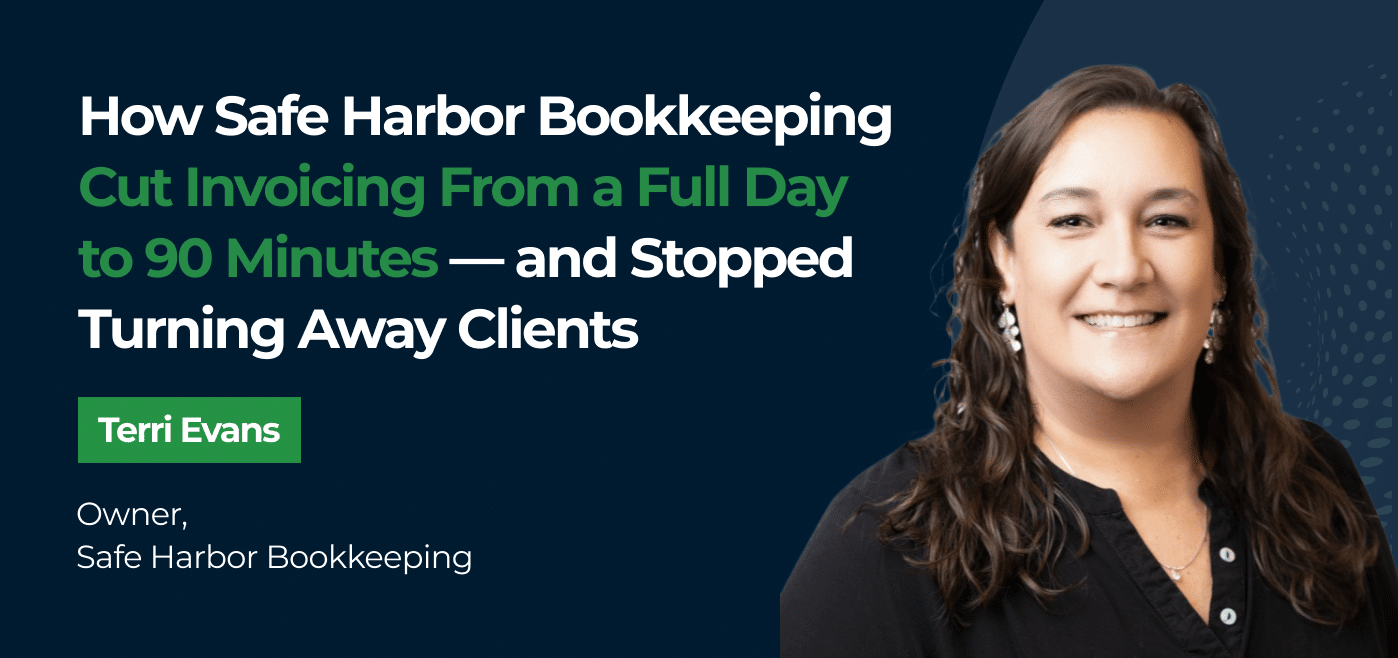


Terri Evans didn’t go to college for accounting. She got her education around the kitchen table.
Her father was a self-employed general contractor; her mother handled his books. The summer after her senior year of high school, Terri jumped in to run the financial side of the business while her parents spent three months on a mission trip in Canada.
Fast-forward to 2009, when she took over the administrative side of her husband’s contracting business—building financial processes and workflows from scratch, earning her QuickBooks certification, and working closely with their CPA firm. Later, she spent three years working in-house at that same CPA firm, eventually becoming their bookkeeping coordinator: onboarding clients, training other bookkeepers, and being the go-to person whenever a client’s books wouldn’t balance.
But by 2023, with her daughter entering high school, Terri wanted more flexibility—and she wanted to build something of her own.
She launched Safe Harbor Bookkeeping with three clients. Within six months, she had a dozen. And after Terri joined a business networking group and started power-partnering with local CPAs, her firm grew to 60–70 clients with a team of four part-time contracted bookkeepers.
It seemed like there was nowhere to go but up. The only thing weighing Terri and her team down? The patchwork of tools barely holding the firm together.
The Problem: Too Many Tools, Not Enough Clarity
Before Financial Cents, Terri was stitching her operations together with spreadsheets for client data, ClickUp for daily task lists, Monday.com for light CRM work, Harvest for time tracking, QuickBooks for invoicing, and even a task list in her email. None of them talked to each other the way she needed them to.
Beyond valuable time lost to toggling between screens, the biggest issue with Safe Harbor’s disjointed tech stack was the lack of visibility across projects, tasks, clients, and team members. Because the firm’s delivery model has clear handoffs—bookkeepers handle the daily work, then Terri reviews the month-end financials before they go to the client and their CPA—Terri needed to know exactly when each bookkeeper finished their piece. Instead, it was a constant volley of emails, Teams messages, and check-ins.
Even simple admin tasks had become painful. For example, Terri pays referral fees to the CPAs and contacts who send her business, so it’s important to track where each client came from. But pulling together a list of clients tied to a single CPA partner felt like pulling teeth.
One day, she vented about all of this to a CPA she works with closely. His response: “I have two words for you: Financial Cents.”
The Solution: From Demo to Go-Live in One Month
Terri booked a demo of Financial Cents and was immediately impressed. Sure, it had all the major features she was looking for—but it also offered functionality she never would have thought to look for. After seeing it live, she spent most of December 2025 immersing herself in training videos and webinars. On January 1, 2026, she flipped the switch in her firm.
First, she set up automations, due dates, and task assignments for her team’s most important projects so every bookkeeper knew exactly what to do, when it was due, and where to hand it off.
Then she tackled billing. Safe Harbor bills by the hour, and Terri’s old process—getting Harvest to talk to QuickBooks, reconciling timesheets, assembling invoices—could swallow an entire day. With Financial Cents’ built-in time tracking tied directly to invoicing, eight hours turned into about 90 minutes.
The processing fees were lower, too—a bonus she hadn’t anticipated when she was evaluating the platform.
The Real Difference-Maker: Features Focused on the Client Experience
Terri’s firm bills hourly, and her client-first philosophy pushes her team to be as efficient as possible. But before Financial Cents, many aspects of her bookkeepers’ workflow were anything but efficient—particularly when it came to chasing down answers on uncategorized transactions. They were spending hours composing detailed emails to clients: listing dates, amounts, and descriptions for every transaction that needed clarification.
Safe Harbor works with a lot of tradesmen—general contractors, skilled trades operators, the kind of business owners who want to swing a hammer, not answer emails about uncategorized transactions. And even when they did eventually reply, the bookkeeper would have to manually classify each open item. It was a tedious process for both sides.
The Month-End Close feature in Financial Cents offered immediate relief. With the uncategorized transactions tool, bookkeepers can send clients a simple, checklist-style request through the secure client portal. The client simply clicks in and enters their answers—no password required. The responses flow back into Financial Cents, the bookkeeper classifies the items, and everything automatically updates in QuickBooks. Easy peasy.
Terri was initially nervous about asking clients to use a portal at all. She assumed it would mean passwords, codes, and a whole lot of complaints. That couldn’t have been further from the truth.
The real validation came from one of her general contractor clients.
The result: months close sooner. Financial statements go out the door more quickly. And Terri can automate document requests—bank statements, tax forms, payroll onboarding paperwork—so they go out on time without anyone having to think about it. Plus, the secure document portal alleviated any client concerns around sending sensitive information via email.
Key Financial Cents Benefits for Safe Harbor Bookkeeping
More Time to Work On the Business, Not Just In It
Before Financial Cents, Terri didn’t really have a full marketing strategy, instead relying on her networking group and CPA referrals. Now, with less time consumed by invoicing, chasing client responses, and coordinating handoffs, she can finally invest in growing the firm: refreshing Safe Harbor’s website and branding, building a social media presence, and improving the firm’s online visibility.
She’s also been able to expand Safe Harbor’s offerings into advisory services—walking clients through their monthly financial statements so they can make smarter decisions about hiring, leasing, and growth.
Less Tax Season Stress
Undeniable proof of Financial Cents’ impact at Safe Harbor showed up during the busiest time of the year.
Last year, when prospective clients reached out during tax season—often referred by a CPA who wouldn’t touch their returns until the books were cleaned up—Terri had to turn many of them away. The onboarding process was too slow, the information-gathering too cumbersome. She’d tell them, “I can take you on, but I can’t have you ready in time for taxes.”
This year was different.
Her bookkeepers felt the difference, too. Where each contractor used to max out at 8 to 10 clients, they’re now comfortably handling 12 to 14—because the streamlined workflows and automated client communication eliminated the drag of constant coordination.
Reliable Support from Real Humans
The customer support Terri and her team have received from Financial Cents has been as valuable as any product feature.
She’s used plenty of software where feedback disappears into a void—a button click that goes nowhere, a support ticket answered by someone unfamiliar with her issue (if it’s answered at all). Financial Cents was immediately different: weekly open-forum webinars where every question in the chat gets addressed, a dedicated success manager who knows her account, and follow-ups that are written by a human.
Results Round-up: Safe Harbor Bookkeeping’s Achievements with Financial Cents
Since adopting Financial Cents, Safe Harbor Bookkeeping has:
- Cut invoicing time from a full day to around 90 minutes using integrated time tracking and billing
- Increased bookkeeper capacity from 8–10 clients each to 12–14 clients each thanks to streamlined workflows and automated handoffs
- Onboarded more clients during tax season than the prior year—and remained open to new business throughout
- Replaced at least five separate tools (ClickUp, Monday.com, Harvest, spreadsheets, email task lists) with one centralized platform
- Launched financial advisory services thanks to time reclaimed from manual processes
- Invested in marketing and brand growth using hours freed up by automation
- Sped up month-end close with automated client requests and secure document collection through the client portal
- Improved their client experience, validated by feedback from tradesmen clients—a notoriously no-nonsense audience
- Confidently onboarded new tax-season clients who previously would have been told to wait until May
What Financial Cents Does for Small Bookkeeping and Accounting Firms (According to Terri)
Share this customer story: