New clients don’t usually leave their accountant over price. They leave because of how the relationship felt—the unanswered emails, the jargon-filled explanations, the radio silence between filings.
Michelle Arnason, owner of Arnason Accounting and Co., has spent 16 years in the profession and eight years running her own firm. She’s bootstrapped it from scratch, grown it to a team of six, and heard the same client frustrations on repeat. Across the thousands of discovery calls she has conducted, Michelle has seen the same five themes pop up again and again. Here they are, along with her advice on each one. All five come back to the same idea: relationships outlast pricing. (For the systems side of that same equation, why modern tools are key to client retention – Joe Woodard makes the case here.)
1. Acknowledge the Emotional Side of Money (Not Just the Numbers)
Money is one of the most emotional topics there is. Clients walk into meetings dealing with debt, divorce, unfiled returns, failing businesses, and silent shame. As accountants, we’re trained to deal with numbers—not emotions. But the two are inseparable for most business owners.
Don’t worry, you don’t need to become a therapist. You just need to stop rushing past emotional cues without acknowledging them. When a client hints that their business is struggling, and you jump straight to the balance sheet, you’ve missed a chance to build trust. They may smile and nod, but they also may not come back.
Shame is the worst feeling a client can walk away with. If they feel small, stupid, or judged for their financial situation, the relationship is effectively over. That doesn’t mean you should sugarcoat hard truths; you still need to tell someone they owe $50,000 in back taxes. But there’s a difference between “how did you let this happen?” and “here’s where we’re at, and here’s how we tackle it together.”
Try this: Pull up your last three discovery calls or year-end meetings. If you record them or use transcription software, listen back. Did you rush past moments where the client was vulnerable? Did you make space for them to be human? Identify the emotional cues that come up repeatedly, and think about how you can respond differently next time.
2. Explain Accounting Concepts in Plain Language
Clients aren’t trained accountants. They love what they do, and they might be excellent at it, but terms like “amortization,” “capital cost allowance,” and “retained earnings” mean nothing to most small business owners. You might think speaking in technical language makes you sound smart, but in reality, it creates distance.
Think of plain language as a service you can provide. How would you explain something to a close friend with no accounting background, sitting across from you at a coffee shop? That’s the delivery your clients need.
Take retained earnings, for example. This is something that constantly trips up clients. Instead of rattling off the textbook definition, try something like this:
Think of your house. Say it’s worth $100,000, you owe $50,000 on the mortgage, and your equity is $50,000. Retained earnings are essentially the same thing for your corporation. It’s the net worth of your company.
Once clients hear that home equity comparison, it clicks instantly.
The same approach works for other terms, too. Installments? Just prepayments toward your tax bill. Shareholder loan? It’s your running tab with your corporation—money in, money out, and at year-end, that tab has to balance. Dividends? A payment from your corporation to you, usually an e-transfer.
Try this: Pick five accounting terms you use regularly, and write down how you’d explain each one to a friend with no accounting background. Then pull up a recent client email where you answered a technical question—something like salary vs. dividends or lease vs. buy. Read it back as if you had zero accounting knowledge. Where would you get lost? Use AI to strip out the jargon and rewrite it in plain language without changing the content. Then start applying that lens to your accounting services engagement letter, website copy, and email templates.
3. Build Client Loyalty With Simple, Consistent Appreciation
You don’t have to schedule tons of lunch meetings or send elaborate gift baskets to build great client relationships. At the end of the day, it all comes down to consistency and a personal touch. And it can take as little as 15 minutes a month.
One approach that works: a handwritten note card and a $5 Starbucks gift card, mailed (not emailed) to a few clients each month to a few clients. That’s it. The same gesture for everyone, kept simple and sustainable. The key details that make this work: you write it yourself (handing it off to an admin changes how it lands), and you send it through the actual mail (in a digital world, physical mail stands out in a way email never will).
The real trick is building a system so it actually happens. Pick one Friday a month as your “card day.” When a client mentions a milestone on a call—a new baby, a business hitting $1 million, a work anniversary—write it down immediately and set a reminder. Use your accounting firm crm to track birthdays, anniversaries, and life events so nothing slips through.
This applies to your team, too. When employees feel noticed, they’re more likely to stick around and tell others about the experience.
Try this: Before the end of this week, pick a monthly card day and put it in your calendar. Write three handwritten notes this month. They don’t need to be fancy; even a dollar-store thank-you card is fine. Write something simple like, “Congrats on the new baby. Hope a coffee gets you through today.” That’s all it takes.
If you want to go beyond handwritten notes and build retention into your systems, here’s how some firms retain accounting clients using CRM to track relationships at scale.
4. Use Clear Proposals and Onboarding to Prevent Scope Creep
Scope creep is one of the most common and most preventable problems in accounting firms. It almost always traces back to unclear expectations at the start of the engagement.
Think about what “bookkeeping included” means to you versus what it means to a client with no accounting background. To you, it’s monthly categorization, GST tracking, and year-end prep. To them, it’s “anything financial that I don’t want to deal with.” This can quickly expand to answering questions about old credit card charges, sorting out personal expenses that are mixed into the business account, and unlimited email support.
The same thing happens with tax planning. You’re thinking of one high-level salary vs. dividends conversation per year. They’re thinking of unlimited advisory calls, holding company restructuring, and meetings with their investment advisor. Before you know it, you’ve spent 10 hours on what was scoped as one.
A clear accounting proposal fixes this. It shows the price upfront, names exactly what’s included, and, most critically, spells out what’s not included. This is actually the most important part of the document, because it prevents resentment later when a client gets a bill they weren’t expecting.
Clear proposals only work if your billing follows through on what was promised. Billing systems built for accounting firms ties invoices directly to the engagement scope, so nothing surprises the client at payment time.
You don’t need to walk clients through the proposal line by line. Write it in clear, plain language so they can read and understand it on their own, and then leave the door open for questions. The discovery call is for building the relationship; the proposal handles the business terms.
Try this: If you already send proposals, add or refine your “what’s not included” section. If you don’t send proposals yet, build a simple one (even a one-page document works). Financial Cents has a built-in proposal and engagement letter feature that makes it easy to define scope, set pricing, and get e-signatures—all in one place. The important thing is to start somewhere. It’ll evolve as you learn where scope creep keeps showing up. An accounting client onboarding checklist also comes in handy at the start.
5. Set Communication Expectations That Build Client Trust
Poor communication is the number-one reason clients leave their accountant, and it’s also the cheapest thing to fix. The complaints tend to follow a similar pattern: “I sent my documents three months ago and haven’t heard anything.” “I emailed a question two weeks ago, and there’s still no response.” “I have no idea where my file is.”
Clients don’t need instant answers. They just need to know when they can expect one. The unknown is what erodes trust. Here are four things that make communication predictable without requiring you to respond faster.
Add your turnaround time to your email signature. Whether it’s 48 business hours, three days, or one week, tell your clients. This one change is the single best retention move you can make, but you have to actually stick to it.
Send a “documents received” confirmation when client files come in. Automate this if you can. A quick message that says, “we’ve got everything, our turnaround is typically three to four weeks, and we work on a first-in-first-out basis” eliminates most of the anxiety.
For a step-by-step approach to streamlining that document collection process, how to get documents from clients faster, without the endless follow-ups.
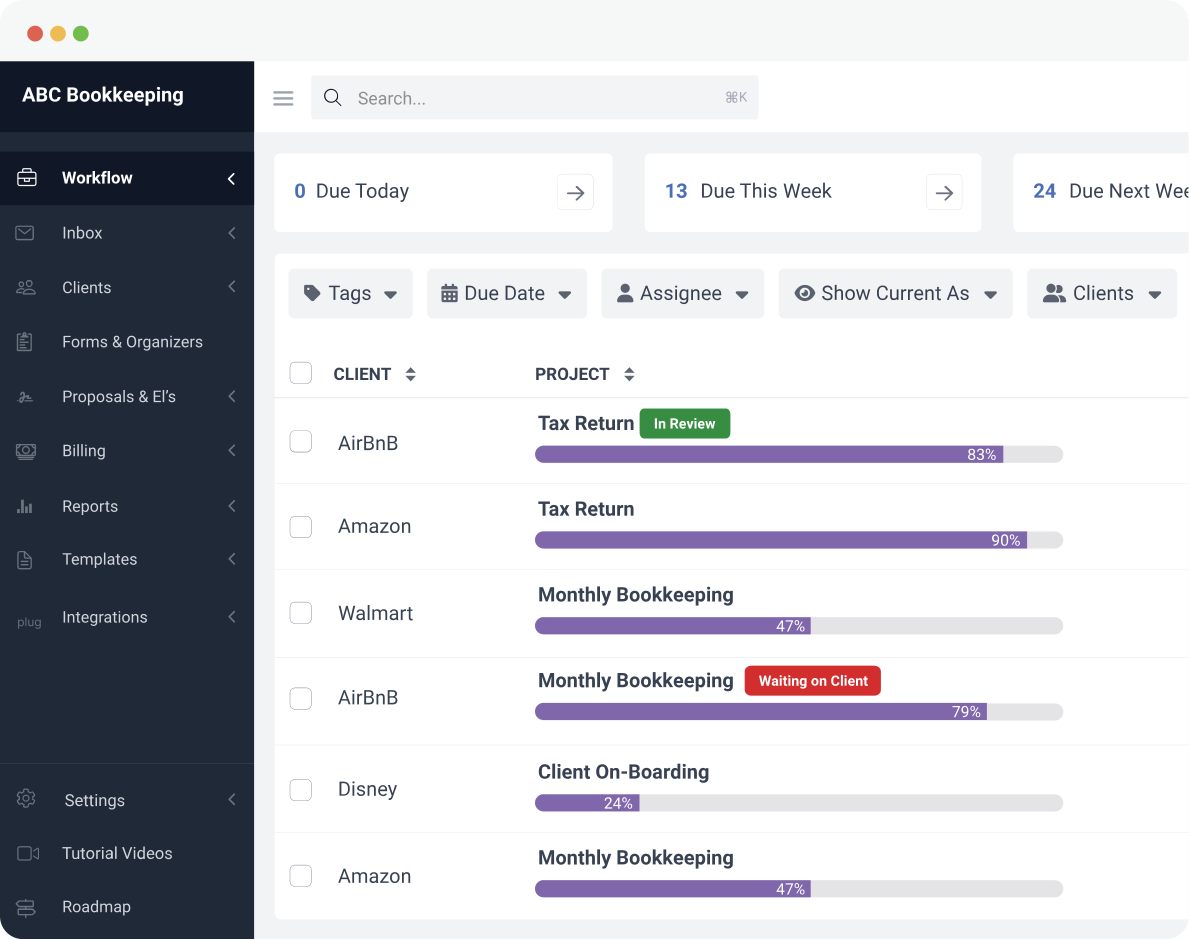
Update clients when their file moves to the next stage. In review, filed with the tax authority, complete—whatever your workflow steps are, communicate them. None of this requires extra work if you set up automations in your practice management software. Financial Cents lets you trigger automatic status updates and notifications as work moves through your pipeline, so clients stay in the loop without you sending a single manual email.
Use your out-of-office. When you’re unavailable, say so. It takes 30 seconds and prevents the spiral of unanswered follow-up emails.
Use a Client Portal: An accounting client portal gives clients one place to submit documents, review requests, and see where their work stands without sending another follow-up email.
One more tactic worth noting: use scheduled send. If you clear your inbox and respond to a client’s email the same day they sent it, you’re training them to expect same-day responses. Instead, schedule the reply for the next day or two. It keeps expectations aligned with your stated turnaround time.
Try this: This week, add a turnaround time to your email signature. Template your most common replies and connect client emails to your workflow so conversations stay attached to the relevant client and project (if you write it more than twice, it gets a template). And batch your email replies into two windows per day—morning and afternoon—instead of checking and responding continuously.
You can also read this client communication guide for accountants.
Pick One and Start This Week
You don’t need to overhaul your entire firm this month. Pick the one thing from this list that hits closest to home and commit to it this week. For most accountants, communication is the easiest win. It requires no budget, no new tools, and it’s the thing clients complain about most.
The firms that retain clients and earn referrals aren’t doing anything revolutionary. They’re showing up as humans, speaking in plain language, noticing the small things, setting clear expectations, and communicating consistently.
Ready to put these ideas into action? Financial Cents gives you built-in proposals, workflow automations, and client communication tools—all built specifically for accounting firms. Start your free trial and see how it works.
Share this article: