For accounting and bookkeeping professionals, consistency is everything. A missed reconciliation, uncategorized transaction, or overlooked accrual can impact financial reports, client trust, and advisory decisions. The free monthly bookkeeping checklist template is designed specifically for firms and bookkeeping professionals who manage monthly books for multiple clients.
This template helps you standardize your month-end workflow, maintain accuracy across accounts, and ensure no critical task is missed. It provides a structured framework you can use internally with your team or customize for different client engagements.
Whether you manage 5 clients or 50, this checklist helps you create a repeatable, scalable monthly bookkeeping process.
What Is Monthly Bookkeeping?
Monthly bookkeeping is the structured process of recording, reconciling, reviewing, and finalizing a client’s financial activity each month. For accounting professionals, it goes beyond data entry, it ensures that financial statements are accurate, complete, and ready for reporting, tax planning, and advisory conversations.
A strong monthly process includes transaction categorization, account reconciliations, receivable and payable reviews, payroll verification, and financial statement analysis. When performed consistently, monthly bookkeeping allows you to identify discrepancies early, maintain clean books year-round, and deliver reliable insights to clients.
Without a documented checklist, month-end close can become inconsistent, team-dependent, and prone to errors, especially as your client base grows.
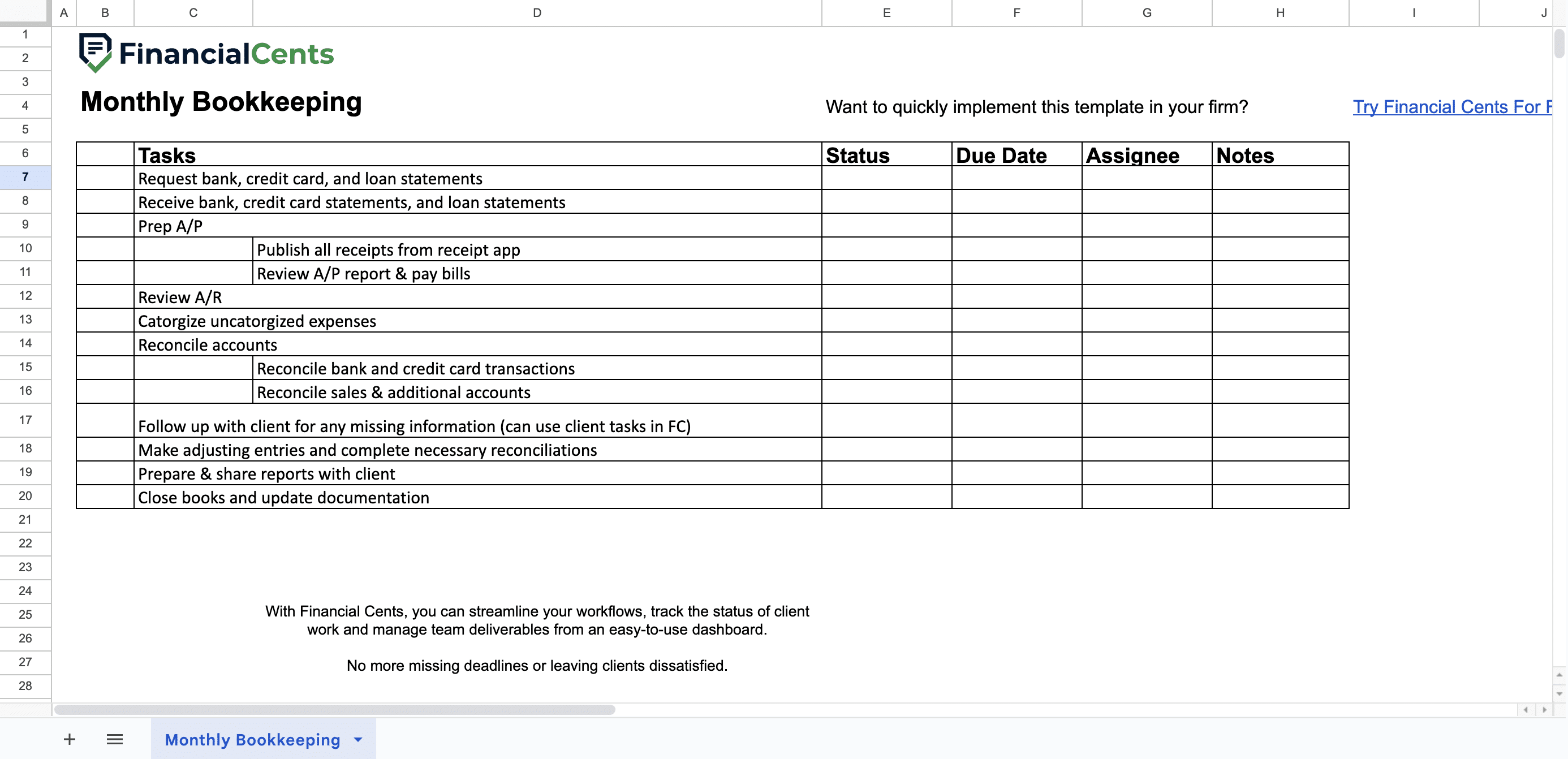
9 Essential Tasks to Include in Your Monthly Bookkeeping Checklist
A strong monthly bookkeeping process should follow a clear, repeatable workflow. Below are the core tasks included in this checklist, structured to help accounting and bookkeeping professionals manage client books efficiently and consistently.
1. Request & Receive Financial Statements
The month-end process begins with requesting bank, credit card, and loan statements from the client (if not directly connected via bank feeds). Ensuring you receive complete and accurate statements is critical before starting reconciliations.
This step sets the foundation for accurate reporting and prevents delays later in the process due to missing documentation.
2. Publish & Record Transactions
Once statements are available, ensure all receipts from receipt capture apps are published and properly recorded in the accounting system.
You should also categorize any uncategorized expenses and confirm that income transactions are accurately posted. Clean transaction coding ensures reliable financial statements and reduces bookkeeping cleanup work at year-end. You can use a month-end close software for this.
3. Manage Accounts Payable (A/P)
Prepare accounts payable by confirming vendor bills are entered correctly. Review the A/P aging report and verify upcoming payments.
If part of your engagement includes bill pay, review the A/P report with the client and process approved payments. This step ensures liabilities are accurately reflected and vendors are paid on time.
Check out our accounts payable template.
4. Review Accounts Receivable (A/R)
Analyze the accounts receivable aging report to identify outstanding customer invoices.
Discuss overdue accounts with the client and determine whether follow-up is required. Monitoring receivables helps maintain accurate revenue reporting and improves cash flow visibility for your client.
Check out our accounts receivable template.
5. Reconcile All Accounts
Reconciliation is one of the most critical monthly bookkeeping tasks. Reconcile bank and credit card transactions against statements to ensure accuracy.
Additionally, reconcile sales accounts and any other balance sheet accounts (loans, payroll liabilities, clearing accounts, etc.). Investigate discrepancies promptly to maintain clean and reliable books.
Related:
AR reconciliation checklist template
AP reconciliation checklist template.
6. Follow Up for Missing Information
If transactions are unclear or documentation is missing, follow up with the client before finalizing the books.
Addressing questions during the month-end process prevents assumptions, reduces errors, and ensures financial statements reflect accurate business activity.
7. Make Adjusting Entries
Record necessary adjusting entries such as accruals, prepaid expenses, depreciation, loan interest, or corrections identified during reconciliation.
Adjustments ensure the financial statements accurately reflect the client’s true financial position at month-end.
8. Prepare & Share Financial Reports
Generate the Profit & Loss Statement, Balance Sheet, and other relevant reports. Review them internally before sharing with the client.
Providing clear, accurate reports strengthens client trust and creates opportunities for advisory conversations.
9. Close the Books & Update Documentation
Once everything is reviewed and finalized, formally close the books for the month.
Update internal documentation, mark tasks complete, and store statements and reports securely. A documented close process improves quality control and scalability as your firm grows.
Related:
The Complete Month-end close checklist (+Free Template)
Who This Template Suitable For
This Monthly Bookkeeping Checklist Template is designed specifically for accounting and bookkeeping professionals who manage books for clients on a recurring basis.
It’s ideal for:
-
Bookkeeping firms managing multiple monthly clients
-
CAS (Client Accounting Services) teams within accounting firms
- Growing firms building scalable month-end close processes
-
Firms onboarding new bookkeeping staff
If your firm handles recurring monthly bookkeeping, this template helps ensure consistency, accuracy, and accountability, regardless of who is assigned to the client.
What you’ll find in our Monthly Bookkeeping Checklist Template
In our fully editable and customizable Monthly Bookkeeping Checklist Template, you’ll find:
- A list of tasks (steps) to complete monthly bookkeeping
- Space to indicate the status of each task
- Due date
- Assignee
- Notes
Note: Remember that you can add or remove any of these items to fit your firm’s unique processes.
Common Mistakes This Checklist Prevents
Even experienced bookkeeping professionals can encounter issues when there is no standardized month-end process. This checklist helps prevent common bookkeeping mistakes such as:
a. Skipping Reconciliations
Failing to reconcile bank and credit card accounts monthly can result in compounding errors that are difficult to fix later. The checklist ensures reconciliations are completed and verified before closing the books.
b. Uncategorized or Misclassified Transactions
Leaving transactions uncategorized or inconsistently coded leads to inaccurate financial reports. A structured review step ensures all transactions are properly recorded.
c. Ignoring A/R and A/P Reviews
Without reviewing receivables and payables, businesses may experience cash flow surprises or overlooked liabilities. The checklist prompts regular review of aging reports.
d. Missing Adjusting Entries
Failing to record accruals, depreciation, or corrections can distort financial statements. Including adjusting entries as a required step improves accuracy.
e. Sending Reports Without Internal Review
Sharing financial statements without reviewing for unusual variances or errors can damage client trust. This checklist reinforces a review-before-release process.
How to Use it Across Clients
To maximize efficiency, this checklist should become part of your standardized month-end close process across all bookkeeping clients.
Start by creating a copy of the template for each client and each month. Assign specific tasks to team members and set clear due dates to keep work moving on schedule. Use the status column to track progress and ensure no step is overlooked before reports are finalized.
To take it a step further, you can streamline your monthly bookkeeping checklist inside an accounting practice management software like Financial Cents. Instead of tracking tasks manually in spreadsheets, you can assign recurring monthly workflows to team members, set automatic deadlines, monitor progress across all clients in one dashboard, and ensure nothing falls through the cracks. This is especially helpful as your client base scales and managing multiple month-end closes becomes more complex.