Key Takeaways
- Tool sprawl is common in growing bookkeeping firms: As firms add clients, services, and team members, they often accumulate multiple tools that don’t connect.
- Fragmented tools create hidden operational costs: When your client information is scattered across multiple platforms, team members waste time switching between systems, copy-pasting, and searching for context.
- Growth amplifies these problems: A disconnected tech stack might work okay for a small team with a few clients, but it becomes a major bottleneck as firms add more projects, tasks, team members, and handoffs to the mix.
- Successful firms centralize their operations in one place: By consolidating workflows into a single system, more and more bookkeeping firms are reducing manual workarounds and making their operations more efficient.
The Hidden Cost of Running a Bookkeeping Firm on Too Many Tools
No bookkeeping firm leader sits down and decides to run their operations with six, seven, or eight individual tools held together by hope and tab-toggling.
Many firms start with a couple of people serving 10 or so clients—largely operating from a handful of spreadsheets and a shared inbox. And it works just fine, because both team members know where every piece of information lives.
Then, they add another client—and another, and another. In what seems like the blink of an eye, 10 clients become 60 (or maybe even 100). To keep up with the growing workload, the firm owner brings on another employee or two.
Things start to feel chaotic, and the team knows they need to automate some of their processes before everything spirals out of control. They decide to start with bookkeeping engagement letters and client onboarding processes, so they implement an accounting proposal software that turns out to be exactly what they needed.
It works so well, in fact, that they look for other opportunities to streamline operations with tech. Over time, they add client portal, document storage, project management, and team collaboration tools to their existing spreadsheets (which, by the way, never really go away).
On their own, each of these tools is a solid solution to a genuine need. The only problem is that most team members work across seven different tools before they’ve even had lunch.
Sure, work still gets done—but it feels harder and clunkier than it should. Bookkeepers spend way too much time chasing down information (instead of serving clients), and leaders live in constant fear of something crucial falling through the cracks.
We call this a patchwork operation—a hodge-podge system of accumulated tools that function well as isolated point solutions, but create a whole other headache when stacked on top of one another.
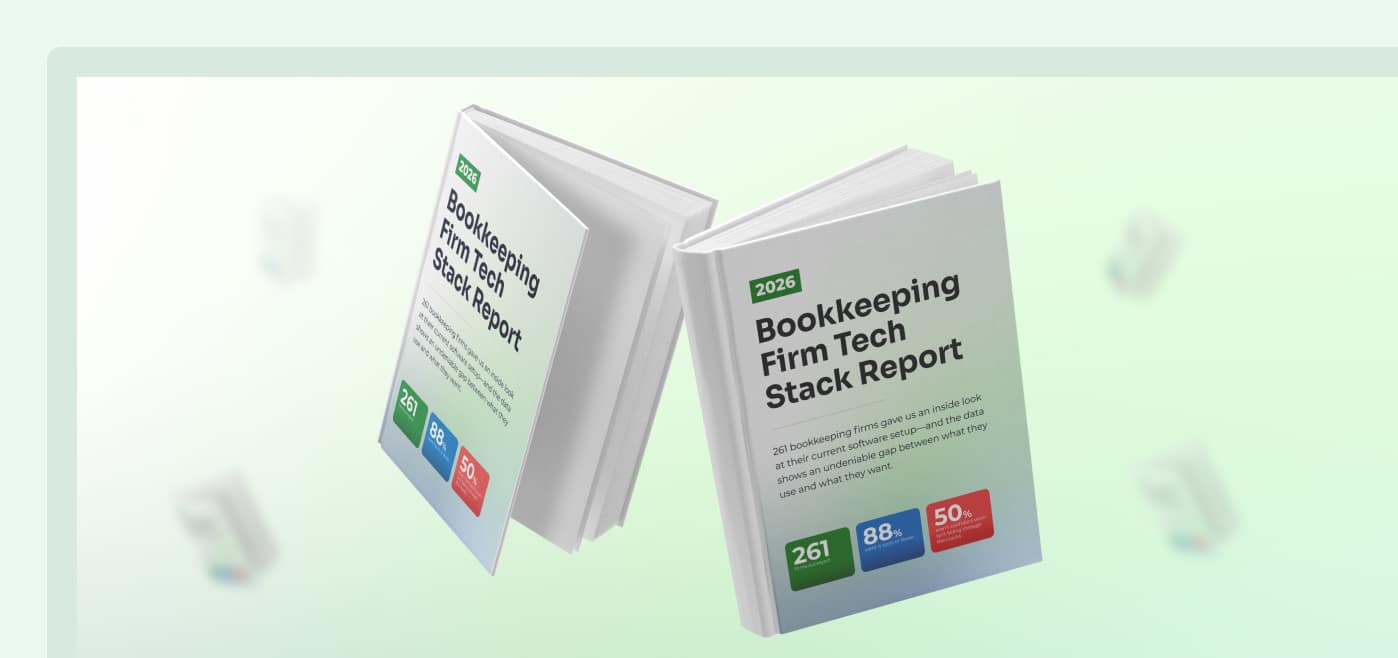
Findings from the 2026 Bookkeeping Firm Tech Stack Report confirm what most firm owners already know too well: the problem isn’t a lack of tools. There are more than enough. The problem is disconnected tools that don’t work together as a system.
What the Data Says About Bookkeeping Firm Tech Stacks in 2026
Based on a recent survey of 261 firms, the 2026 Bookkeeping Firm Tech Stack Report revealed a striking gap between most firms’ ideal tech stack and what they actually have in place today.
The findings show that tool sprawl is more common than firm leaders realize, and it comes with significant hidden costs in the form of stress, lost time, and compliance risk.
Most firms are using more bookkeeping tools than they want to
Nine out of 10 bookkeeping firms want to run their operations on 4 or fewer tools. Yet, less than half actually do.
Like the hypothetical business from our intro, most firms aren’t adding tools with the intent of creating more complexity—quite the opposite, actually. Tool creep happens slowly and inadvertently.
Teams spend significant time copying information between systems
Only 1 in 7 bookkeeping firms never (or rarely) have to manually re-enter or copy data between tools.
Many have simply accepted data re-entry as a normal part of their week. Whether they’re moving client details from a proposal tool into a spreadsheet or re-entering the same information into a bookkeeping client management tool or billing app, all of these little workarounds add up fast—turning into hours of non-billable work as the firm grows.
Visibility across client work is often limited
Only 1 in 3 firms has a clear view of the status of client work at any given moment.
Most leaders have to consult multiple systems or team members to get the full picture, which explains why nearly half of firm owners are not confident that nothing is falling through the cracks in their firms. And when bookkeeping firm owners are unsure of whether they’re on track with deadlines and deliverables, last-minute scrambles become the rule instead of the exception.
Curious how your firm’s tech systems stack up? Read the full benchmark report here.
How Fragmented Systems Show Up in Everyday Firm Operations
Fragmented systems make everyday tasks more difficult to manage, ultimately creating operational bottlenecks that make client deadlines harder to meet. That’s because:
1. Information lives in too many places
In many bookkeeping firms, critical files and information end up scattered across a disconnected mess of tools:
- Documents live in Google Drive or Dropbox
- Tasks and due dates sit inside a project management tool
- Team communication happens in Slack or Microsoft Teams
- Client communication lives in email
- Work status is tracked in a spreadsheet
Again, each tool works just fine on its own. But when your team has to constantly pause what they’re doing in one system to track down information in another—the latest document version, the current status of a certain task, a phone number or email address—all those little interruptions can quickly add up to hours of unnecessary (and unbillable) admin work.
“Our communications are scattered across email, text, my list, their list,” one survey respondent admitted. “It’s frustrating and unprofessional.”
Plus, the more you’re manually moving information across systems, the greater your risk of working with data that’s outdated, incomplete, or just plain wrong.
2. Manual data entry becomes normal
When apps don’t sync automatically, bookkeeping firms are forced to use manual workarounds to keep information consistent across systems. And as the survey data revealed, 6 out of 7 firms are currently working this way.
“We have to manually enter all the data because the tools are not syncing,” one frustrated firm owner disclosed.
What starts as a quick fix can easily become routine—and as client loads grow, so does the risk of human error. One missed update, typo, or outdated document can jeopardize the accuracy and compliance of a client’s financial statements—and that could land your firm in serious hot water.
3. Owners and ops leaders become the “human integration layer”
When tools don’t integrate automatically, someone inside the firm ends up connecting the dots. In many bookkeeping firms, that person is the owner, the operations manager, or a senior bookkeeper.
They take on the added responsibility of:
- reminding team members about deadlines,
- forwarding important messages,
- tracking down missing documents, and
- making sure work moves from one stage to the next.
“We rely on the experience of the manager to ‘catch’ these things (updating task status and reminding team members) or pick up the pieces later,” explained one bookkeeping professional. “It eventually gets caught, but slows them down.”
As the firm adds clients, team members, and tools for bookkeeping, this approach becomes harder to sustain. When your entire workflow depends on one person’s memory and oversight, what happens when that person is overwhelmed or unavailable?
4. Month-end close becomes a nightmare
Despite being one of the most-repeated workflows in bookkeeping, the month-end close process is fragmented in most firms.
According to the 2026 Bookkeeping Firm Tech Stack Report, more than half of firms manage their month-end close workflows using spreadsheets, sticky notes, or email threads rather than a centralized system.
This might look like:
- one spreadsheet for tracking client progress,
- shared documents with checklists for tracking handoffs,
- email threads for requesting missing information, and
- messaging apps for updating internal team members.
When team members have to double-check spreadsheets, search email threads, and confirm task statuses across multiple clients, the month-end process becomes unnecessarily stressful, time-consuming, and error-prone for everyone involved.
“It’s tough to keep track of all the tasks (including month-end tasks) associated with each client,” one survey respondent shared. “There have been a few slips, and it’s always stressful.”
5. Lack of centralization leads to poor firm visibility
When work is siloed in multiple disconnected systems, firm owners and managers can’t see what’s happening at the firm level.
The tech stack report shows that only 1 in 3 bookkeeping firms has a centralized view of client work. For most firms, answering the simple operational question of “where a client’s work stands” requires checking several different tools or asking the person who has the most context.
The consequences can be dramatic. As one survey respondent shared, “The firm owner signed a new client and thought she had delegated the work to a bookkeeper, who never actually received the notice of the work. After 12 months, I realized there was a client that no one was tending to. It was a rush job to get caught up before year-end.”
The fact is, without high-level visibility, bookkeeping leaders waste precious time piecing together updates. Plus, they’re forced into a reactive position of dealing with issues as they arise, because they don’t have the context they need to proactively manage the firm. This makes it harder to plan capacity, meet deadlines consistently, and respond to clients in a timely fashion.
The 7 Patchwork Personas
The 2026 Bookkeeping Firm Tech Stack Report surfaced several common workarounds today’s firms are using to keep client work moving—despite their messy, disconnected systems.
We call these patterns the Patchwork Personas—the operating styles that emerge when firms rely on fragmented tools and manual processes to manage their bookkeeping workflows:
- The Tool Toggler: These bookkeeping teams throw a new tool at any problem that pops up. The result? Their tech stack balloons into a web of logins to remember and new systems to learn.
- The Human Router: In these firms, nothing moves unless someone moves it. People become the cables connecting all the tools, tasks, and team members in the workflow.
- The Constant Copy-Paster: Manual data entry is just part of the routine for these teams. Staff repeatedly enter the same information across multiple tools, draining both their time and their mental energy.
- The Month-End Magician: Month-end close is total chaos for these firms, yet they always find a way to pull through—constantly hustling to meet client deadlines instead of taking the time to build a smooth, repeatable process.
- The Message Miner: In these firms, critical updates are buried inside multiple platforms (email, Slack, text, etc.), so team members have to go dig for them when needed.
- The Apology Artist: These firms rely on the good graces of their clients when mistakes and missed deadlines inevitably happen. They’re great at smoothing things over, but all of that recovery effort would be better spent building a system that prevents balls from dropping in the first place.
Get instant clarity with our free 1-minute assessment.
Why These Problems Get Worse as Firms Grow
Again, patchwork systems can work well when your firm is just starting out. It’s easy to keep tabs on projects and deliverables when you’re a team of two or three people, because you’re all involved in most of the work.
But as you take on more clients—and maybe even hire more people—that level of simplicity quickly fades. Work must move across multiple team members, deadlines multiply, and the number of active tasks soars.
Each new client, task, and handoff increases the chances of errors, delays, and missed steps. And when you’re managing all of your work across disconnected systems, the odds are truly stacked against you.
How Bookkeeping Firms Actually Want to Operate
Even though bookkeeping tool sprawl is a major problem for small bookkeeping firms, most of them understand the value of having the right tech stack.
They want simpler, more connected systems that allow work to flow without the manual workarounds.
As one respondent from the 2026 Bookkeeping Firm Tech Stack Report noted, “I want all my tools to sync seamlessly in real time, so nothing ever falls through the cracks and I can focus entirely on delivering results instead of troubleshooting integrations.”
Across all 260-plus firms that contributed to the report, these were the most commonly cited features of their ideal tech setup:
| Characteristics of an ideal setup | Real survey-taker comments |
|---|---|
| One platform to manage workflows and client work |
"We want to have one comprehensive tool that satisfies all needs rather than multiple tools working separately." "One place for client receipt and document storage, invoicing, proposal and contract generation, client transaction questions, and payment processing." |
| One source of truth for tasks, notes, and documents |
"I want everything to flow through the same system—client communication, checklists, uploaded documents." "To find all information for clients in one place." |
| Better visibility into client status, team capacity, and deadlines |
"One platform, full visibility, and seamless integration." |
| Integration and automatic data sync |
"I want data to transfer automatically, so I don't have to manually enter multiple times when numbers change." |
The Shift From Patchwork to Centralized Operations
Clearly, many bookkeeping firms recognize that:
- When tools are disconnected, they will pretty much always make work unnecessarily difficult—even if they work great as standalone solutions.
- The friction that drags down team members on a daily basis is a structural problem that can only be solved by rebuilding the system itself.
That’s exactly why so many firms are making the move toward a more centralized platform for coordinating and managing work.
Firms that have already made this shift now enjoy:
Consolidated workflows
Work and client information live in one platform, and recurring tasks, handoffs, reviews, and approvals move through a clear, seamless process.
Instead of tracking month-end close steps in spreadsheets, requesting documents through email, and confirming a project’s status through messaging apps, the entire workflow lives in one organized system.
Every step, responsibility, and deadline is documented and visible—to everyone.
Shared visibility
Centralized dashboards show firm owners and operations leaders what work is in progress, what has been completed, and which tasks may be at risk.
This visibility helps firms identify bottlenecks earlier, monitor deadlines more confidently, and ensure work continues to move forward without constant follow-ups.
Standardized processes
Workflow templates can help standardize repeated bookkeeping processes (like client onboarding, month-end close, and year-end adjustments), ensuring a consistent client experience. Even better: Purpose-built cloud accounting practice management software can automate workflows in one centralized system.
Reduced manual work
Tasks, notes, documents, and updates are connected within one system, so information is entered once and synced across all relevant tools for easy reference. Notifications, reminders, and status updates can also be automated so that work progresses without human intervention.
Why Firms are Ditching Patchwork Systems and Choosing Financial Cents
All-in-one platforms like Financial Cents were created specifically to help firms move from a tangle of disconnected tools to a single, centralized practice management solution.
Built for small bookkeeping and accounting firms, Financial Cents brings all core firm activities into one platform designed for high-volume, recurring, and client-dependent workflows.
That means:
One Platform for the Whole Firm
Financial Cents centralizes proposals, workflow management, automated communication, client collaboration, team capacity, billing, and reporting in one place, enabling teams to manage client projects from start to finish—no toggling required.
I want to reiterate how much of a business/life-saver Financial Cents has been for my firm. We were using as many as 7 different applications to try to keep our workflow and information in order, but nothing was connecting, and things were falling through the cracks. My bookkeepers were frustrated, and so was I. A CPA recommended Financial Cents to me, and it was the best decision I could have made for my business."
Terri Evans, Owner at Safe Harbor Bookkeeping Professionals LLCBuilt-In Month-End Close
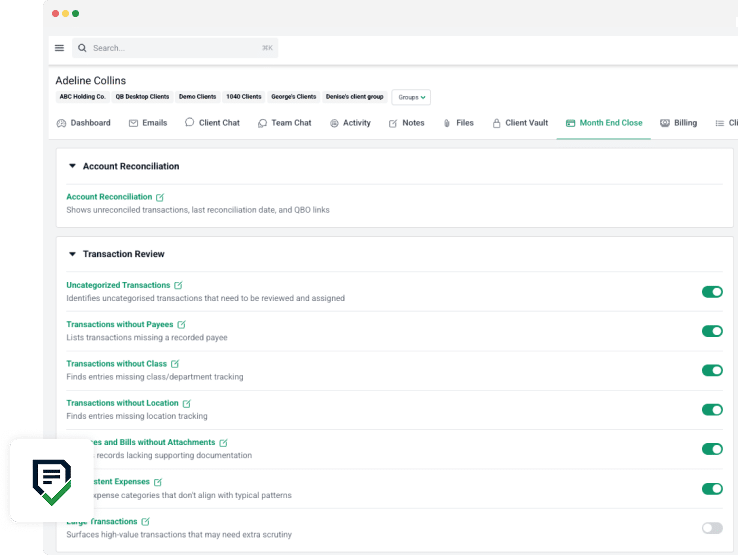
Month-end close workflows and transaction reviews are built directly into Financial Cents, making them easy to track, repeat, and manage across clients.
Financial Cents’ month-end close process is extremely easy to use and creates a smooth close by enhancing my client communications regarding questions on transactions. Plus, the integration into our workflows templates created even more efficiencies for a quicker accurate month-end close."
Greg Scholten, On Track Accounting Solutions
Single Source of Institutional Knowledge
Processes that once lived in spreadsheets—or worse, in the minds of experienced team members—can be documented and standardized using the Financial Cents workflow templates feature.
This enhances knowledge-sharing across the entire team, reduces reliance on individual memory, and makes operations scalable as the firm grows.
Financial Cents helps me determine what needs to be done next with due dates (so I am less reactive and more productive!). It ‘holds my brain’...I was able to keep track of what was going on with more than 250 clients and not rely on my memory."
Christi B.In fact, this is one of the key drivers for firms that have made the shift to Financial Cents:
We needed to get our systems all shored up to make sure that we were ready to grow sustainably. With the system we had before, we used a lot of emails and pulled client emails into a special folder in our Outlook system. That was difficult because just keeping track of what questions and answers were outstanding was an issue."
Lori Hawkins, President, L&L BookkeepingThis operational bottleneck was preventing Lori and her team from taking on new clients—even though they had a waiting list. That’s when she decided to make the jump to Financial Cents—a decision that turned out to be an excellent one:
Our biggest benefit in Financial Cents has been our workflow. We have it more structured. We can put more details and hyperlinks that lead to the other areas we need to go into. Everything is in one hub, and that is wonderful."
Lori Hawkins, President, L&L BookkeepingThe Bottom Line: Centralize Your Tech Stack, Regain Full Visibility, and Scale Your Firm
Perhaps the most important takeaway from the 2026 Bookkeeping Firm Tech Stack Report is that the average bookkeeping firm is performing well and meeting client deliverables despite fragmented technology—not because of it.
Much of their success comes from manual effort, clever workarounds, constant vigilance, and month-end hustle.
This approach can work when your firm is small. But as you add more clients, tasks, and team members, the system becomes increasingly prone to risk—not to mention exhausting to maintain.
But while tool fragmentation may be common, it is not inevitable.
The firms that scale successfully tend to be those that have made a deliberate shift from patchwork systems to centralized operations. This enables them to run their entire firm in one place—where processes are standardized, visibility is shared, and tasks are automated.
That’s how modern bookkeeping firm owners run their business with clarity, enhance internal collaboration, and avoid the month-end scramble—giving their staff the confidence and breathing room to meet client deadlines.
Get a clear picture of how bookkeeping firms are managing their tech—and where inefficiencies are holding them back.
So, if you’re providing top-notch service to your clients—but your day-to-day operations feel harder than they should—identifying your firm’s patchwork patterns is a great first step toward regaining control. Luckily, we’ve made it easy for you.
See where your firm currently stands by taking the 1-minute Patchwork Persona Assessment.