You can spend hours, days, even weeks building the perfect workflow—only to have the whole thing come crashing down with one unusually complicated client. For Kellie Parks, CPB, that client was a business owner with a web of related companies and money flowing between all of them.
“He really showed me the gaps in some of the questions I had not been asking,” she said. But, that one tricky client was the catalyst for rebuilding her client questionnaire to capture better client data upfront. And at the end of the day, Kellie chalks that up as a win. Because the truth is, no matter how many times you’ve tweaked, added to, or completely overhauled a particular workflow, it’ll never really be done.
That concept was the heart of “Workflow Reset,” the second session of Financial Cents’ month-long Summer Workflow Camp. Led by Kellie, owner of Calmwaters Cloud Accounting and a self-described “relentless organizer,” this interactive event invited attendees (ahem, campers) to select and rebuild one real workflow causing real snags in their firm.
Here, we’ve turned this exercise into a process you can run with your own team, whether or not you attended the live session. (That said, we definitely recommend watching the full recording to get the most out of Kellie’s infinite wisdom, especially if you’re interested in seeing her approach to creating and optimizing workflows in Financial Cents!)
TL;DR
- A good workflow is never done. Kellie’s whole approach is “build it, use it, find the holes, fix it, repeat.” So, think of it as a constant work in progress.
- Impact, not size, should drive priority level. Start with a workflow that buys you freedom, improves the client experience, or is operationally critical (even if it’s small and simple).
- Kellie’s rebuild formula: Export the template to a spreadsheet, fix it there, then rebuild it in Financial Cents section by section (adding automations, dependencies, and emails last).
- You might end up revisiting a freshly built workflow sooner than you thought you would. (Session attendee Katie Pomeroy, for example, rebuilt her onboarding barely a year ago and is already taking another pass, because a real client surfaced bottlenecks she couldn’t have predicted.)
- AI has a place in your processes, but it’s not a substitute for the human touch. Be extra careful with how you leverage AI on the client side of things.
- Kellie’s parting rules: Build for today, break up large workflows into sections/milestones, name and date everything, always test new workflows from the client’s perspective, and never stop iterating.
Start small and simple
When you finally sit down to fix your workflows, it’s tempting to go straight for the biggest, messiest one of the bunch. Kellie strongly advises against this approach.
So, how do you decide what to rebuild first? Kellie laid out three filters:
1. Pick the workflows that will give people the most freedom (including you).
If a workflow would help you (or a team member) stop doing work you don’t want to be doing, then it’s probably a great candidate for a reset. One of Kellie’s own examples was a small workflow for checking the general ledger against the trial balance. “I wanted it to already be reviewed before it came to me,” she explained.
2. Pick the workflows that help create great client experiences.
Kellie is adamant that your workflows should make clients feel like they’re in professional, capable hands. Her file-review workflow—often a new client’s very first touchpoint with her firm—is a perfect example. “I want to make sure that it’s seamless…and assembly-line ready so that all of the stuff that the client needs to do can get done by them simply, with the least confusion,” she said.
3. Pick the workflows that are critical even if they’re not super complex.
To illustrate this point, Kellie offered a quick non-accounting example. She lives in a gated community where she is responsible for occasionally locking the gate in an upright position (lately because construction trucks need to get through). “It’s not complicated, but I forget what all the steps are,” she admitted. So she wrote a simple SOP for locking and lowering the gate and handed it off to a few of her neighbors. “That created some freedom for me, because I’m not always around to make sure it gets done,” she said. The main idea is that a workflow doesn’t have to be elaborate to be worth building; it just has to remove you as the bottleneck.
Follow the Kellie Parks rebuild formula
During the live session, Kellie walked through how she rebuilt her firm’s client onboarding workflow. It’s not a workflow she runs every day, but like the file review process, it “tells my clients how easy it is to work with us.” Here’s how she executed the rebuild, step by step. (Note that the overall process is replicable across virtually any workflow you want to reset.)
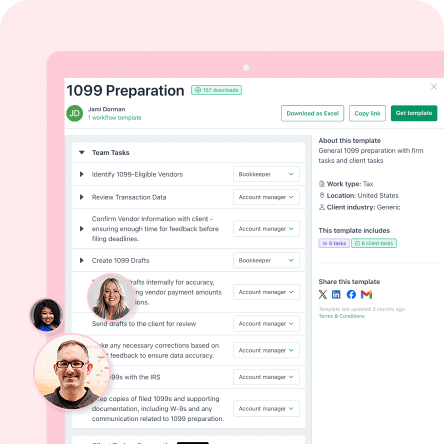
Snag Kellie’s full updated onboarding workflow template from the Financial Cents Template Library.
Step 1: Add what’s missing to what you’ve already got.
If you already have some type of process in place, there’s no need to start from a blank page (especially if you’re too busy to revamp that particular workflow at the moment). Instead, add to what you have as you go, knowing that you can always give it a more comprehensive refresh in the future.
By her own admission, that can cause workflows to get “a little unruly” over time, but that’s completely normal. “I was jamming, which is better than not jamming,” she said.
Step 2: Export the template to a spreadsheet.
This is one of Kellie’s signature moves. Rather than reshuffle everything inside of her project management software, she downloads the workflow as a CSV and works there. The spreadsheet export gives you a clean set of columns, rows, and labels that enable you to see how everything fits together in one comprehensive view.
Step 3: Fix it in the spreadsheet.
Hide the columns you don’t need, rewrite task descriptions, make additions, and reorganize to your heart’s content—all directly within the spreadsheet. Kellie’s reasoning for this step is purely practical: “Most of us are pretty spreadsheet savvy,” she said. “We know how to move around, how to find what we want. So it’s super quick.” Editing individual tasks inside an app, on the other hand, can be slow and tedious.
Step 4: Rebuild it in your practice management software, section by section.
Once the spreadsheet is right, Kellie builds a fresh workflow in Financial Cents, creates each section, and copies the rows (i.e., tasks) directly from the spreadsheet. Subtasks work the same way: copy the subtask cells and paste them into Financial Cents so they nest under the right task. Only after the structure is in place does she layer on “all of the super-duper features” like automations, dependencies, and task-triggered emails.
Step 5: Organize the workflow into sections that match the cadence of the work.
Kellie’s onboarding workflow is grouped into contextually similar sections:
- A short discovery stage (which includes a handful of initial questions designed to filter out any clients who are obviously not a fit, effectively keeping prospects out of Financial Cents until they’re serious);
- A file review stage that automatically kicks off once discovery is complete (it’s substantial enough to be its own workflow);
- The quote stage; and
- Everything else she needs from the client.
Crucially, she sends client requests in batches, grouping similar questions and to-dos together.
As she admitted during the session, many of those client-facing questions are the result of lessons learned the hard way. For example, she didn’t know she was going to need a client’s emergency contact until she was doing contingency planning for them. And for her multi-entity clients, she now asks for org charts that map to the companies and their people, “especially if money flows between them.”
Step 6: Name it, date it, and do it all over again.
Kellie uses a naming convention and a revision date on every template. “It makes it much more searchable,” she said, and it lets her line up related templates and know at a glance when she last cleaned one up. And of course, at some point, she’ll run the whole process over again—because workflows are never really finished.
That’s also why she updates workflows in real time rather than putting fixes off in the hopes that the software will eventually solve for the pain points she’s feeling. For example, Kellie rebuilt her onboarding workflow in Financial Cents even though she knows features like native questionnaires and in-app signatures are on the way.
“Building them before the features come out can solve some problems right now, but it also sets the stage for when the features you’re jonesing for do come out,” she advised. Rethinking her questions now means she’ll be totally ready to slot them when the new questionnaire functionality is released.
Don’t set it and forget it
If there’s one thing Kellie wants firm owners to internalize, it’s that a workflow is a living process—a habit, not a one-time project.
“You will never be done honing them,” she said.
Katie Pomeroy, owner of KP Solutions in Smiths Falls, Ontario, is living proof. Katie joined Kellie on the virtual stage for a few minutes during the workshop, sharing that the onboarding example hit close to home. Katie is actually in the middle of rebuilding her own onboarding workflow right now, less than a year after she created the current version.
This is exactly why Kellie urges firms to test out their workflows using the “view as client” feature in Financial Cents, but even then, it’s impossible to catch everything that could possibly go wrong. So, don’t worry too much about making everything perfect; just get it live, pay extra attention to the first few clients who move through it, and plug the holes quickly so it gets better with every cycle.
Tech Talk: Where AI Fits into Your Workflows (and Where It Doesn’t)
During the session, Katie asked Kellie if she uses AI to support her onboarding workflow. The answer was a firm no, but perhaps not for the reason you’d expect.
“I want onboarding to happen without me,” Kellie said. “But there’s a lot that isn’t going to happen without us. This is where we should have the human touch. It’s not that I’m anti-AI. I’m quite ‘AI.’ But I need my clients to feel me.”Where AI does fit into Kellie’s process is behind the scenes, specifically with heavy analytics or data-processing work. On multi-entity, multi-year cleanups, for example, she’ll drop prior returns and financials into an LLM and have it run a “preflight” on where the problems are.
She also has it run the general ledger against the trial balance to flag what to look for. “Last year it kind of stank at it,” she said. “But now it’s actually kind of great, and it’s saving me hours and hours”—especially on big charts of accounts and intercompany, multi-currency work.
Katie leverages AI as a thinking partner for the workflow itself. “Where I’ve been using AI is simply taking my onboarding workflow, plugging it in, and having it work through with me to figure out some holes before I get it to the testing stage,” she said.
Looking for more great AI tips for accounting firms? Check out our new AI Accounting video series.
Stick to Kellie’s rules for the road
Kellie closed with the principles she comes back to every time she builds (or rebuilds) a workflow:
1. Build for today.
Software features are always shipping and improving, so don’t stall out waiting for the perfect one. “If there’s a compelling reason to get busy with it, then get busy with it,” Kellie said. Building for the here and now helps you surface the flaws, plan for the future, and establish the right flow. When the shiny new feature does arrive, you’ll already have a foundation in place that allows you to easily plug it in and leverage it to the fullest.
2. Use sections to control the flow.
Sections (or milestones) are one of Kellie’s most-used tools when designing workflows in Financial Cents. In an onboarding workflow, for example, this functionality allows you to drip work out to clients so they aren’t buried under a mountain of tasks. You can also group tasks into batches of questions that require similar thinking (e.g., questions about their business details in one section, questions about how their finances run in another). Use sections internally, too, to match your own cadence of work.
3. Name it and date it.
Every template is labeled according to Kellie’s established naming convention and stamped with a revision date. This keeps templates searchable, helps the system serve up related ones, and clearly tells you when you last reviewed something (so you know when it’s safe to retire an old version).
4. Test before you release it into the wild.
This one’s non-negotiable for Kellie. Before any workflow goes live, walk through it exactly as the client would. As noted above, Financial Cents’ “view as client” option makes it easy to catch potentially confusing steps or dead ends before they cause any client frustration.
5. Put dependencies ahead of automations.
A small mechanical rule that’ll save you a lot of embarrassment: don’t fire off an automated email asking a client to do something they can’t do yet. “You don’t want to send out an email that says go get your reports when you haven’t even uploaded the reports to where they need to go,” Kellie said. Set a dependency first so the ask only goes out when it makes sense chronologically.
6. Always be iterating.
Finally, get into the habit of continually reviewing your workflows against the backdrop of your desired outcomes. “What do you want to be free of? What do you want the client to feel? What do you want your team members to do?” Kellie asked. Your answers will help you assess whether your workflows are working—and when it might be time for another reset.
This was the second of four sessions in the Summer Workflow Camp series. Next up is Alisa McCabe’s “Out of Office Ready” on July 21, followed by “The Send-Off: Camp Talent Show + Stress Test Finals” on July 28.
Missed Kellie’s session? Watch the full “Workflow Reset” recording and register for the remaining Summer Workflow Camp sessions (it’s free)—then pick one workflow and rebuild it before the week is out.
Share this article: