It’s Monday morning. Your team is already at it. You know how this week ends: month-end dragging into the third week, two clients emailing about reports that should have gone out on Friday, that advisory engagement still sitting on the back burner. And nobody’s slacking. They’re at it from 8 to 7.
If that sounds like your firm, you’re probably calling it a capacity problem. It’s almost always an efficiency one.
And it’s not just you. Per our 2025 State of Accounting Workflow Automation Report, 55.5% of firms now rank workflow inefficiencies as their single biggest operational challenge. Rightworks’ 2025 Post-Tax Season Survey also points to the cost: 12% of firms scaled back their tax client base last year just to match their available workforce, turning away revenue because the work wasn’t moving fast enough.
The good news is efficiency is measurable, and the leaks are predictable. By the end of this guide, you’ll know what accounting efficiency actually means, how to measure it in your firm, where it most commonly leaks, and the highest-ROI ways to fix it.
TL;DR
- Efficiency in accounting is the ratio of useful output (completed engagements, billable hours, deliverables) to input (staff hours, tools, overhead). Formula: Efficiency = Output ÷ Input.
- Measure it with realization rate, profitability rate, utilization rate, effective hourly rate, average turnaround time, and revenue per employee. Track at least three.
- The biggest leaks are chasing clients for documents, recreating recurring work by hand, no capacity visibility, disconnected tools, and undocumented processes.
- Start small: document your top five recurring processes, build them into workflow templates, and automate client document collection.
What Is Efficiency in Accounting?
Efficiency in accounting is the ratio of useful work your firm produces to the resources it burns producing that work, mostly staff hours, plus software overhead, and the time you lose to rework and chasing clients.
The formula is simple: Efficiency = Output ÷ Input.
The translation matters more than the math. Two firms can have identical revenue and identical headcount and wildly different efficiency.
| Firm A | Firm B | |
|---|---|---|
| Month-end closes completed | 20 | 20 |
| Total staff hours used | 200 | 320 |
| Hours per close | 10 | 16 |
| Extra hours spent vs. Firm A | – | 120 |
Both firms deliver the same work. Firm B burns 60% more time getting there, 120 extra hours a month that get paid in overtime, missed deadlines, and the new work you can’t take on.
An efficient firm isn’t working harder. It’s wasting less of its team’s time.
Why Efficiency Matters for Accounting Firms
When efficiency is bad, four things break easily:
- Profitability: Every hour on admin or rework is an hour you can’t bill or reinvest in advisory. Efficient firms run higher realization and utilization, and that gap lands directly on net margin. Keeping your accounting firm profitable goes deeper on the mechanics.
- Capacity: Efficient firms absorb new clients with the team they have. Inefficient ones add a head every time work grows.
- Burnout and retention: Rework, scattered tools, and last-minute client chasing drive staff out during tax season. With the talent shortage, replacing one experienced hire takes 60+ days.
- Client experience: Efficient firms hit deadlines and communicate proactively. Inefficient ones miss handoffs. Clients notice. They churn.
Michael McMullin, Managing Partner at JTC CPAs, describes the before-state clearly. The firm used to track work on sticky notes:
“We would write things on a sticky note and place it on somebody’s desk because the person wasn’t there… Then a client calls and they’re upset because something wasn’t done. It was just total chaos.“
That’s what inefficiency actually feels like. Not a number on a dashboard. A client on the phone asking where their work is.
How to Measure Efficiency in Your Firm
Here are the five metrics that actually tell you whether your firm is efficient.
1. Realization rate
Think of realization rate as the gap between what your work was worth and what you actually invoiced. A project scoped at $5,000 that you ended up billing at $4,200 lands you at 84%. The other 16% is money the firm earned but didn’t get paid for. Maybe you discounted it to keep a client happy. Maybe scope crept and you ate the extra hours. Either way, it shows up here first.
Formula: (Amount billed ÷ (Standard rate × Hours worked)) × 100
If you’re below 80%, the leak is usually in your scoping or your discounting habits, not in your team’s work.
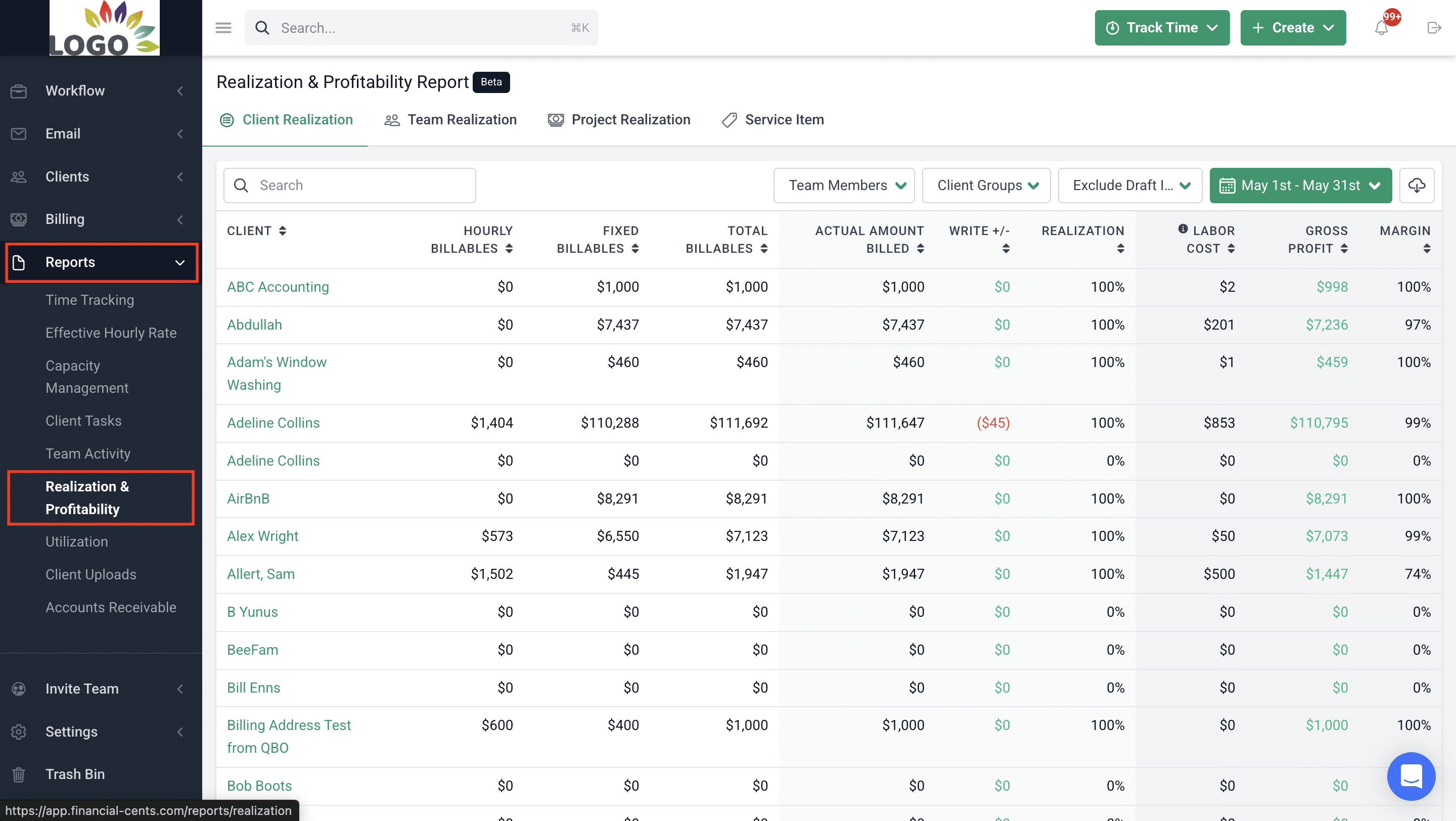
Realization tells you what you collected. Profitability tells you what’s actually yours after the cost of getting the work done. Two engagements can have identical realization rates and very different profitability. Same invoice, but one team closed the work in 10 hours and the other took 18.
To track this properly, you need labor costs broken out per engagement, not just billable hours. Financial Cents’ profitability rate does that, so you can see which clients are paying you well and which are quietly bleeding the team.
Formula: ((Project revenue − Project cost) ÷ Project revenue) × 100
Learn more about Realization Rate in Accounting in this comprehensive guide.
2. Utilization rate
Utilization answers the question: how much of my team’s actual work day turns into client work? Eight hours in the office doesn’t equal eight billable hours. Meetings, admin, internal review, and waiting on clients all eat into the day. Utilization puts a number on what’s left.
Formula: (Billable hours ÷ Total available hours) × 100
80%+ is tax-season territory: fine for a stretch, but if it’s your baseline, burnout is coming.
3. Effective hourly rate
Take a bookkeeping client paying $800 a month. The work eats 12 hours of team time. That’s an effective rate of $66 an hour. If your team’s standard rate is $125, that one engagement is running at half-price without anyone calling it a discount. Multiply that across 30 fixed-fee clients and you’ve got a margin problem hiding in plain sight.
Formula: Revenue earned ÷ Hours worked
Our guide to time tracking for accountants goes deeper on how to capture this without making your team feel surveilled.
4. Average turnaround time per engagement
This is the metric your clients actually feel. They don’t care about your realization rate. They care about when their books close, when their return gets filed, when their reports land.
Track it separately by engagement type: monthly bookkeeping, quarterly reviews, year-end, 1040s. When one of those numbers drops, you know the system is working. When one creeps up, you’ve got a bottleneck to chase down.
Formula: Days from receiving complete client documents to delivering finished work.
5. Revenue per employee (RPE)
RPE is the bluntest measure on this list and the easiest to run. Take your annual revenue, divide by full-time-equivalent headcount, and you’ve got a single number that says roughly how much each person on the team is producing.
It isn’t perfect. Juniors and partners don’t generate the same output, and a great EA can make a partner look more productive than they are. But trend it over time and you’ll see whether you’re scaling efficiently or just adding bodies.
Formula: Annual revenue ÷ FTE headcount
The 5 Most Common Efficiency Bottlenecks
When firms run those metrics and find efficiency lower than expected, the leak is almost always in one of five places.
1. Chasing clients for documents
Per our 2025 Workflow & Automation Report, getting documents from clients is the number one workflow issue in accounting firms, surpassing manual admin tasks. After automating document collection, 60.7% of firms now receive documents within 1–3 days.
2. Manually recreating recurring work each period
Bookkeeping firms rebuild the same monthly close checklist for every client, every month. A single recurring accounting task management template can save 30+ minutes per engagement. Across 50 monthly clients, that’s 25 hours gotten back in a month.
3. No visibility into team capacity
Partners assign work on gut, not data. Senior staff get buried while associates have slack. Nobody sees the imbalance until a deadline slips. Knowing your firm’s maximum operating capacity is the precondition for assigning work confidently.
4. Disconnected tools
The team hops between QuickBooks, a tracking spreadsheet, Slack, and Dropbox. Every handoff is a place where work stalls. The real cost isn’t the subscriptions. It’s the context-switching tax on every staff member, every day. Our research on disconnected bookkeeping tools breaks down the numbers. A consolidated accounting task management system pays off better.
5. No documented processes
New hires take 3–6 months to ramp because nothing is written down. The same engagement gets done five different ways by five different staff. Reviews catch the variations; rework eats the margin.
How to Improve Efficiency: A Practical Playbook
a. Document your top five recurring processes: Start with the engagements that consume the most team time: monthly bookkeeping, quarterly reviews, payroll, year-end, 1040s. Write them down.
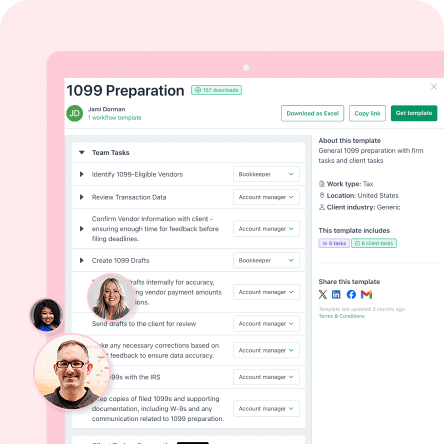
b. Build recurring workflow templates: Convert each documented process into a template inside your accounting practice management platform. This single move can cut hours of admin per client.
c. Automate client document collection: Replace the manual email chase with reminders on a schedule. Before automation, 53.8% of firms spent 5+ hours a week scheduling and assigning work. After, 75.8% cut that to under 5 hours.
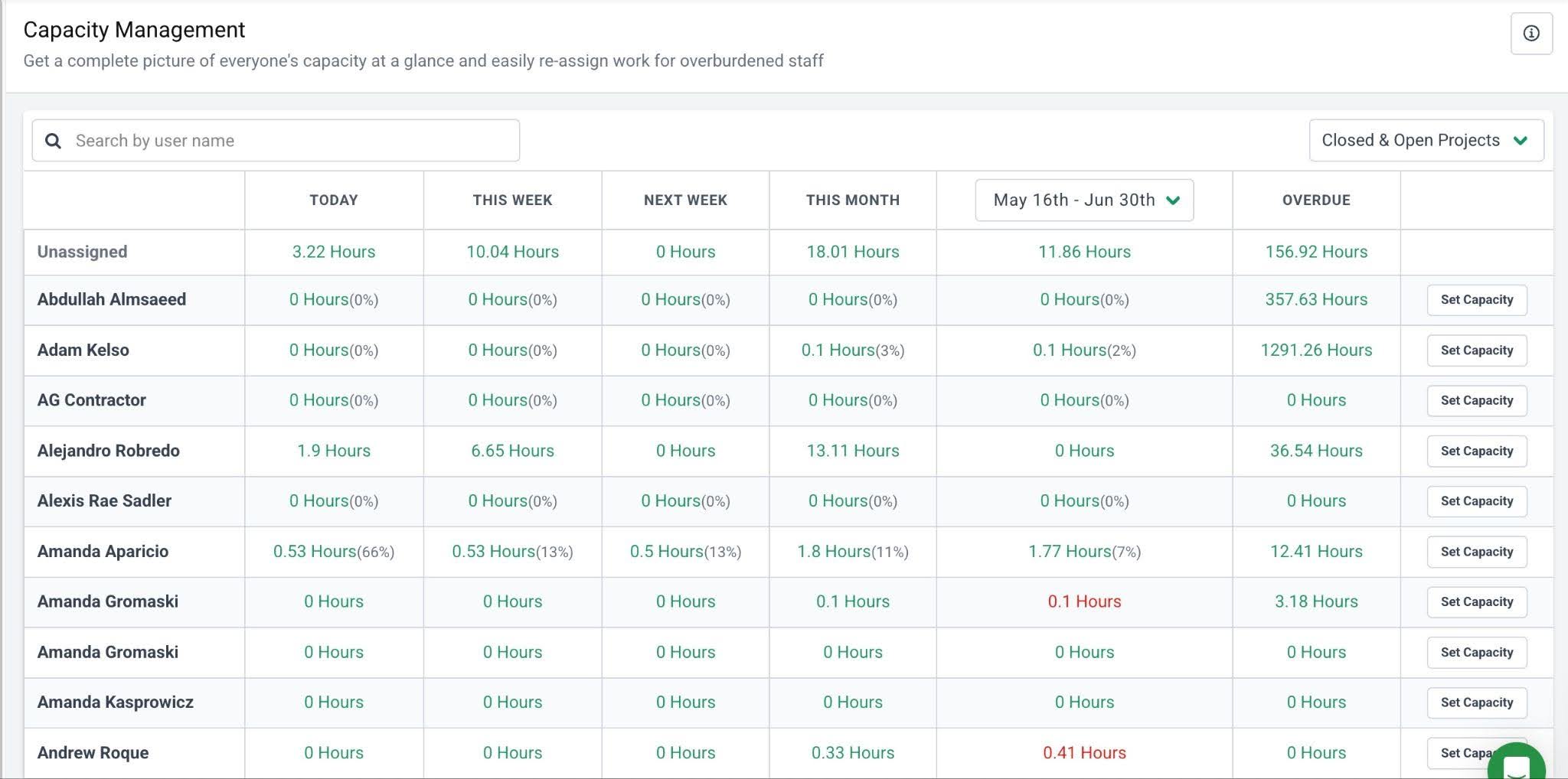
d. Get visibility into team capacity: Use a capacity management view to see who’s over and under-loaded before deadlines slip. This alone changes how partners assign work.
e. Centralize work in a single practice management platform: Stop running operations across five tools. See our guides on how to boost your firm’s efficiency and manage an accounting firm.
f. Track 2–3 efficiency metrics monthly: Pick from the six above. Realization + turnaround + capacity utilization is a solid starter set.
g. Niche down where you can: Generalists spread efficiency thin across too many engagement types. Specialists reuse the same processes across similar clients. The accounting niches guide covers how to pick one.
h. Train the team on the system, not just the work: A template is only as efficient as the staff member who knows where to find it. Make system fluency part of onboarding. If your workflows are already broken, start with how to fix broken accounting workflows.
Common Mistakes Firms Make When Trying to Improve Efficiency
Buying tools before fixing processes
A new app on top of a broken process gives you a broken process with a subscription fee. Document first, then automate.
Trying to improve every metric at once
Pick one bottleneck per quarter. Improve it. Move to the next. Firms that try to overhaul everything simultaneously move nothing.
Confusing busy with efficient
A team that’s fully booked at 50% realization isn’t efficient. Hours-in-chair is a vanity metric. Output per input is the real one.
Ignoring the human side
Improvements that don’t account for how people actually work get rejected within three months. Bring staff into the documentation process. They know the bottlenecks better than the owner does.
The Role of Practice Management in Firm Efficiency
You now know how to measure efficiency, where it leaks, and how to fix it. The tool that operationalizes all of this is an accounting practice management software.
Financial Cents is built for exactly this:
- Recurring workflow templates that auto-generate weekly, monthly, quarterly, annually or based on the frequency your firm needs, along with the right tasks, due dates, and assignees.
- Capacity management view shows team workload at a glance before you assign new work.
- Automated client document requests replace manual chasing with reminders on a schedule.
- Centralized dashboard keeps every client engagement, deadline, and message in one place.
- Time tracking tied to engagements measures realization and utilization without a separate timesheet tool.
- Work insights and reporting showing which clients, services, and team members are most profitable, plus where work is stalling.
- Email integration syncs Gmail or Outlook into a client-focused inbox, so client conversations live next to the work instead of in a separate tab.
- Workflow automation that auto-creates next period’s work, notifies the next assignee when a task is ready, and sends client reminders on a schedule that you set.
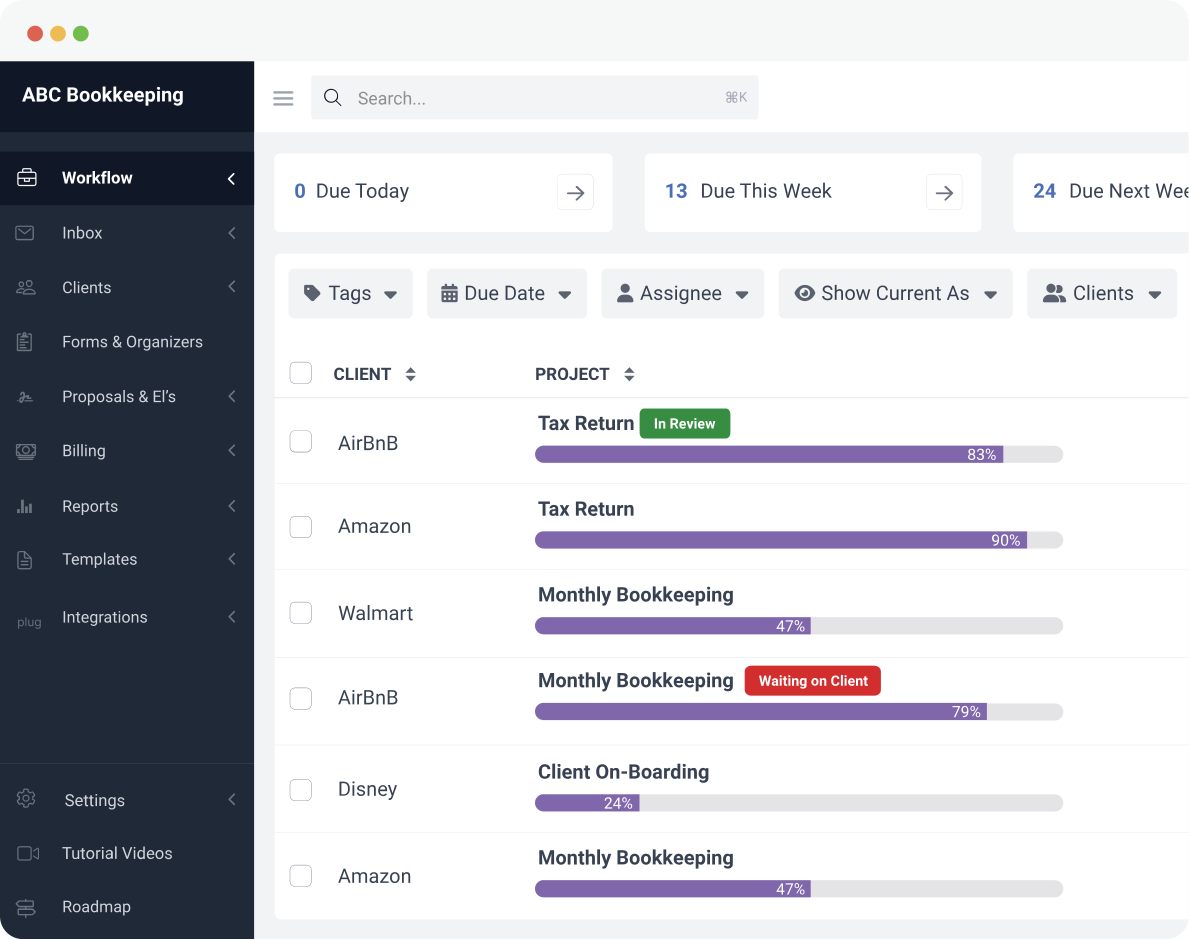
Per our 2025 Workflow & Automation Report, the most sought-after workflow features are a centralized dashboard (73.9%), client reminders (69.3%), and a client portal (60.6%). All available in one platform.
Angela Main Roberts, CEO of Main Accounting Services, switched after struggling to track time vs. monthly fees in Asana:
For Michael McMullin at JTC CPAs, the win was reclaiming partner time:
Conclusion
Efficiency in your firm isn’t abstract. It’s measurable, and the leaks are predictable. Realization, utilization, turnaround, and revenue per employee give you a clear read on where your firm actually stands. And almost every firm leaks in the same five places: chasing clients for documents, recreating recurring work by hand, flying blind on team capacity, hopping between disconnected tools, and running on undocumented processes. The good news is you don’t have to fix all of it at once. Pick one bottleneck. Apply the right tool. The rest gets easier from there.
Try Financial Cents free for 14 days. See your firm’s bottlenecks in one dashboard and start moving more work, more efficiently.