
You’ve spent years building your accounting practice. But here’s a question most firm owners avoid until it’s almost too late: how are you going to exit?
Selling an accounting practice is one of the most significant financial and emotional decisions you’ll ever make, yet few owners plan for it with the same intentionality they brought to building it. The result is often a rushed sale, an undervalued firm, and a transition that leaves clients and staff uncertain.
It doesn’t have to go that way. With the right preparation, strategic timing, and a clear roadmap, you can maximize your firm’s value and exit on your own terms.
This guide walks you through every stage, from preparation to post-sale transition, with a free checklist to keep you on track. If you’re on the other side of the deal, see our guide to buying an accounting practice.
TL;DR
- The best time to sell is when you choose to, not when you’re forced to. Common triggers are retirement, burnout, market opportunity, a growth plateau, and health or unexpected circumstances.
- Start early: owners within five to ten years of stepping back have time to raise their firm’s value before going to market.
- The 14-step process: plan your exit, prepare the firm, evaluate value, organize client information, prepare staff and operations, get legal and compliance ready, improve marketability, build a seller’s package, find and vet buyers, negotiate the LOI, complete due diligence, sign the purchase agreement, execute the transition, and wrap up.
- What buyers pay for: recurring revenue, low owner dependency, documented workflows, centralized client information, clear task ownership, and a stable team.
- Biggest mistakes: preparing too late, overvaluing the firm, undocumented processes, poor client communication, ignoring staff retention, choosing on price alone, and disengaging after closing.
When Is the Right Time to Sell Your Accounting Practice?
There’s no universal answer, but the worst time to sell is when you’re forced to. The best exits are planned, not reactive. These are the most common reasons firm owners decide it’s time.
1. Retirement planning
For most firm owners, a practice sale is the retirement plan. Unlike a salaried employee with a 401(k), your wealth is tied up in the business you’ve built. If you’re within five to ten years of stepping back, now is the time to plan how you’ll convert that asset into retirement income. Starting early gives you room to increase your firm’s value before you go to market, rather than selling at whatever the practice is worth today.
2. Burnout or lifestyle changes
Running an accounting firm is demanding. Tax seasons stack up, client expectations grow, and at some point the grind outweighs the reward. If you feel that shift, you’re not alone, and it’s a legitimate reason to sell. The key is to act before burnout shows up in your numbers: buyers pay for healthy, well-run practices, and a firm neglected because the owner checked out is a harder sell.
3. Market opportunity
Private equity-backed consolidators are actively acquiring accounting practices, which has increased competition for quality firms. If your firm is in good shape, current market conditions may be a window worth taking seriously. Timing a sale to favorable conditions, rather than waiting for a personal trigger, can meaningfully affect what you walk away with.
4. Growth plateau
Sometimes a practice reaches a ceiling its current owner can’t push through, whether because of capacity, geography, service mix, or capital. If your firm has strong fundamentals but limited runway under your leadership, a strategic buyer may be positioned to take it further. For some owners, that’s a reason to explore other growth strategies; for others, it’s the signal to sell to someone with the resources to grow what you’ve built.
5. Health or unexpected circumstances
Illness, a family situation, or a sudden change in circumstances can force the conversation before you’re ready. That’s why preparing early matters, even if you have no intention of selling soon. A practice that’s well documented, properly staffed, and operationally sound is far easier to sell under pressure than one that runs entirely on the owner’s knowledge and relationships.
What Are the Steps to Selling an Accounting Practice?
Selling an accounting practice takes 14 steps across preparation, valuation, buyer selection, deal-making, and transition. Each stage has its own tasks that can make or break your outcome.
1. Plan your exit
Before anything else, get clear on your goals. What does a successful sale look like for you? How involved do you want to be after the sale? What’s your ideal timeline? What’s the minimum number you’d accept? These answers determine the type of buyer you target, the deal structure you’ll accept, and how aggressively you need to prepare.
A full sale is the cleanest break, but it’s not the only option. Some owners prefer a partial sale or buy-in, while others consider a merger that lets them step back gradually. Each path attracts a different type of buyer and requires a different approach.
Define your deal-breakers upfront, too. If staff layoffs, client service changes, or relocation are non-starters for you, document that before you start any buyer conversations.
2. Prepare your firm for sale
Think of this as getting your house ready before listing it: make your practice as attractive and easy to evaluate as possible. Clean up your financials, document your processes, address operational gaps, and reduce owner dependency wherever you can.
Take stock of your service mix, too. Know what percentage of your revenue comes from tax, bookkeeping, payroll, and advisory services. Buyers evaluate this early because it shapes how they’ll integrate your firm, and a practice with strong advisory services is often viewed more favorably than one that’s heavily compliance-dependent.
Also assess your firm’s reputation and marketing presence. Check your online reviews, consider your referral volume, and be honest about how your firm is perceived in your local market. Buyers will do this research anyway, and knowing where you stand lets you close gaps before they become negotiating points.
3. Evaluate firm value
Understanding what your practice is worth means looking at your financials and your client base together.
Start by pulling your gross revenue, net income, and profit margins for the last three years, and go deeper than the top-line numbers in your reporting. Buyers will want to see your realization and utilization rates, your recurring versus one-time revenue split, and your normalized earnings or seller’s discretionary earnings, which strip out owner-specific expenses to show what the business actually generates.
Research comparable sales in your region to understand where your firm sits in the local market. Going in blind on price is one of the most common mistakes sellers make.
4. Organize client information
Build a detailed client list with revenue broken down by client. Identify the high-value relationships that will matter most to a buyer, and flag clients who may be at risk of leaving during a transition.
Document client contact information, service history, preferences, and cross-selling opportunities in your current base. Workflow software for accounting firms makes it much easier to pull this together in a format buyers can actually evaluate.
5. Prepare staff and operations
Create an organizational chart that maps roles and responsibilities, and update employment agreements while you’re at it, since outdated or informal arrangements complicate due diligence. Document staff productivity and utilization metrics too, because buyers will want to see how efficiently your team operates.
Identify key staff and think honestly about retention: will they stay after the sale? Some sellers include stay bonuses in the deal structure to give buyers confidence that critical people won’t leave.
Operationally, document your workflows. If your accounting workflow management process exists only in people’s heads, write it down, so a buyer can understand how work moves through your firm without asking you for every detail. Finally, verify that your payroll, HR records, and benefits information are accurate and current.
6. Get legal and compliance ready
This stage makes sure everything is in order before a buyer starts asking questions. Start with compliance fundamentals: confirm that your CPA licensing is current and in good standing, and verify your IRS e-file compliance status.
Review your entity documentation and operating agreements, particularly if your practice is a partnership, and address any provisions that affect a sale before you’re in active negotiations. Surface any existing legal or financial liabilities upfront.
On insurance, review your errors and omissions (E&O) coverage and claims history, not just whether the policy is active. Gather your vendor contracts, lease agreements, loan documents, and software license agreements, including renewal dates, and check each for change-of-ownership clauses that could complicate a transfer.
7. Improve practice marketability
Make your firm as attractive as possible before buyer conversations start. Some fixes are quick; others take time, which is why starting early matters.
Address profitability issues and resolve overdue work in progress and old accounts receivable, which buyers read as signs of poor financial discipline. Reduce owner dependency in client relationships: the more clients are tied to your firm rather than to you personally, the less transition risk a buyer has to price in.
Update your branding, website, and marketing materials. It sounds superficial, but a firm that looks professionally run signals that the business has been well managed. Improve your client communication templates and strengthen your internal documentation and controls; together, these details show a firm that operates with consistency and care.
Want a structured approach? Take the free 5-day email course Build a Buyer-Ready Practice with Adam Shay.
8. Create your seller’s information package
Your seller’s information package, sometimes called a confidential information memorandum, is the document you share with serious buyers. It needs to be thorough, well organized, and professional. At a minimum, include an executive summary of your firm, a three-year financial summary, and your asking price with valuation rationale.
Add a team overview of your staff structure, a client demographic analysis that goes beyond a simple list, and a breakdown of your accounting tech stack so buyers understand the tools the firm runs on. Include your workflow and process documentation, lease details, and a draft transition plan that shows how a handover would work. This document sets the tone for how buyers perceive you as a seller.
9. Find and vet buyers
Decide whether you’ll use a broker or pursue a private sale. Both are viable; the right choice depends on how much of the process you want to manage yourself and how broad a buyer pool you need.
Your options include existing partners, internal succession candidates, CPA firm networks, practice brokers, industry marketplaces, and strategic acquirers. Each channel attracts a different type of buyer, so match it to the exit you want.
Have prospects sign an NDA before you share sensitive information. Then review each buyer’s financial capability to confirm they can close, validate their CPA licensing and experience, evaluate cultural fit, and understand their long-term goals for the practice. The right buyer isn’t always the highest bidder.
10. Negotiate the letter of intent (LOI)
A letter of intent outlines the basic terms of the deal before formal agreements. Agree on your purchase price or range and a payment structure, whether cash, seller financing, an earnout, or a hybrid. Define the length of the transition period, establish non-compete and non-solicit clauses, and clarify exactly which assets and liabilities transfer.
11. Complete final due diligence
At this stage, the buyer will verify everything you’ve represented about your practice. Be ready to provide detailed financial records with full backup for revenue and expenses, sample client files, staff performance summaries, a software access overview, lease and vendor agreements, legal compliance confirmations, E&O insurance confirmations, and your entity’s tax filings. The more organized you are, the faster this stage moves.
12. Execute the purchase agreement
Once due diligence is complete, formalize the deal. Sign the final purchase and sale agreement, confirm the payment schedule and escrow arrangements, and complete required licensing and registration updates. Finalize staff transition agreements, coordinate with your attorneys and accountants, and update your insurance policies.
13. Execute the transition
Notify your staff first, then your clients. Introduce the buyer to your top clients personally and give the buyer training and system access so they can hit the ground running. Complete data migration, oversee the workflow and engagement handoff, and support the buyer through the transition period. Your involvement here directly affects how smoothly clients transfer and how well the practice holds together under new ownership.
14. Wrap up after the sale
Once the transition is complete, tie up loose ends. Finalize the payout of outstanding accounts receivable and monitor any seller financing or earnout arrangements. Update your personal licensing status and remove your access from all firm systems. Transfer ownership of the domain, website, and email accounts to the buyer, then hold a final meeting to formally close out the process and confirm everything has been handed over as agreed.
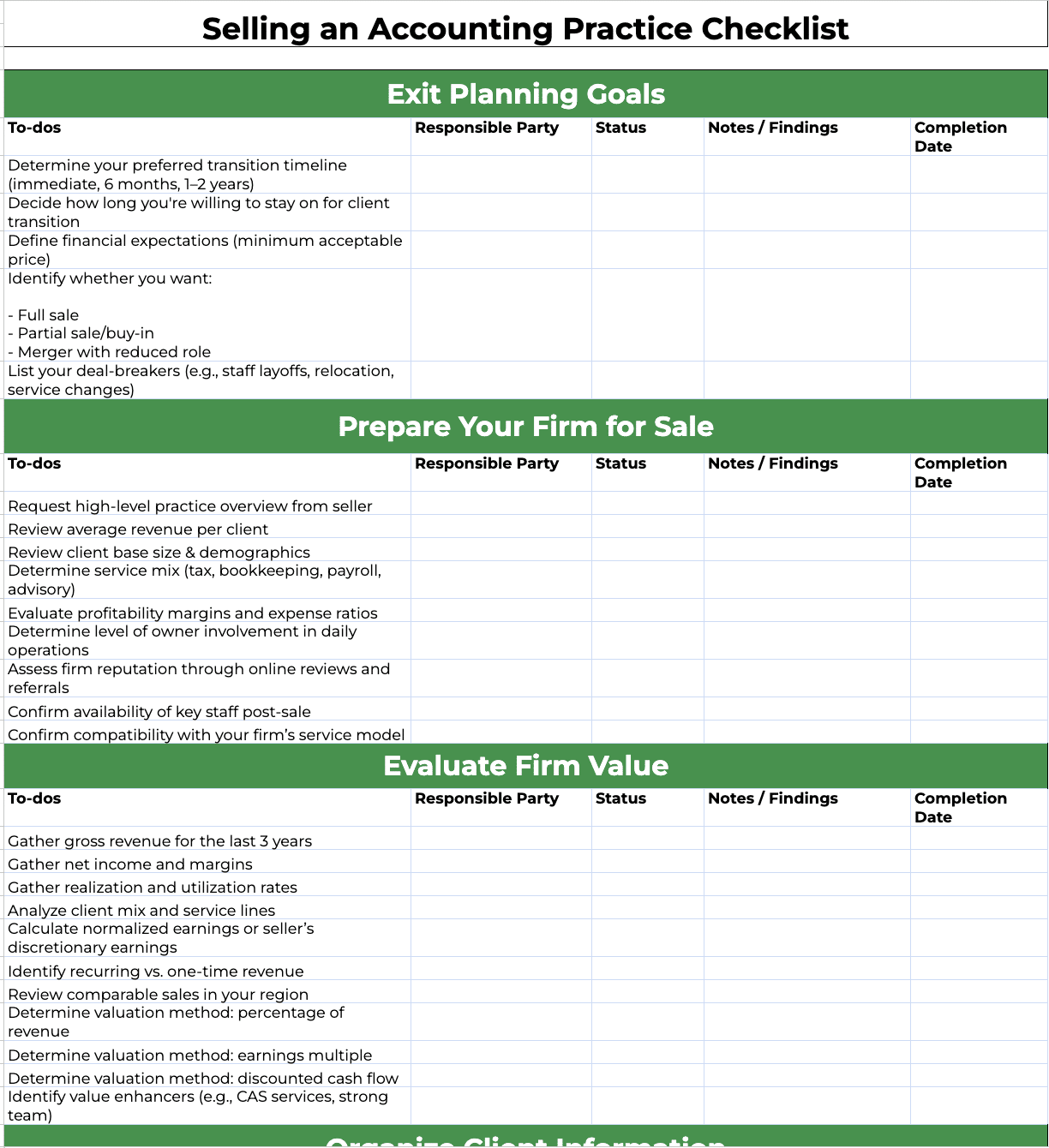
Free Checklist Template for Selling an Accounting Practice
Every stage in this guide maps to a set of tasks to complete before, during, and after your sale. To make tracking easier, we’ve put together a free checklist template you can use from day one.
What Are the Most Common Mistakes When Selling an Accounting Practice?
The most common mistakes are waiting too long to prepare, overvaluing the firm, failing to document processes, communicating poorly with clients, ignoring staff retention, choosing a buyer on price alone, and failing to plan the transition.
- Waiting too long to prepare: By the time most owners are ready to sell, there’s no time left to close valuation gaps or clean up operations. The earlier you start, the more options you have.
- Overvaluing the firm: Emotional attachment is understandable, but buyers look at the numbers. Pricing above what your financials justify shrinks your buyer pool and stalls deals, so get an independent valuation first.
- Failing to document processes: If your operations live in your head, buyers will price that risk into their offer. Documented workflows show the practice can function without you.
- Poor client communication: Clients who hear about a sale from someone other than you lose trust fast. Plan your client communication strategy early and control the narrative.
- Ignoring staff retention: If key staff leave before or during the transition, it raises red flags and can affect your earnout payout. Have honest conversations early and consider retention incentives.
- Choosing a buyer solely on price: The highest offer isn’t always the best deal. Weigh financial capability, operational fit, and culture alongside the number.
- Failing to plan the transition: Disengaging too quickly after closing is one of the fastest ways to lose clients. Honor your transition timeline and stay engaged.
How Do Strong Systems Increase the Value of Your Practice?
Strong systems increase your practice’s value because buyers are assessing risk, and documented workflows, centralized client information, standardized delivery, clear ownership, and operational transparency prove the firm will hold together after you leave.
- Documented workflows: When processes are written down and consistently followed, the business can be handed off without falling apart. Firms that invest in accounting practice management software before going to market move through due diligence faster, with fewer surprises.
- Centralized client information: Disorganized client data is a transition risk in a buyer’s eyes, while a centralized system that shows every client relationship tells a very different story.
- Standardized service delivery: Consistency reduces dependency on specific people and makes the firm easier to scale. Buyers know what they’re getting, and that certainty has real value.
- Clear task ownership: Buyers want defined roles and clear accountability. If answering “who owns what” requires a conversation with you, that’s a risk buyers will price in.
- Operational transparency: Real-time visibility into what your team is working on reduces the unknown, and buyers pay more for firms that leave less to the imagination.
Financial Cents practice management software is built to help you create exactly these systems. Getting your practice onto a solid platform before you go to market is one of the highest-return investments you can make.
Start Preparing Your Exit Now
The firm owners who exit well are the ones who started preparing long before they were ready to sell. They documented their processes, organized their client data, and built a practice that could stand on its own. When the time came, they had options. The ones who struggled waited too long and had to accept whatever was on the table.
Use the checklist in this guide as your starting point. Work through each stage, close the gaps, and give yourself enough runway to make meaningful improvements before you go to market. The work you do now directly shapes what you walk away with later.
Financial Cents is all-in-one accounting practice management software that centralizes client information, standardizes workflows, clarifies task ownership, and gives you real-time visibility across your firm: everything a buyer wants to see, and everything you need to manage your practice in the meantime.
Use Financial Cents to manage your accounting firm. Start a free trial or book a free demo.
Frequently Asked Questions (FAQs)

The Financial Cents Editorial Team creates practical guides, templates, and resources for accounting, bookkeeping, and tax firms, drawing on our in-house experts and the firm owners we work with.
Share this article