
Not long ago, a firm owner sat down with us and ran through some quick math.
She has around 100 clients, and her team devotes a healthy chunk of time each month to chasing down the same old things: uncategorized transactions, missing receipts, and other items needed from clients before the books can close. (Sound familiar?)
Prior to this conversation, she’d never really put a number on it. It was simply “part of the process”—something her firm had dealt with for so long that she didn’t really think about it as a cost. But when we attached a dollar amount to all that month-end admin time, it was hard not to see the impact it was having on her bottom line.
At Financial Cents, customers who use our Month-End Close feature save an average of two hours per client, per month. Based on that average, here’s the estimated financial impact of our solution in this particular firm:
- 100 clients × 2 hours/month = 200 hours, every month, going to administrative chase-work.
- At the team’s billing rate of around $70/hour, that’s $14,000 a month.
- Annualized, that comes to 2,400 hours, or roughly $168,000 a year in potential billable time being spent on admin work.
And for some firms, the consequences don’t stop there. Some might bring on additional staff so they can keep up with the administrative backlog, which can quickly get expensive. And then there’s the drag on team morale when everyone has to repeat the same slog every. Single. Month. 😩
Month-End Close Cost Calculator: Run Your Own Numbers
As we mentioned above, across the firms we work with, automating the routine pieces of month-end close frees up about two hours per client, per month. So, if you want to run your own numbers, the formula looks like this:
(Your Number of Clients × 2 Hours) × Your Hourly Billing Rate = Potential Revenue Reclaimed Each Month
What is your manual month-end close costing you?
Most firms treat the close as overhead. It is really billable capacity you are giving away every month. Enter your numbers and see the trade-off.
Billable capacity you reclaim every month
$14,000
That is $168,000 a year, or 2,400 hours.
Month-End Close costs $500/mo for this firm. Every $1 spent returns $28 in capacity.
Month-End Close in Financial Cents is $5 per client, per month. ROI = reclaimed billable capacity divided by annual cost.
Multiply that revenue number by 12 for the annual figure.
To put it into context for smaller firms, let’s run through another specific example. Say you have 30 clients at the same $70 rate. That means a manual month-end close process is costing you about 60 hours a month. That’s $4,200 monthly, or about $50,000 a year in added capacity for billable services—still a substantial amount by most standards.
Where Those Hours Actually Go
Most month-end close processes go something like this:
- Export the uncategorized transactions out of QuickBooks into a spreadsheet.
- Email the spreadsheet to the client.
- Wait.
- Follow up.
- Wait some more.
- Send a text because they didn’t see the email.
- Get the file back, half-answered.
- Enter the answers into QuickBooks.
- Realize three transactions are still missing receipts.
- Start over on those.
In other words, you’re stuck in a neverending game of spreadsheet ping-pong. It’s not the most difficult work, but it is tedious, repetitive, and frustrating—because you can’t finalize anything until the answers come back.
Then there’s the 1099 problem, which is a whole other headache. Everyone always intends to track 1099-eligible vendors throughout the year as part of the month-end close process, but in reality, almost nobody does. And all those good intentions won’t help you come January, when you’re scrambling to collect missing W-9s and figure out which vendors need 1099s—all against the backdrop of a hard IRS deadline.
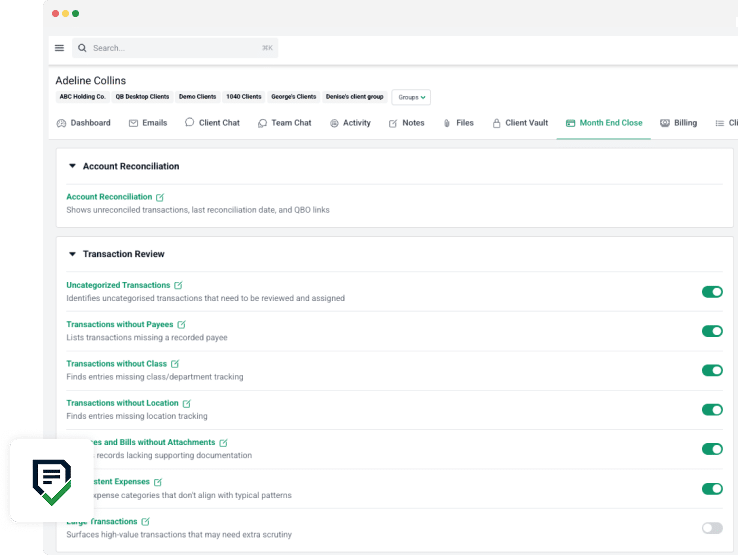
And, of course, there are transactions without payees, class, or location; expenses and bills without attachments; and large transactions. Manually flagging and resolving—not to mention reviewing and confirming—all of those eats up even more time and seriously jeopardizes quality assurance.
These are exactly the kinds of problems your accounting firm practice management software should be solving—so your team can focus more of their time and energy on the work that actually makes your firm money.
Other Free Tools
Free Accounting Business Name Generator
Free Bookkeeping Services Pricing Calculator
What Changes When You Automate Month-End Close
This is the gap Month-End Close Software was built to fill. Instead of disrupting your existing workflow, it simply automates the most tedious parts of the process. That means:
Less manual work, faster client requests.
Rather than typing out every missing detail by hand, your team just codes a transaction to a designated account, and the request routes to the client automatically via their secure accounting portal.
1099 prep becomes a year-round habit rather than an annual scramble.
A single dashboard shows which vendors are flagged, which W-9s are in hand, who needs a reminder, and what’s still outstanding—with reminders going out on a set schedule automatically. By the time January arrives, everything’s up to date and ready to go.
Review you can actually verify.
For firms running a two-tier preparer-and-reviewer structure, reporting in Month-End Close gives reviewers one organized place to confirm the work is done and accurate.
The Difference Your Clients Will Notice
Greater efficiency on your side is only half the story. The client experience also gets noticeably better with Month-End Close in Financial Cents—which, not coincidentally, is part of what gets clients to respond to your requests faster.
Instead of being pinged about individual transactions at random, clients get their outstanding items batched together on a set schedule. They simply click into their portal and provide all the needed responses in one intuitive hub. And once they answer a question, it disappears from their list, rather than piling up into a convoluted backlog.
For clients who own multiple entities, everything lives on one screen instead of behind a maze of separate logins—part of a broader “one portal for everything” philosophy that firms and their clients both gravitate toward.
Even the holdouts tend to come around once they’ve experienced the Financial Cents difference.
In fact, after wrapping up his first month-end close with Financial Cents, one firm’s newest client extended some unprompted positive feedback.
The Real Payoff: Increased Capacity (Not Just Time Saved)
Circling back to where we started, the real reason the hours lost to month-end admin matter isn’t the hours themselves—it’s what they cost you in capacity. The firm owner from our opening conversation was less worried about being busy than she was about being able to hire fast enough to continue growing. With qualified bookkeepers and accountants still in short supply, it’s a squeeze pretty much every growing firm will feel at some point.
Reclaiming those precious hours through smart tech solutions empowers you to take on more clients without additional headcount, because the work that was eating your team’s time is now handled automatically.
And increased capacity doesn’t always have to mean more clients served—it could also mean more breathing room for existing team members. One firm we work with intentionally built itself around a flexible, family-first culture—and the time Financial Cents gives back to staff members is part of what makes that possible.
The Bottom Line
A manual month-end close process carries a cost that many firms never put a number on—and when they finally do, it’s often well into the five or six figures in annual billable capacity drained by tedious admin work.
Automating it doesn’t require you to reinvent your entire process. It just removes some of the most frustrating pieces (e.g., the spreadsheet exports, follow-up emails, year-end 1099 panic, and ambiguous review). With Month-End Close in Financial Cents coming in at only $5 a month per client, the cost of fixing the problem is a fraction of the billable capacity it gives back.
For that 100-client firm, the cost of Month-End Close comes to $500 a month—$6,000 a year—set against roughly $168,000 in reclaimed billable capacity. That’s a 28x total return on investment (ROI). But even if you only convert a fraction of those freed-up hours into actual billed work or new clients, the return still dwarfs the cost many times over.
If chasing receipts and chasing clients is draining your team’s time and morale, it’s worth running your own numbers—and then seeing what it would take to win that time back.
Share this article: