Some bookkeepers and accounting firm owners have a version of their week that looks like this: rebuilding the same recurring tasks from last month, chasing clients for bank statements they promised last week, copying data between platforms, and firing off follow-up emails one by one. None of this is difficult. But it’s relentless. And every hour it takes is an hour you don’t get back.
Our 2025 State of Accounting Workflow Automation Report confirms it. 55.5% of accounting firms ranked workflow inefficiencies as their number one challenge. And before adopting automation, 53.8% were spending more than five hours per week just scheduling and assigning work.
That’s time that could go toward advisory, client relationships, or simply running a tighter operation. Bookkeeping automation is about clearing the busywork so you can focus on the work that actually moves your firm forward.
This guide breaks down the bookkeeping automation examples that deliver real-time savings, what to prioritize first, and how firms are putting these into practice today.
Key Takeaways
- Bookkeeping automation covers two layers: transaction automation (bank feeds, categorization, reconciliation) and firm workflow automation (recurring tasks, client reminders, document collection, deadline tracking). You need both.
- The highest-ROI examples are recurring workflow templates, automated client document requests, bank feed rules, and invoice processing.
- Before automation, 53.8% of firms spent over five hours per week scheduling and assigning work. After, 75.8% reduced that to five hours or less.
- QuickBooks and Xero automate the ledger. Financial Cents automates the firm side: tasks, deadlines, reminders, and team coordination.
- Start with what’s high-volume, low-judgment, and repeat on a predictable schedule. Leave exception handling and advisory conversations manual.
What Is Bookkeeping Automation?
Bookkeeping automation is the use of software to handle repetitive, rules-based tasks that would otherwise eat into your week manually. Think transaction entry, categorization, client follow-ups, task scheduling, and document collection. This is essentially work that has to happen, but doesn’t require your judgment every single time.
What most bookkeepers get wrong about automation is that they treat it as a simple layer, but there are actually two layers.
The first is transaction automation, which is what happens inside the ledger. Bank feeds pulling in data, rules auto-categorizing recurring vendor charges, software matching transactions for reconciliation.
The second layer is firm workflow automation, which is what happens inside your practice. Automatically generating recurring client work each month, sending document requests without manual follow-up, tracking deadlines across your entire client base, and assigning tasks to your team without a spreadsheet.
This is the layer that bookkeeping practice management software like Financial Cents handles. And it’s the layer that can speed up your workflow processes without additional manual effort. Automating the ledger without automating how your firm operates only solves half the problem, which is why this guide covers both.
Get a clear picture of how bookkeeping firms are managing their tech—and where inefficiencies are holding them back.
Read the full report
Why Bookkeeping Automation Matters for Accounting Firms
Manual work costs you more than time. It costs you accuracy, because errors slip through when you’re juggling too many repetitive tasks at once. It costs you deadlines, because nothing is tracking them except your memory. And it costs you growth, because when every client engagement requires you to manually create tasks, assign work, send reminders, and track progress, your capacity has a hard ceiling. You can’t take on more clients without hiring more people or burning out the team you have.
The biggest drain is document collection. Our 2025 Workflow & Automation Report found that getting documents from clients is now the number one workflow issue for accounting firms, ahead of manual administrative tasks. Firms that have automated this step now receive client documents within 1 to 3 days (60.7%, to be specific).
Arta, an admin assistant at Controller4Hire, saw this firsthand. Her firm sets up automated reminders in Financial Cents for recurring clients so that document requests go out on a set date every month.
“If it’s a recurring thing, the documents will magically appear every month when you’re ready to start your work. You don’t even have to think about it anymore,” she said.
That’s an example of the real case for automation. Not that it replaces what you do, but that it removes the operational drag that prevents you from doing more of it.
10 Bookkeeping Automation Examples That Save Time
1. Bank Feed and Automatic Transaction Import
Instead of manually entering every transaction from a bank statement, you connect your client’s bank account to your accounting software and let transactions flow in automatically. QuickBooks Online, Xero, and most modern accounting software platforms support this out of the box.
The real leverage comes from setting up bank rules for recurring vendors. If your client pays the same supplier every month, you create a rule that auto-categorizes that transaction the moment it comes in. For high-volume clients, this alone can eliminate 40 to 70% of manual entries.
2. Automated Transaction Categorization
Beyond basic bank rules, accounting platforms are getting smarter at learning your patterns over time. QuickBooks Online and Xero use AI-assisted categorization that suggests accounts based on how you’ve coded similar transactions before. The more consistent your coding, the more accurate the suggestions become. Third-party tools like Dext add another layer by extracting data from receipts and bills and routing them into the right accounts automatically.
Remember, this isn’t a set-and-forget system. Automated categorization handles the routine, but exceptions still need a human eye, your eye. Which is worth a month-end close software can be useful for. The goal is to reduce the volume of manual decisions, not eliminate review altogether.
3. Bank Reconciliation
Matching bank transactions to ledger entries used to be one of the most time-consuming parts of monthly bookkeeping. Now, accounting software handles most of the matching automatically. QuickBooks Online and Xero compare incoming bank data against your existing records and suggest matches, so the process becomes less about finding the right entries and more about confirming them.
4. Invoice Processing and Accounts Payable
Manually keying invoice data from paper or PDF documents into your accounting software is slow and error-prone. Tools like Dext, HubDoc, and Bill.com use OCR (optical character recognition) to scan invoices, extract key data like vendor name, amount, date, and line items, and push it directly into QuickBooks Online or Xero.
For firms managing accounts payable on behalf of clients, this cuts out the most tedious step in the process. Instead of opening each invoice, reading it, and typing the details into your software, the data is captured and categorized before you even touch it. Your job becomes reviewing and approving, not entering.
5. Recurring Workflow Templates
This is where automation shifts from the ledger to the firm, and for bookkeeping practice owners, it’s arguably the highest-ROI example on this list.
If you’re doing monthly bookkeeping for 30 clients, that’s 30 sets of tasks you need to create, assign, and track every single month. Most firms handle this with accounting spreadsheets, calendar reminders, or memory. None of those scale. And every month you spend recreating the same work is a month you could have spent on something that actually grows the firm.
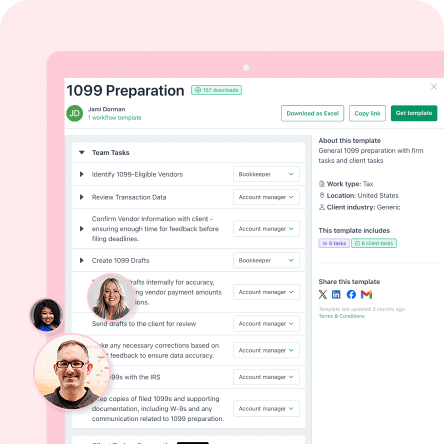
With recurring workflow templates in Financial Cents, you build the workflow once, every task, subtask, assignee, and due date, and it auto-generates at the right time each month, quarter, or year. When the project recurs, the tasks are already assigned and the client document requests are already sent.
It’s why firms that adopt this kind of automation see such a sharp drop in admin time. Before automation, 53.8% of firms were spending more than five hours per week just scheduling and assigning work. After, 75.8% reduced that to five hours or less (Workflow & Automation Report).
6. Automated Client Document Requests and Reminders
Document collection is a top workflow issue for accounting firms, as mentioned earlier. And every firm knows why. You email a client asking for bank statements, hear nothing, follow up, hear nothing again, call, get a promise, and repeat. Multiply that across your entire client base, and you’ve lost a significant chunk of your week to chasing.
Financial Cents automates this loop. You set up a document request, attach it to the relevant project, and the system sends reminders via email and text on your behalf until the client uploads through Financial Cents client portal. The client clicks a link, uploads their documents, and the task is marked complete automatically.
60.7% of firms that automated this step now receive client documents within one to three days. If you want to see how this works in practice, here’s how firms get documents from clients faster.
7. Automated Client Communication and Email Reminders
Document requests are one type of client communication you can automate, but they’re not the only one. Deadline reminders, status updates, and follow-ups on outstanding items can all run without you manually sending each one.
The problem with handling this through regular email is that context gets lost. A reminder you sent three weeks ago lives in a thread your client forgot about, and your team has no visibility into what was said unless they were cc’d.
Financial Cents keeps all communication tied to the relevant project. Clients can comment directly on specific tasks from their client portal, your team can reply from within the project, and everyone can see where things stand without digging through inboxes.
Nayo Carter-Gray, EA and founder of 1st Step Accounting, saw the impact of this firsthand. She set up automated reminders in Financial Cents to follow up with clients every few days until they completed their document tasks. “It helped me really cut down on having to have that back and forth with my clients about what we need, and when you’re going to get it to me,” she said. The result was that her firm’s average return turnaround dropped from eight weeks to three.
8. Financial Reporting Automation
Accounting software generates profit and loss, balance sheet, and cash flow reports from live data. You can also schedule those reports to send to clients on a set cadence, which removes the manual process of exporting and emailing them yourself each month.
For firms handling month-end close, Financial Cents’ Month End Close feature recently added an Account Reconciliation report that pulls every account you need to reconcile for a given client into one view. You can see who handled each reconciliation, when it was completed, and jump straight into QuickBooks Online from the report if something needs attention. It fits into your projects alongside your other Month-End Close tasks.
9. Payroll Integration and Automation
If you manage payroll for clients, platforms like Gusto, ADP, and Rippling can automatically post payroll journal entries to the general ledger after each pay run. That removes an entire manual step where you’d otherwise re-enter the same payroll data into QuickBooks Online or Xero after the fact.
Payroll runs on a predictable cycle, which makes it a strong candidate for automation. The data is the same structure every time, and the fewer times your team manually touches it, the fewer opportunities for errors or missed entries.
10. Time Tracking and Automated Billing
If your team is filling out timesheets at the end of the week from memory, the data is going to be inaccurate, and you’re going to lose billable time in the process.
Financial Cents ties time tracking directly to projects, so hours are captured as the work happens. You start a timer on a task, it logs the time to the right client and project, and you can see exactly how long each engagement took.
That tracked time feeds directly into billing. You can set hourly rates per team member, see whether a project is running over budget, and invoice clients based on actual hours worked rather than estimates.
If you are looking to explore tools for this, here are time and billing software for bookkeeping firms you can review.
The biggest shift happens when you combine both layers of automation. Transaction automation handles what happens inside the ledger. Firm workflow automation handles how your practice operates around it. That combination is what allows bookkeeping firms to take on more clients, maintain quality, and run with the consistency of a much larger team.
What to Automate First (and What to Leave Manual)
Trying to automate everything at once is a fast way to create more problems than you solve. Start with the tasks that are high-volume, low-judgment, and repeat on a predictable schedule.
Three automations deliver the fastest return:
- Bank feeds and transaction imports (easiest starting point, immediate time savings)
- Recurring workflow creation (eliminates the most repetitive piece of managing multiple clients)
- Automated client document reminders (tackles the single biggest source of wasted time)
If you want a step-by-step approach, this guide on how to set up workflow automation walks through it in four steps.
On the other side, some tasks should stay manual. Handling miscategorized transactions still requires your judgment. Complex reconciliation items need context that software can’t provide. Client communication around sensitive topics should stay human.
A good rule of thumb: if you do the same thing for more than three clients each month without thinking, it should be automated. If it requires you to pause and make a call, keep it manual for now."
Common Mistakes When Setting Up Bookkeeping Automation
Automating before systematizing: If your current process is inconsistent or undocumented, automation just makes the inconsistency happen faster. Write down your workflow first, identify which steps are the same every time, and automate those. This bookkeeping workflow guide is a good starting point.
Relying only on accounting software automation: QuickBooks and Xero automate what happens inside the ledger. But they don’t manage your team’s tasks, track which engagements are falling behind, or send document reminders on your behalf. Firms that stop at accounting software automation still end up manually managing everything else. Using a practice management software for bookkeeping firms can help you handle that.
Over-automating client communication: Automated reminders for document requests and deadlines make sense. But if every touchpoint your client receives is automated, the relationship starts to feel like it’s running on autopilot. Advisory conversations and sensitive discussions should stay human.
Skipping the review step: Automated categorization handles routine charges well. It doesn’t handle edge cases or vendors your system hasn’t seen before. A weekly review-and-confirm step catches problems before they reach the client’s financials.
Automate the Firm, Not Just the Books
The first four examples in this guide automate the ledger. Your accounting software handles those. The last six automate the firm itself, how work gets created, assigned, tracked, and communicated. That’s the layer most accounting software doesn’t touch, and it’s what Financial Cents is built for.
Financial Cents automates recurring workflow creation so monthly, quarterly, and annual engagements generate automatically with tasks, assignees, and due dates already in place. It automates client document requests with reminders that follow up until the client uploads what you need. It gives you a centralized dashboard where you can see every client’s work status without chasing your team. It tracks deadlines across your entire client base. And it connects to your other tools through Zapier for cross-platform automation.
Stelle Anderson, owner of Infinite Accounting Solutions, used to manually recreate projects every month in Trello, a process that was slow and created room for error. After switching to Financial Cents, automated client reminders became her favorite feature. After switching to Financial Cents, automated client reminders became her favorite feature. “Mine is the client task and the ability to send recurring client reminders until they grant our request instead of us having to worry about following up with clients,” she said.
If you’re ready to automate the operational side of your firm, book a free demo with one of our product specialists.
Conclusion
The firms that save the most time are automating transactions and how the firm runs. Bank feeds and categorization handle the ledger. Recurring workflows, client reminders, and deadline tracking handle the operations around it. Those two layers together are where real time savings come from.
You don’t need to automate everything at once. Pick one or two examples from this guide that address your biggest bottleneck and build from there.
When you’re ready to automate the operational side, try Financial Cents free.
Frequently Asked Questions
The use of software to handle repetitive, rules-based tasks across two layers: ledger automation (bank feeds, categorization, reconciliation) and firm workflow automation (task creation, client reminders, deadline tracking).
Bank feed imports, transaction categorization, reconciliation, invoice processing, recurring workflow creation, and client document requests.
For routine transactions with good bank rules, yes. Exceptions and one-off transactions still need human review.
Not fully. Rule-based tasks can be automated with high accuracy, but advisory work, exception handling, and client relationships still require a human.
It varies by firm. Our 2025 Report found that 53.8% of firms spent over five hours per week on scheduling and assigning work before automation. After, 75.8% reduced that to five hours or less.
Accounting software (QBO, Xero) automates the ledger. Practice management software (Financial Cents) automates the firm’s tasks, reminders, deadlines, and team coordination. You need both.
You can read this practice management guide for a comprehensive introduction.
Share this article: