You take on a new client in March for a simple project: to reconcile their accounts. You agree on a price and get to work. A few months in, the work starts to grow.
First, they hire employees, so now there’s payroll. Then they open a second bank account, and soon they’re calling you for financial advice on major decisions. Now your simple project is not so simple anymore, but you handle it all to keep them happy.
When you finally send your accounting invoice that reflects the extra work, the client pushes back. As far as they’re concerned, the price was the price. You never put the original scope in writing, so the client had no way to know where it ended, and you can’t show that the new tasks weren’t part of the agreement. Just your word against theirs.
An engagement letter prevents that. It states what you’ll do, what you won’t, what it costs, and what each side is responsible for. Done well, it protects your firm legally and sets expectations the client can’t dispute later.
This guide covers how to write one: the elements every engagement letter needs, the mistakes to avoid, and five free templates you can download and adapt to your services.
TL;DR
- An accounting engagement letter is a signed agreement that defines the work you’ll do for a client, the fees, the timeline, and what each side is responsible for.
- Send one before starting work with every new client, when the scope changes, and at the start of each year, even for ongoing clients.
- Clearly define the scope. State exactly what’s included and what’s not so there’s no confusion.
- A complete letter covers the parties, engagement period, scope, fees and payment terms, client responsibilities, confidentiality, limitation of liability, termination clause, dispute resolution, and signature lines.
- E-signatures are legally valid and get letters signed in minutes.
- This guide includes five free templates you can download: general bookkeeping, tax, audit, advisory, and full-service accounting.
What is an Accounting Engagement Letter?
An accounting engagement letter is a written agreement between your firm and a client. It defines the work you’ll do, the fees, the timeline, and what each side is responsible for. Once both parties sign, it becomes legally binding and governs the engagement.
You send a new letter for every new client before work begins, every new service or scope change for an existing client, and every new tax year.
But sending it is only the start. “Your engagement letter should not be forgotten about. It should be a living document,” says Dave Kersten, CEO & Founder of Capavario. He further shares that you should use this document as a reference point during monthly or year-end reviews to confirm the services delivered align with the agreed scope.
Why Every Accounting Firm Needs an Engagement Letter
An engagement letter is non-negotiable for every accounting firm. Here’s why:
Legal Protection
Provided all parties sign it and it contains the essential elements of a valid contract, an engagement letter is legally enforceable. It won’t stop a client from filing a professional liability claim, but it’s often a firm’s strongest defense when one comes, since it documents the scope both sides agreed to.
Scope Clarity
The letter defines exactly what you’ll deliver and what you won’t. That distinction keeps a client from assuming a service was included when you never agreed to it. When the scope is in writing, both sides know where the work ends, and any request beyond it becomes a new engagement with its own terms.
As Dawn Brolin, CPA, CFE, puts it, “An engagement letter is a great opportunity for you to set those boundaries when it comes to the scope of the work that you’re doing for your clients.”
Professional Credibility
A clear, well-organized engagement letter shows the client you run a serious firm. It sets expectations before the work starts and signals that you treat their business (and your own) with care and professionalism.
AICPA and State CPA Board Requirements
Some services require a signed engagement letter by rule. The Statements on Standards for Accounting and Review Services (SSARS), for instance, require a written agreement signed by both parties for preparation, compilation, and review work. Your state board may also add its own limits on what the letter can contain. So it’s better to have one to ensure compliance.
Payment Protection
The letter states your fees, billing schedule, payment terms, and what happens when a client pays late. If there’s a payment dispute, you have a signed record of the terms they agreed to, rather than a verbal understanding that’s hard to enforce.
Essential Elements of an Accounting Services Engagement Letter
A good engagement letter covers the same core elements, whatever the service. Here’s each one:
Identification of Parties
The first thing to do is name both parties in full. Use the firm’s legal name and the client’s legal name, not just their first name. If the client is a business, name the entity that’s actually engaging you and the person with authority to sign for it, so that if a dispute arises later, there’s no question about who agreed to what.
Effective Date and Engagement Period
State when the engagement begins and how long it runs. Some engagements cover a specific tax year or fiscal year; others run until one side ends them. Make clear which this is, so the client knows whether they’re signing for a single filing or an ongoing relationship. For recurring work, add an annual renewal clause. This keeps you from operating under outdated terms, since your fees or services may have changed.
Scope of Services
This is the most important element in the letter, and is one you should take care in drafting. List exactly what you’ll deliver, item by item. Make sure it’s clear so there’s no misunderstanding. Then state clearly what’s not included in the scope. Both the inclusions and exclusions are important because, if not explicitly stated, they can cause scope creep and fee disputes.
Fees and Payment Terms
Next, spell out your fees and payment terms. This covers what you charge, when payment is due, how you want to be paid, and what happens if a client pays late. State the payment structure too, whether that’s a flat monthly retainer, an hourly rate, or a per-project price.
This way, the client knows exactly what they owe and how you work, so a late or missing payment becomes a clear breach of agreed-upon terms you can hold them to.
Read more: How to price bookkeeping services
Client Responsibilities
Add everything you need the client to do, like the documents they must provide, when, and the information they need to share. Emphasize that timely responses to your questions and requests are important for you to finish their work on schedule.
Confidentiality and Data Privacy
Include a statement on confidentiality. Assure clients their data is safe and that you won’t share it with unauthorized persons or third parties except when the law requires it. Most accounting and tax firms fall under the FTC Safeguards Rule, which requires you to maintain a Written Information Security Plan (WISP), so note your compliance here.
Limitation of Liability
Include a limitation of liability clause. This caps how much your firm can be held responsible for if something goes wrong, which keeps a single mistake from turning into a claim that threatens the whole firm. Many firms set theirs at the total fees paid for the engagement, or a defined multiple of those fees. This is standard practice, but have your attorney review your clause before you use it.
Termination Clause
Every engagement letter needs a termination clause. This outlines how either side can end the engagement: the notice required, how to handle outstanding work and final invoices, and what happens to client records afterward. A clear termination clause ensures the exit is smooth, so the relationship ends on good enough terms.
Dispute Resolution
State how you’ll handle disagreements if they come up. Will you use mediation, arbitration, or the courts? Which state’s laws govern the engagement? Spelling this out in advance gives you a clear path to follow when you need it, instead of arguing over the process while you’re already in conflict.
Signature Lines
End the letter with signature lines. It’s important both parties sign, since an unsigned engagement letter won’t be binding. For a business client, make sure the signatory actually has the authority to bind the entity, or the agreement may not be enforceable against the business.
The signature doesn’t have to be physical either. E-signatures are just as binding under US law, and they make the whole process faster and easier.
The 5 Free Accounting Engagement Letter Templates
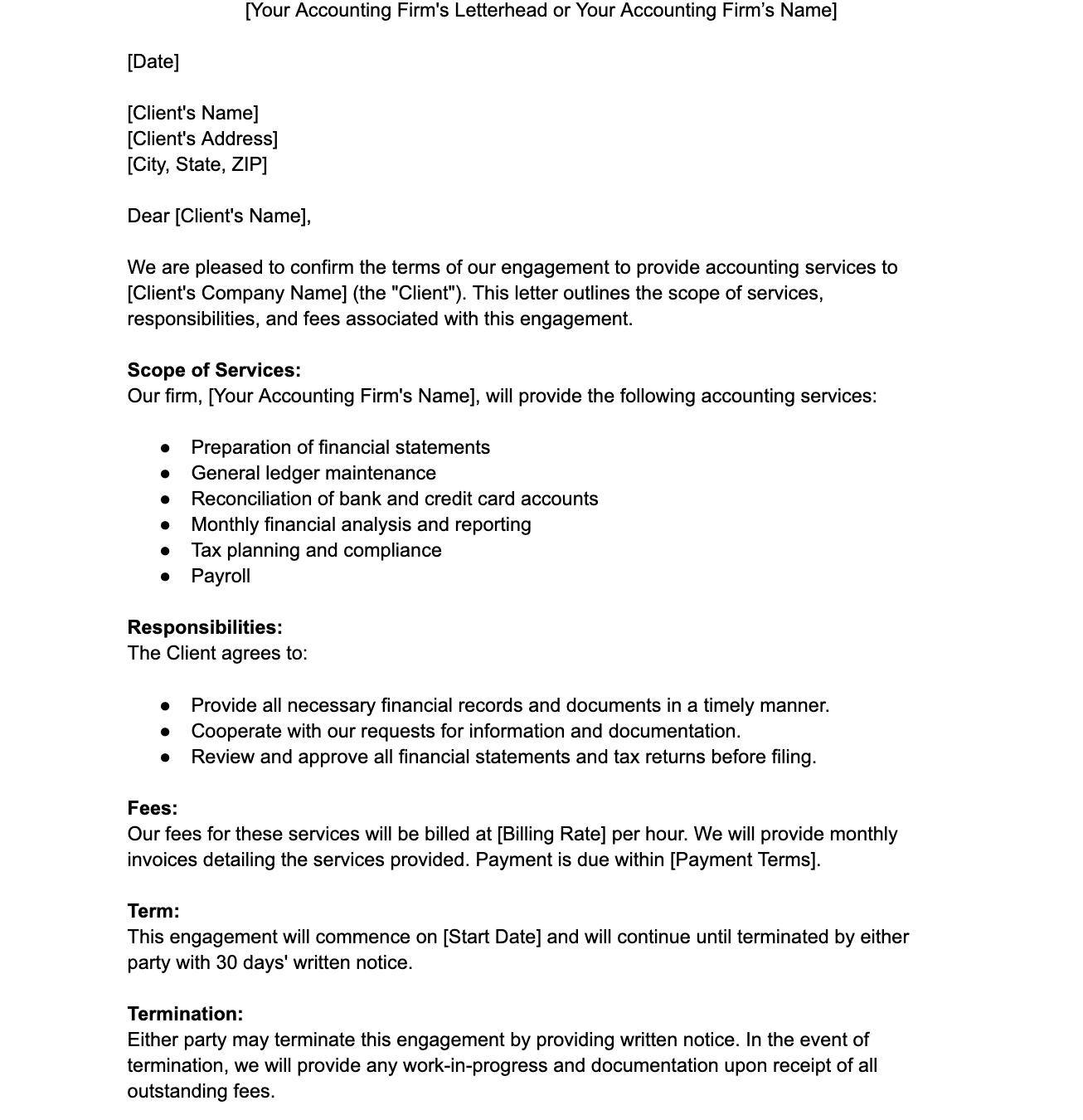
Writing a letter from scratch for every client takes time. An engagement template gives you a consistent structure to start from. You only need to tailor the scope and fees to each client, which reduces setup time by at least 50%, according to Dave Kersten, CEO & Founder of Capavario.
We’ve put together five free templates, one for each common service type. Pick the one that fits the engagement, then adjust it to your firm.
Template 1: General Bookkeeping Engagement Letter
This is a bookkeeping engagement letter for ongoing bookkeeping clients. It covers monthly reconciliation, financial statement preparation, and other bookkeeping deliverables, with no tax filing or services outside that scope. The fee structure is usually a monthly retainer that covers all the services provided.
Template 2: Tax Preparation Engagement Letter
This tax engagement letter template is for annual tax return preparation. It names the specific returns you’re preparing and the tax year they cover, sets a document submission deadline, and states your extension policy.
Template 3: Audit Engagement Letter
The audit engagement letter template references the auditing standards the work follows, like GAAS for private-company audits or PCAOB standards for public companies, outlines the auditor and management responsibilities, and states the reports you’ll deliver at the end.
Template 4: Accounting Advisory/CFO Services Engagement Letter
This letter is for ongoing advisory work, fractional accounting or CFO arrangements, or strategic financial guidance. It sets the cadence of your advisory meetings, the deliverables you’ll provide, and the fee structure.
Template 5: Full-Service/CAS Engagement Letter
Offering a bundle of services? This is the template for it. The full-service, or client accounting services (CAS), letter covers bookkeeping, payroll, tax, and advisory in one agreement, so a client buying several services from you signs one letter instead of several separate ones. It outlines each service tier and the package pricing, so everyone knows exactly what’s included and what it costs.
Bonus: Compilation Engagement Letter
This compilation engagement letter template is for firms that compile financial statements from client-provided information without expressing any assurance. It clearly states that no audit or review is being performed, specifies the applicable accounting framework, separates management’s responsibilities from the firm’s, and defines who the compiled statements are intended for. For firms following AICPA’s SSARS or CPA Canada’s CSRS 4200 standards, the letter references the applicable standard so both parties understand the nature and limitations of the service.
What to Avoid When Writing an Engagement Letter for Accounting Services
To write an effective accounting engagement letter, there are a few things to avoid.
Vague Scope Language
Don’t use vague language like “bookkeeping services as agreed” or “monthly accounting support.” It leaves room for ambiguity. Be specific instead. List the exact deliverables you’re providing, like monthly reconciliation, financial statements, and quarterly payroll filings. The clearer you are, the less room a client has to claim you promised something you didn’t.
No Revision or Correction Limit
Never leave revisions open-ended. If you don’t set a limit, a client can keep asking for changes for as long as they want, and you end up spending hours of unbillable time that cuts into your firm’s profit. State how many rounds of revisions you include per project, and what you charge for anything beyond that.
Missing the ‘Not Included’ List
A common mistake is to state what you will do, but not what you won’t. Without this distinction, the client can assume those services are included. So state the exclusions plainly, like “this engagement does not include IRS audit representation.” That can save you from disputes later on.
Forgetting to Update Annually
Don’t forget to update the letter every year. The AICPA recommends issuing a new engagement letter annually and a revised letter or addendum any time the scope changes. A letter you signed three years ago still applies three-year-old fees, scope, and terms that no longer match your work.
Client Responsibilities Left Out
If the letter covers just what you’ll do, every delay looks like your fault, even when you’re waiting on documents the client never sent. State what they must provide and by when, so they can’t blame you for delays they cause. Clear accounting communication is key here.
No Payment Consequences
Firms often hesitate to include this section. They’re afraid it’ll make them lose the client or set an adversarial tone. But done well, it does neither. Clear payment terms read as professional, the same way any business stating how it gets paid does. State what happens when an invoice goes unpaid, whether you’ll pause work or apply a late fee.
Using Legal Language That Scares Clients
Don’t write the letter in dense legal language your client struggles to read. Keep it plain and clear so they can follow and sign with confidence. Otherwise, if there’s ever a dispute that reaches court, the case will likely be ruled in the client’s favor because the letter was ambiguous.
For more, here are the dos and don’ts of accounting engagement letters.
Best Practices for Sending and Getting Signatures Faster
Send the Letter Promptly
Once you and the client agree to work together, use one of the templates we’ve provided, customize it for your firm and the client, and send the letter within a day or two. The sooner you send it, the better your chances of a fast response, while the engagement is still fresh and the client is eager to start.
Use E-signatures
You can’t always have clients in the room to sign, and these days, you don’t need to. Accounting e-signatures are fast, and they’re just as binding under US law.
Follow up if It’s Not Signed
If the client hasn’t signed after a few business days, follow up. They’ve usually just forgotten or gotten busy. Keep following up at a few days’ interval until they sign or tell you they’re no longer interested.
Store Signed Copies Centrally
Keep signed copies in a central, secure digital location everyone can access, so that if a dispute ever comes up, you can find the letter quickly.
Once your template is finalized, engagement letter software for accountants can help personalize, send, track, sign, renew, and store agreements without relying on separate manual tools.
Get Engagement Letters Signed Faster with Financial Cents
Maybe your usual process is like this: you store the letter in Google Drive, send it to the client as a PDF, then get it signed through a separate e-signature tool. That works, but it’s a lot of steps in your accounting workflow spread across separate tools. Financial Cents does all of it in one place.
You can draft your engagement letters directly in the software and store them as templates for future use, or start from one of the templates in this article. Customize one for your firm and client, send it, have them sign through the platform, and track their activities, all within Financial Cents. You move faster because you’re not toggling between tools.
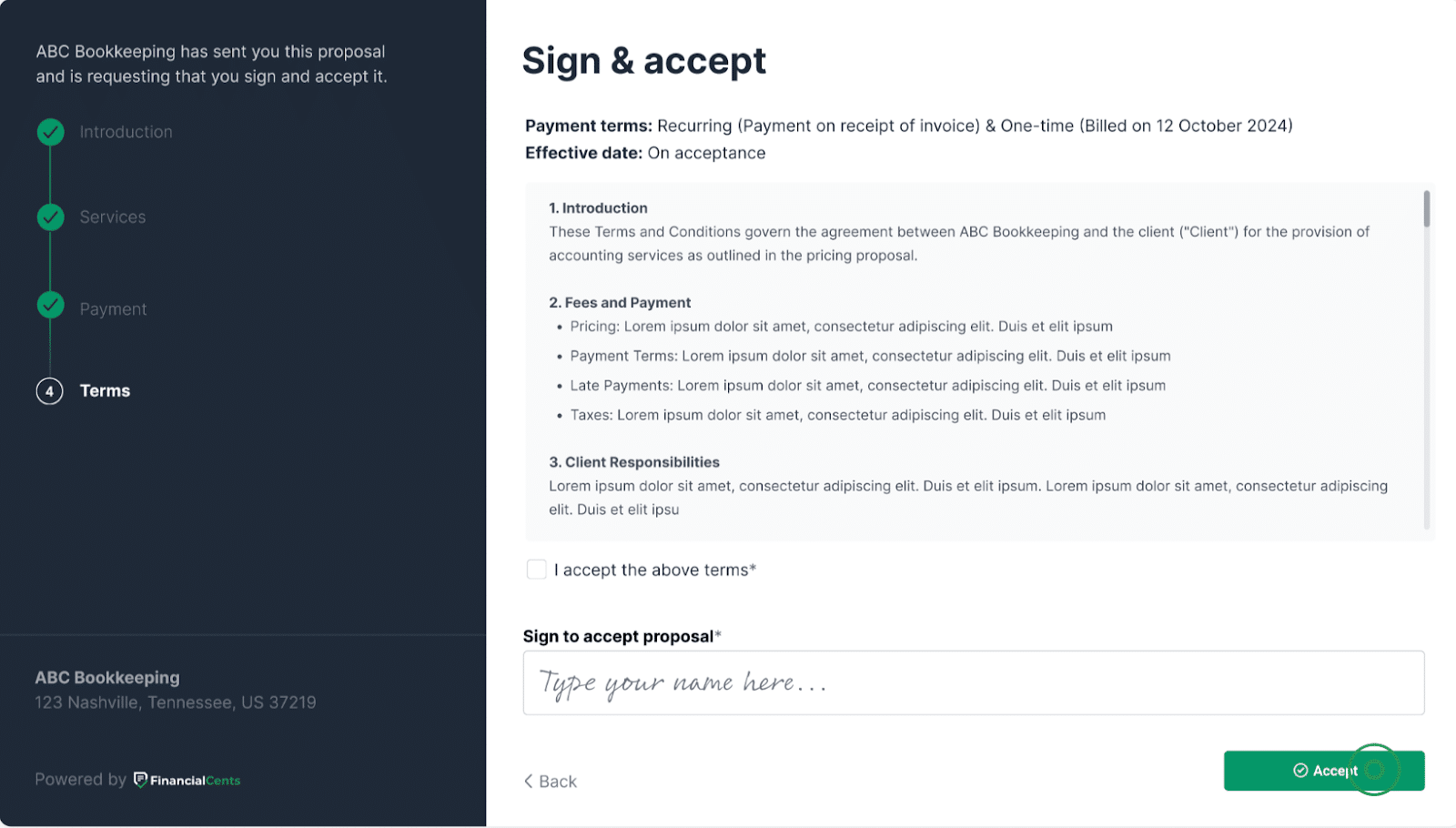
The accounting proposal tool lets you define services, scope, pricing, and billing frequency in the engagement letter, whether it’s a one-time project or a recurring monthly service.
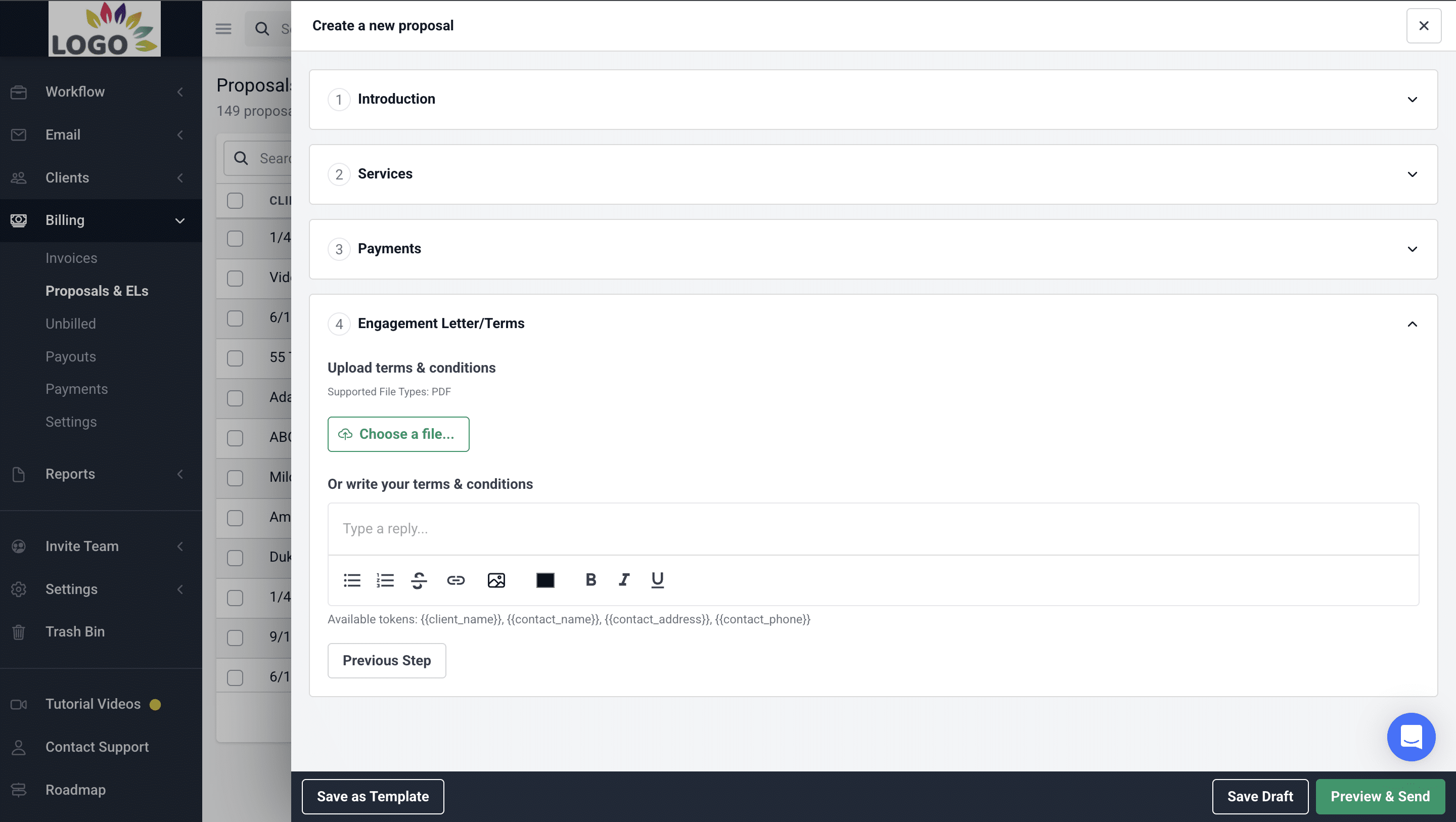
It also lets you offer tiered packages clients choose from directly in the letter, each with its own services and add-ons, which makes it easy for a client to pick the option that fits or upgrade to a higher tier.
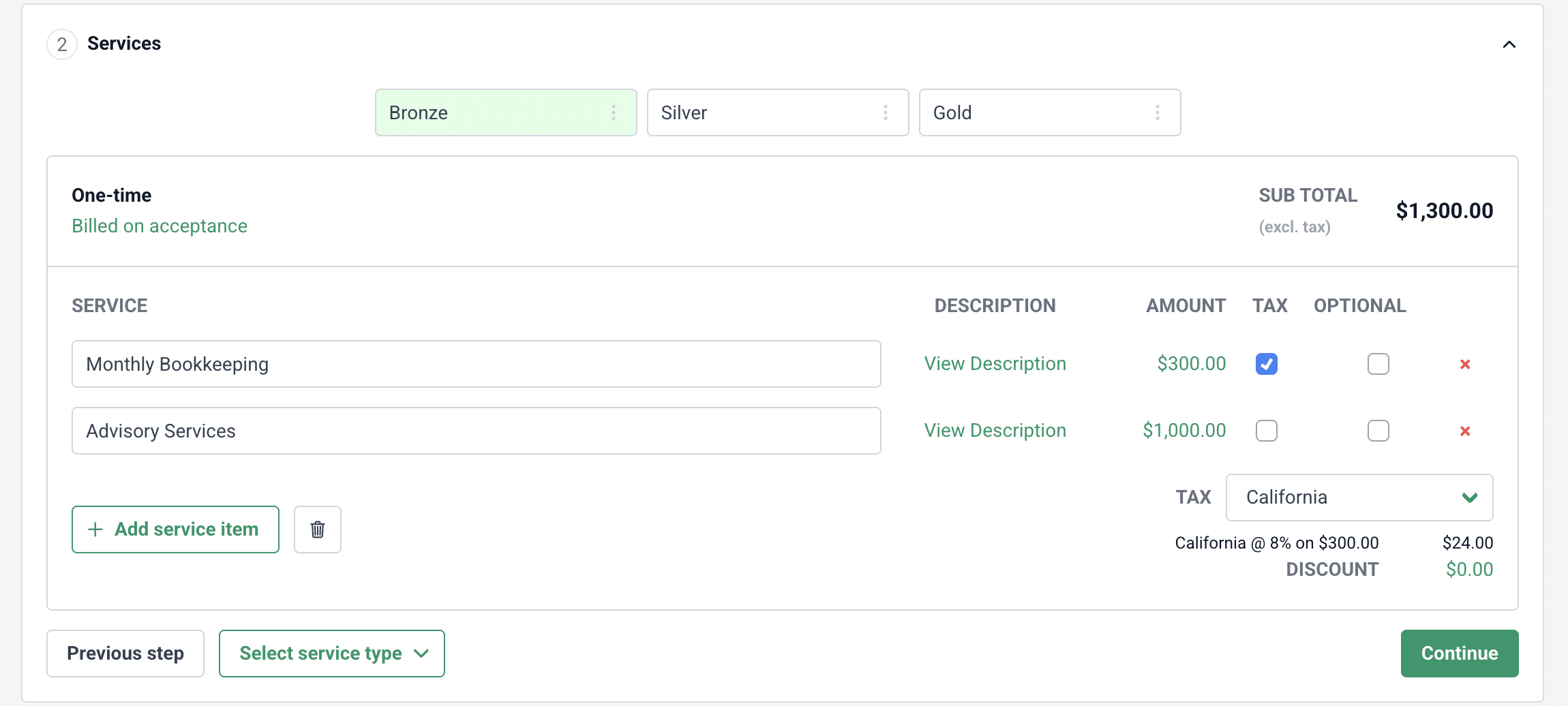
Once the client signs, Financial Cents generates the invoice automatically from the agreed services and terms, sends it to the client, and tracks the payment status in real time. This, together with our integrated billing feature, makes it seamless to collect payments from clients.
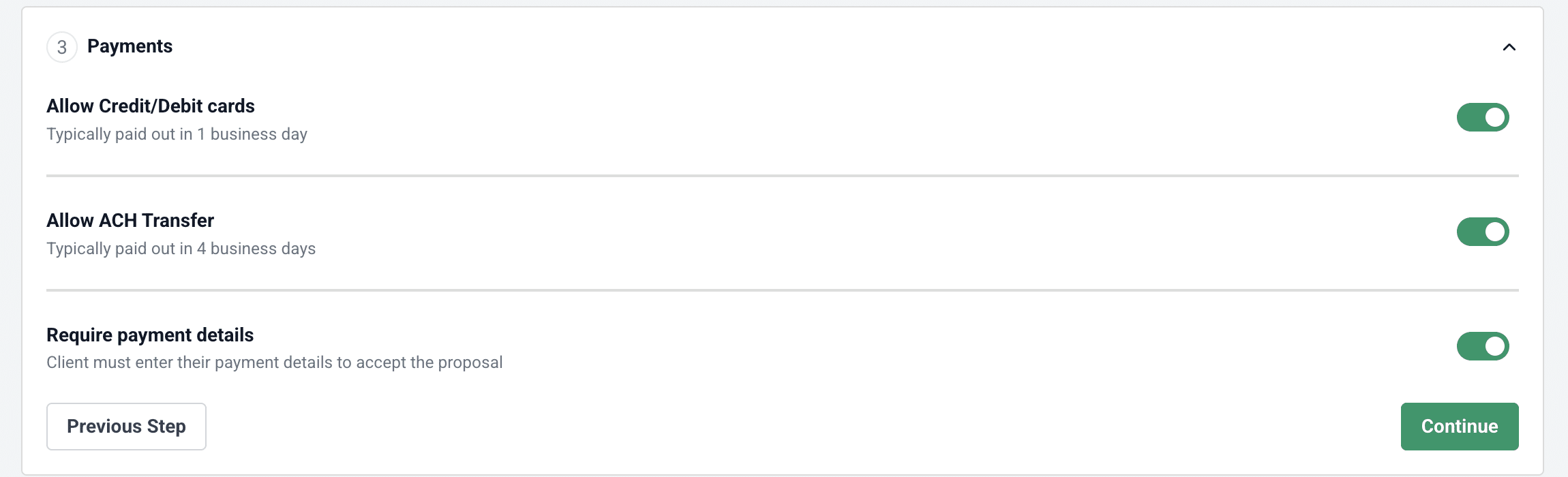
You can set automatic payment reminders, so you don’t have to follow up manually. After payment, you can then onboard the client.
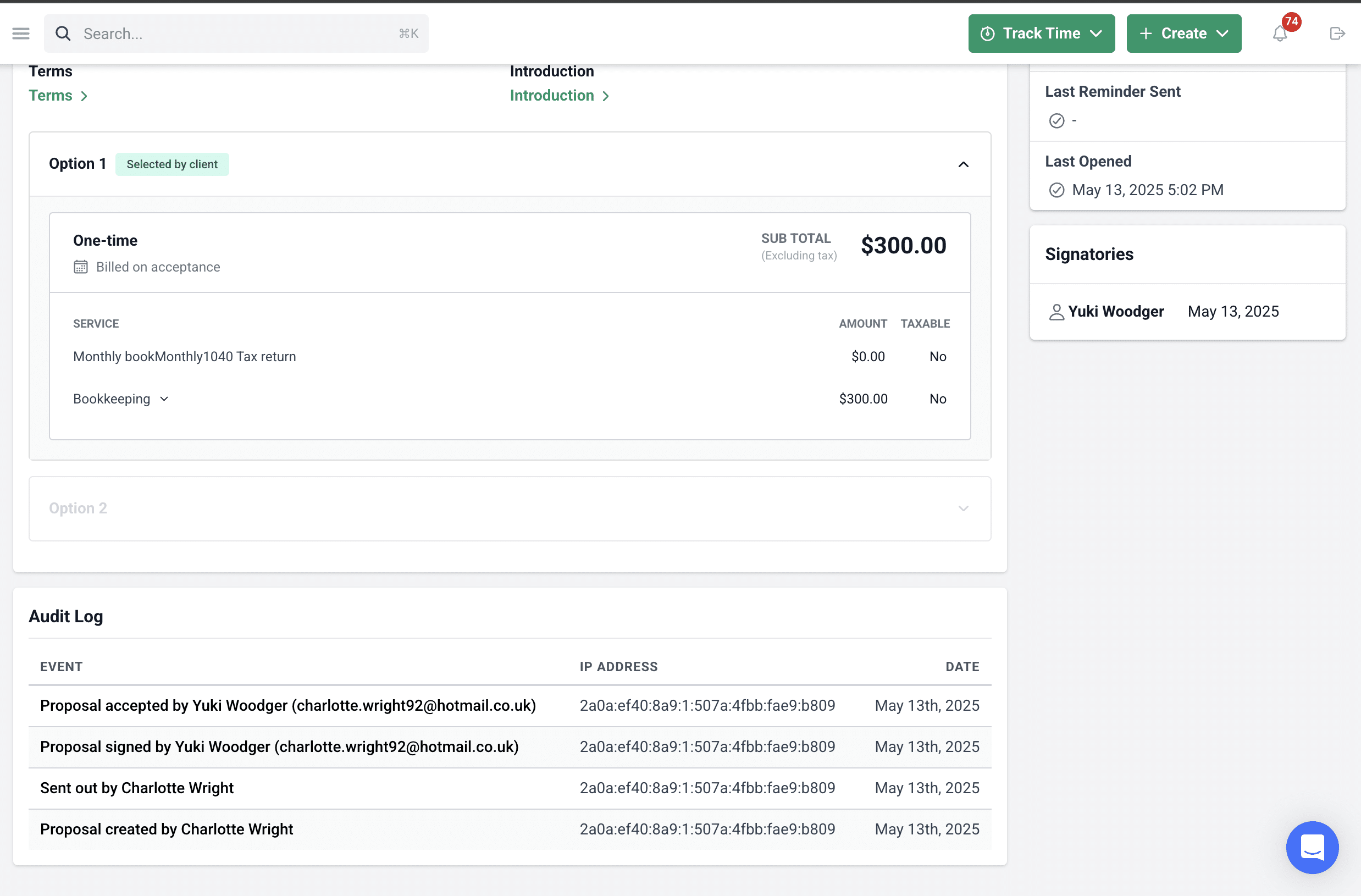
The signed letter is stored securely inside Financial Cents, and you can access or download it anytime. The tool also records the signer’s name, email, IP address, and the date signed, providing an audit trail that serves as evidence if a dispute ever arises.
Book a Free Demo to get a personalized walkthrough of our platform.
Make the Engagement Letter Standard Practice for Every Project
An engagement letter does three things: it protects your firm, sets clear client expectations, and shows you run a professional practice. That’s why you need to send one for every project.
Be clear when detailing the scope. The more specific you are about what’s included and what isn’t, the less room a client has to assume otherwise, and the fewer disputes you’ll face later.
The whole process can take time, especially when you renew annually and have dozens of clients. But accounting practice management software like Financial Cents makes it simple, with e-signatures, engagement letter creation, and billing in one place. That makes creating, sending, signing, and getting paid fast enough that there’s no reason to start work without a letter.
Start a Free Trial of Financial Cents today.
Share this article: