By now you’ve almost certainly heard about ChatGPT, and maybe even used it a few times. It’s the second fastest-growing app in history, crossing 1 million users in just 5 days. It’s also the most popular AI tool currently, with 1 billion global monthly active app users.
Despite this popularity, however, a good number of firm owners hesitate to bring ChatGPT fully into their firm. Some worry they’ll expose client data or run into a compliance problem. Others don’t trust its output, since they’ve heard enough about AI in accounting getting things wrong to stay cautious. And plenty of the ones who do use it never set any guardrails, so they and their team end up using it in unsafe ways.
This piece helps with all of that. We’ll show you how to use ChatGPT for accounting in your firm to save time and work faster without sacrificing quality or compromising safety. You’ll also get practical use cases and prompts you can copy and use.
TL;DR
- ChatGPT is a general-purpose AI tool that’s good at drafting client emails, summarizing documents, explaining concepts to clients, and creating marketing content. But it’s weak at maths and calculations.
- Write better prompts with the CLEAR framework: give it Context, set Limits, provide Evidence to work from, name the Audience, and add a Review step.
- Keep client data out of ChatGPT, and use sanitized or dummy data.
- Always have a human verify its output against a primary source before using it. ChatGPT hallucinates, and it sounds just as confident when it’s wrong.
- Use ChatGPT for general drafting and thinking, and use purpose-built AI, like the features in Financial Cents, for work tied to your real client data and workflow.
What Is ChatGPT and What Is It Good For in Accounting?
You probably know ChatGPT as the chatbot you ask questions and get instant answers. And yes, that’s the basic idea. It’s an app that runs on a Large Language Model (LLM) trained on a huge amount of data, and it answers by predicting which word should come next, then the next. That’s how it can respond to almost any question, and now, with internet access, it can often look things up on the web to verify information further.
Accountants find it useful for writing emails, articles, and documents, summarizing long text, organizing data, and other language-based work (with the right prompting and human editing).
Where it’s weak is doing complex math and calculations, acting as your source of accounting or tax truth, giving definitive advice and replacing your professional judgment.
ChatGPT isn’t the only general-purpose assistant firms are exploring. Our guide to Claude for accounting explains how Anthropic’s Chat, Cowork, and Code interfaces can support accounting work, and where human review is still necessary.
15 Practical ChatGPT Use Cases for Accountants & Accounting Firms (with Prompts)
Here are 15 ways you can use ChatGPT for accountants, along with the exact prompt to use.
1. Drafting Client Emails and Follow-Ups
Client communication is one of the most common ways accountants use ChatGPT. Give it the context, your style guide, the outcome you want, and a few sample emails, and it’ll draft client emails you can review and send.
Financial Cents, an accounting practice management software, has built-in AI for this, so you can draft emails in seconds without leaving the tool.
Here’s an example prompt you can copy and paste:
“Act as an accountant writing to a long-term client I value. Context: I’m raising their monthly fee from [$X] to [$Y], effective [date], because [reason]. Write a warm, confident email that acknowledges the relationship, gives the reason, and states the new fee and start date. Keep it under 180 words, don’t apologize for the increase, and give me two subject line options. Don’t invent any figures or history I haven’t provided. If anything you need is missing, ask me before drafting.”
2. Summarizing Long Documents, Engagement Notes, or Meeting Transcripts
Instead of reading a lengthy document, transcript or dense report, get ChatGPT to produce a summary you can easily read. You can even ask it to highlight decisions, action items, open questions, deadlines, and anything that needs follow-up.
Example prompt:
“Summarize the following meeting transcript for an accounting firm. Organize the output into key decisions, client requests, action items with owners, deadlines mentioned, open questions and information we still need from the client. Use only what’s in the text and flag anything ambiguous as ‘Needs clarification.’ Transcript: [paste sanitized transcript]”
3. Explaining Accounting and Tax Concepts in Plain English for Clients
The average client will likely not understand accounting jargon, so use ChatGPT to translate it into plain English for reports, messages, and documents.
Example prompt:
“Act as an accountant explaining a concept to a client with no accounting background. Context: they need to understand [accrual vs. cash basis accounting]. Explain it in plain language with one short example, under 200 words, and define every term you can’t avoid. Flag any figure, rate, or rule I should verify before I pass this on, and don’t state one as fact if you’re unsure.”
4. Writing SOPs, Checklists, and Workflow Documentation
Turn how you already do a task into a repeatable SOP or checklist another team member can use, so work always remains consistent no matter who’s doing it. Financial Cents AI for accounting firms can do this too. Type your prompt and get a workflow checklist template, then customize it to your firm.
Example prompt:
“Turn the process below into a step-by-step SOP with numbered steps, purpose, when to use it, instructions, role responsible for each step, and quality-control checks. For context, this is how we currently handle [task]. Use only the steps I describe, and ask me about any gap rather than inventing a step. Process: [describe your steps].”
5. Creating Marketing Content
Your firm can use ChatGPT to generate first drafts for blog posts, newsletters, and social posts that you can then edit to your voice. Remember to give it detailed context and instructions.
Example prompt:
“You’re a marketer for an accounting firm that serves [target audience]. Write a 300-word LinkedIn post on [why bookkeeping cleanups spike in Q1]. Start with a useful insight rather than a generic hook. Use a practical and conversational tone, no hype, one clear takeaway, and end with a soft question to invite comments. Don’t invent statistics or claims. Where a number would help, leave a placeholder for me to fill in and verify.”
6. Drafting Proposals and Scope Descriptions
ChatGPT can help you write accounting proposals and engagement letters for clients. Feed it your notes and context, and it’ll draft a personalized proposal.
Example prompt:
“You’re an accounting firm preparing a client proposal for a prospect with the following details:
– Service: [service]
– Problems this service addresses: [problems]
– Deliverables: [deliverables]
– Frequency: [frequency]
– Exclusions: [exclusions]
– Pricing: [cost].
Keep the language specific and avoid vague promises. Use only what I’ve provided, and ask me before drafting if any scope detail is missing.”
7. Building Research Scaffolding and First-Draft Answers to Review
ChatGPT can help you start accounting or tax research by breaking a question into issues, identifying information you’ll need, and suggesting what to investigate. It should not be your final research authority; rather, your first draft. So fact-check everything.
Example prompt:
“I’m researching [how bonus depreciation applies to X]. Act as a research assistant and give me the key sub-questions to answer, a first-pass explanation, and the authoritative sources I should verify this against. Label anything you’re unsure about.”
8. Validating Client Documents at Upload
Check whether an uploaded file is the right document, complete, and readable, so you have all you need and don’t have to start chasing the client for anything once the project is underway. Financial Cents has an AI file validator that automatically checks every document upload in your practice management software, so you don’t have to paste the text into ChatGPT.
Example prompt:
“I asked a client for their [2024 bank statement], and below is the text they sent. Check it against what I expected: it should be a bank statement, cover [the 2024 period I name], and include [list fields, e.g. dates, descriptions, amounts, running balance]. Tell me whether it matches the description, list any of those expected elements it’s missing, note anything unreadable, and say if it looks like a different document than the one I asked for. Judge only the text I paste, and don’t assume anything that isn’t there. Text: [paste sanitized text].”
9. Creating Spreadsheet Formulas and Cleaning Text Data
ChatGPT can help you write formulas and clean up messy text data into a consistent, readable format.
Example prompt:
“Write an [Excel] formula that [returns the client name in column A only if the invoice in column C is overdue]. Explain what each part does, show how to adapt it for Google Sheets, and tell me how to test it on two or three rows first. If my request is ambiguous, ask before writing it.”
10. Brainstorming Pricing Packages, Positioning, and Job Descriptions
ChatGPT can act as a brainstorming partner when you’re evaluating how to package services, position your firm, or hire for a new role. It can help you generate options and surface questions you haven’t considered, while you make the final decision.
“Act as a pricing and positioning advisor. For context, my firm offers [services] to [niche], and I want options to react to. Brainstorm three pricing packages (good, better, best), each with a name, what’s included, the ideal client, and a rough price band. Then suggest two positioning angles that would set the firm apart. Ask me for any input you need rather than assuming it.”
Read: AI in Accounting: What’s Hype, What’s Useful, and What’s Next
11. Create Scenario Models and Advisory Questions
Use ChatGPT to think through “what if?” scenarios and turn them into questions to raise with clients. It shouldn’t replace the actual financial model or calculations, but it can help you structure the analysis.
Example prompt:
“Structure an analysis for a client deciding whether to [hire a full-time employee or a contractor]. Create three scenarios: conservative, base case, and upside. List the financial and non-financial factors, the questions I should ask them, and the data I’d need to model it. Don’t calculate any figures or invent numbers. Focus on the assumptions, variables, and questions for the analysis.”
12. Renaming and Organizing Client Files Automatically
Standardized file naming makes it easier for your team to find documents and reduces confusion when multiple files arrive from the same client, and this is something ChatGPT can help with.
If you’d rather implement this directly within your workflow, Financial Cents offers an AI file renaming agent that reads each document and renames it using your firm’s naming convention.
Example prompt:
“Rename the files below to match my naming convention, [ClientName]_[DocType]_[YYYY-MM], and list them in a table. Use only the files I give you, and flag any that don’t fit the pattern instead of guessing. Here are the files: [paste sanitized list].”
13. Turning Process Gaps Into Training Scenarios, Quizzes, and Role-Play Exercises
Once you identify where employees commonly make mistakes, ChatGPT can turn those situations into realistic training exercises. This gives your team a way to practice a process before handling it with a real client.
Example prompt:
“New team members keep [miscategorizing owner draws]. So act as a trainer for junior staff and create a short training scenario, a five-question quiz with answers, and a role-play exercise to fix it. Keep it practical for a junior bookkeeper, and don’t include confidential client information.”
14. Drafting Service Descriptions
Write clear, concise descriptions of your service for your website, sales decks, or onboarding materials, so clients understand exactly what they’re getting.
Example prompt:
“You’re the copywriter for an accounting firm and here are the services you offer: [list]. For each, write a one-line summary, who it’s for, what’s included, and the outcome the client gets. Keep it plain and benefit-led, no jargon. Don’t invent services, features, or claims I haven’t listed. Leave a placeholder where you need details from me.”
15. Creating FAQ and Onboarding Materials From Your Processes
Once you’ve documented your firm’s processes, ChatGPT can turn them into FAQs that answer common questions and an onboarding questionnaire guide that details how you work. This saves you from answering the same questions over and over again.
Example prompt:
“Using our onboarding process below, write a client FAQ of eight questions with answers, a step-by-step onboarding checklist and questionnaire. Include a document checklist step, file-naming instructions with examples, and what happens after documents are submitted. Use only the process I describe, and ask me before adding a step. Process: [describe your onboarding].”
The CLEAR Prompt Framework for Accounting Work
Looking at all the accounting ChatGPT prompts above, there’s a pattern. They’re all specific and detailed, telling ChatGPT what to do, what not to do, who the output is for, what to work from, and what the final result should look like. In other words, they follow the CLEAR prompt framework: Context, Limit, Evidence, Audience, and Review.
Here’s how it works:
- Context: Give ChatGPT details about your business and project so output is more relevant. Add information about your role, objective, and any relevant background.
- Limit: Set your boundaries. Tell it what to use, what it should leave out, what it shouldn’t assume, and what it shouldn’t. This keeps its output inside the facts you’ve given it instead of filling gaps on its own.
- Evidence: Give it materials to work from, like your notes, meeting transcript, data, documents, etc so it doesn’t hallucinate or make up details.
- Audience: State who the output is for, since that shapes the tone. Share their industry, role, pain point, etc.
- Review: Add a review step. Instruct ChatGPT to flag its own assumptions, uncertainty, missing information, dubious calculations, then check the output to ensure it’s all true. Never use what it gives you without checking it first.
You can make CLEAR produce even better results by adding a quality loop. Particularly for complex or long prompts, tell ChatGPT to restate the task in its words, identify missing inputs, produce a draft, critique it against criteria, and then hand you a checklist to verify.
Mark Wickersham, Chartered Accountant and best-selling author of Value Pricing Academy, recommends ending a long and complex prompt with a “Rules” section that restates your key requirements, because the longer a prompt gets, the more likely ChatGPT is to miss something important. A line like “to complete the task you must obey the [Rules]” helps ChatGPT remember all important details.
And if you don’t get the results you want the first time, rephrase your prompt and ask again.
Read: 100 ChatGPT Prompts for Accountants and Bookkeepers
Client Data and Confidentiality: The Non-Negotiable Rules
Using ChatGPT for accounting firms comes with certain risks, like exposing client data. It’s happened before. On March 20, 2023, a bug let some ChatGPT users see the titles of other people’s conversations, and during a nine-hour window that day, it exposed the billing details of 1.2% of active ChatGPT Plus subscribers. And there are other similar instances.
This is not to scare you from using the tool; it’s just to show you should take client data and confidentiality seriously. You don’t want their information being exposed, as that will cause them to lose trust in your firm.
Here are some rules to follow:
- Never paste client PII, SSNs, bank details, or identifiable financials into ChatGPT. Instead, remove all identifying information and use anonymized or dummy data for tasks.
- Know your plan’s data settings. For individual plans, data sharing for training is enabled by default, though you can opt out. On business plans like ChatGPT Business and ChatGPT Enterprise, OpenAI doesn’t use your data to train by default unless you turn it on. So consider a Business or Enterprise plan which gives you data ownership, encryption, and administrative controls. Enterprise adds further controls like Advanced data privacy with custom data retention policies, and encryption at rest and in transit.
- Provide the minimum necessary data ChatGPT needs to complete the task. Don’t give it your entire client file to reduce the amount of sensitive information you’re exposing.
- Create an AI policy that highlights how employees can use ChatGPT safely, what they can use the tool for, what they shouldn’t put into the tool, what requires human review and so on. If this feels restrictive, Jason Staats, CPA, and Founder, Realize & Accounting, who speaks often about AI in accounting, says it’s the opposite. “You need to put that document together to liberate your team. Define what the boundaries are to give them a way to use it responsibly,” he says.
- Vet AI providers before rolling their AI tool out to your firm. Look at their security controls, data handling, retention, and so on. Then once your team is using it, update your firm’s written information security plan (WISP) to cover how employees should use generative AI, what data is prohibited, the required review procedures, how to anonymize data, and what to do in case of a data breach.
Most firms have not yet formalized those safeguards. According to the State of AI in Bookkeeping and Accounting, only 13% of AI-active respondents said their firm had a formal written AI policy. The report also examines firms’ concerns about accuracy, client confidentiality, training, and human review.
Limitations, Hallucinations, and Why a Human Must Review
If there is a rule you must always follow when using ChatGPT for accounting, it is to always have a human review its output. This is not optional. ChatGPT, like every other generative AI tool, hallucinates quite a lot. OpenAI itself has admitted to this problem.
It generates completely false information, fake facts, or non-existent sources, presents them as true, and does it so confidently that you’ll be tempted to trust it. Don’t. Review the output first, and check every figure, stat, citation, and explanation against a primary, authoritative source. Click every link it gives you to be sure the source is real and says what ChatGPT claims. Only once you’ve confirmed all of it should you sign off.
ChatGPT vs. Purpose-Built AI in Your Accounting Software
Generative AI tools usually fall into two categories: general-purpose and purpose-built. ChatGPT is general-purpose. It’s broad and flexible, ready to help with almost any language task. But its versatility can also be a drawback. It’s not trained specifically for accounting, so it doesn’t have much industry knowledge or context, and it relies on general information available on the internet.
The AI built into accounting automation software you already use, like Financial Cents, is purpose-built. It’s built specifically for accountants and bookkeepers, so its responses come from that context and tend to be more accurate and relevant. These AI accounting tools also connect to your records, so they work from your real client and workflow data instead of generating answers in isolation. For a closer look at what that looks like in practice, see smart ways to use AI accounting software.
For your accounting firm, it’s often better to use purpose-built AI as it fits into the way your team already works and helps you get more relevant and specific output. But you can still use ChatGPT for general thinking and drafting.
Use Financial Cents’ Purpose-Built AI Features for Your Firm
ChatGPT can help you draft an email, develop a checklist, analyze sanitized data, or research a question, but that work still sits in a chat window, disconnected from the client it’s for and the process it belongs to.
Financial Cents, however, offers purpose-built AI features for accounting and bookkeeping firms. It ties AI-assisted work to the right client and document, so you get more relevant output and don’t have to copy anything afterward.
Here are four of its AI features:
- Rename Client Files Automatically: The AI File Renaming Agent reads each file a client uploads, identifies the date, document type, account, and client, and renames it to your firm’s naming convention. You can let it rename on its own or have it ask you first, and it flags anything it isn’t sure about.
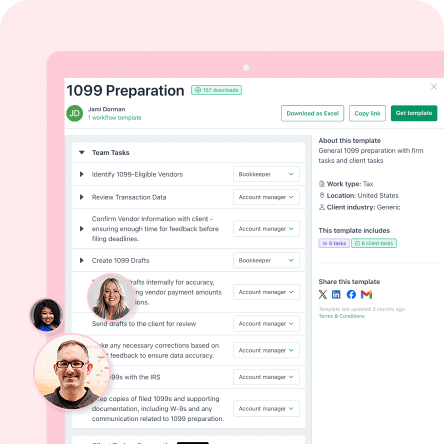
- Generate Workflow Checklist Templates: Type a prompt and get a full workflow checklist template in seconds that you can then adjust to your firm’s processes. No need to type the prompt in ChatGPT, copy the answer, then paste it into another document, then share with your team. You can do all of that in Financial Cents.
- Validate Client Documents at Upload: The AI File Validator checks each file the moment a client uploads it to a task. It compares the file against what you asked for, the accounting period, and the client’s details. If it’s the wrong year, bank, or document, the client is alerted and can swap it right away.
- Draft Client Emails: Draft emails inside the client’s record, where Financial Cents already knows who you’re writing to and what it’s about. You can then save your best ones as templates and reuse them.
Want to try the AI features? Book a Free Demo or Start a free 14-day trial of Financial Cents.
FAQs
Share this article: