Picture this: It’s a regular Tuesday afternoon, and you’re sipping a steaming hot cup of tea as you wrap up a few final to-dos for the day. Everything is calm and peaceful—until the sudden buzz of your phone jolts you out of your chamomile zen. Your stomach drops when you see the name on your screen: one of your biggest clients.
Next thing you know, your mug is cold and abandoned on the edge of your desk, your afternoon calm completely forgotten. Because now you’re full-on scrambling—pulling up tabs, digging through emails, and frantically trying to piece together where this client’s work actually stands while they wait silently on the other end of the line.
Some version of this problem is plaguing most accounting and bookkeeping firm owners today—whether they realize it or not. And based on what we learned during our recent Bookkeeping Workflow Summit, it’s actually their biggest problem.
Because when work lives in too many places, ownership is unclear, and communication constantly bounces between a dozen different platforms, something is bound to slip through the cracks—and when it does, the owner is often the one stepping in to save the day.
Over the course of four lively sessions with firm owners and experts, summit attendees dug deep into the pitfalls of workflow fragmentation: why it happens, what it costs, and how to actually fix it. What follows is a field guide constructed from their combined frameworks—a practical blueprint for building a firm that runs on systems, not on you.
Missed the summit or want to relive the magic? You can check out full recordings of each session by following the links below, or read on for a recap of the most important takeaways.
- Session 1: Why Your Firm Isn’t Centralized: Identifying the Root Cause of Your Scattered Systems (with Roman Villard, CPA)
- Session 2: How to Stop Being Your Firm’s Bottleneck: A 3-Step Program for Your Systems (with Ryan Lazanis, CPA)
- Session 3: Fixing the Friction: Designing Workflows for a Patchwork-Free Firm (with Kellie Parks, CPB, FCPB)
- Session 4: Master the Embedded Month-End Close (with Greg Scholten and George Abdelmessih)
The Bookkeeping Tool Trap: Why “More” Is Almost Never “Better”
When things feel chaotic, your first instinct as a firm owner might be reaching for a new solution that will finally get things organized:
- A better project management software
- A client portal
- An AI tool that will handle follow-ups
- A new Slack channel
- Another spreadsheet
On the surface, it makes sense. But it rarely has the effect you think it will.
According to the 2026 Bookkeeping Firm Tech Stack Report—a deep analysis based on data collected from more than 260 bookkeeping firms—about half of firm leaders are not confident that nothing is falling through the cracks, and only one in three have a unified view of all client work.
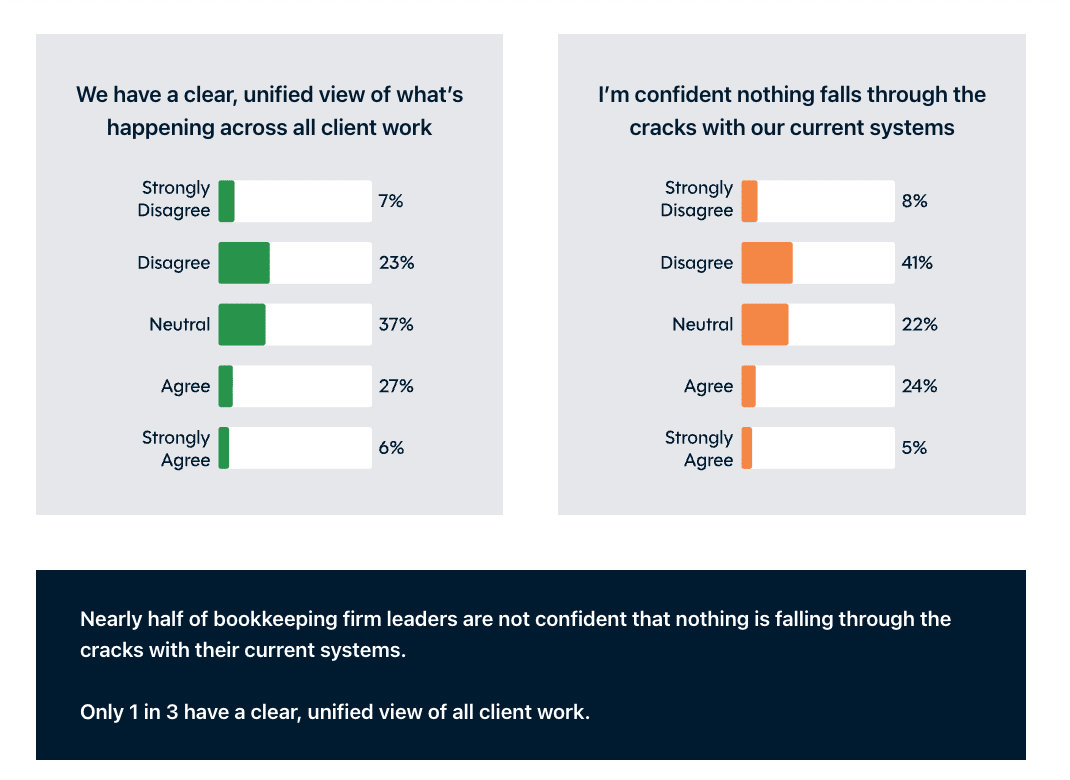
And considering that less than half of firms run on four tools or fewer for bookkeeping—and over 80% manually copy data between tools on at least a weekly basis—it’s clear that thicker tech stacks aren’t creating more streamlined operations. Quite the opposite, actually.
“There’s not a ton of tech you could probably just implement today that’s gonna solve all that,” Roman Villard, CPA and founder of Full Send Finance, explained during his speaking session.
But, he urged firm owners not to beat themselves up if their tooling has spiraled out of control, because they’re definitely not alone. “The fact of the matter is, about half the firms feel the exact same way,” he continued.
Still, it’s a problem worth addressing—and fast, because it’s costing you more than your monthly subscription fees. In addition to any re-work that must happen when details get lost or mixed up, you’re also losing valuable time to context-switching and screen-toggling every time you and your staff have to jump between systems to reconstruct what happened with a client. And then there’s the ever-present security risk of a sensitive document floating out to who-knows-where.
At the end of the day, this could all add up to lost clients and a damaged reputation, which might be the biggest long-term cost of all.
Clearly, the solution is simplification: fewer tools, better clarity, and ideally, one single source of truth. Easier said than done, we know.
The Self-Diagnosis: What Kind of Patchwork Are You?
Step one to fixing the fragmentation is naming how it’s showing up in your firm. During his Workflow Summit session, Roman introduced a self-diagnosis framework that resonated immediately with attendees: the seven “Patchwork Personas.”
- The Human Router stores all information and context in human brains instead of a centralized system that’s accessible to everyone on the team. If this is your firm, then you probably find yourselves sending each other a whole lot of “what’s the status?” messages, manually transferring information from one place to another, and fielding client questions that only certain team members can answer.
- The Spreadsheet Stalwart has an accounting Excel sheet for everything. And if something’s not logged there in black and white, then it doesn’t exist. Period.
- The Tool Toggler keeps stacking software on top of software like a game of Jenga, always hoping the next subscription will be the one that solves it all. The tech stack has grown to fifteen tools and counting, and nobody on the team knows which system to go to for what.
- The Month-End Magician pulls off month-end close through sheer willpower. Every. Single. Month. It works, but just barely—and it’s reliably miserable. Talk about a culture killer.
- The Message Miner is perpetually hunting through Slack, email, and texts to find the one thing a client sent three weeks ago that’s suddenly critical today.
- The Copy-Paster and The Apology Artist round out the set—one spending hours re-entering data across systems, the other perpetually following up on (and often begging forgiveness for) things that slipped.
If you recognize yourself in more than one of these personas, you’re in good company. And luckily, it’s totally fixable.
Think of your persona as a vehicle diagnostic that tells you exactly why your “Check Engine” light is on. Pinpointing the problem with your operating model is a far more useful diagnosis than “I think we need a new tool.”
Get instant clarity with our free 1-minute assessment.
3 Principles of Building a Winning Workflow
Moving away from a patchwork model is the first step toward creating a firm that runs like a well-oiled machine. But our summit speakers also detailed some broader strategies for designing a bookkeeping firm workflow that will grow with you—whether that means taking on more clients, hiring more staff, or simply gaining more time back for your life outside of work.
Principle #1: Build a Centralized View So You Don’t Become the Dashboard
When you’re first starting out, you might think of a “centralized view of client work” as a weekly standup or a master spreadsheet (or worse, a “just ask the boss” protocol).
But a truly centralized view is one place where, at any given moment, you or anyone else on your team can see what’s next, who owns it, what’s blocked, when it’s due, and where the last client communication landed.
Right now, most firms don’t have that, which means the owner often fills the gap.
One of Roman’s “hot tips” for breaking this pattern was almost comically practical: remove your phone number from your email signature.
While taking calls and solving problems on the spot might feel good in the moment, the reality is that every call or text that bypasses a shared system is a visibility problem. It’s a decision made verbally and off the record—one that your team can’t act on and that you’ll probably forget to log.
But the real fix goes deeper than phone numbers. It requires making a deliberate decision about where work lives—and then building firm-wide discipline around that decision.
Kellie Parks, FCPB and founder of Calm Waters Cloud Accounting, presented a clean framework for this that she runs with the help of Financial Cents. She distinguishes between three modes of client communication, each with a specific purpose:
- Email is for information only—templated, automated where possible, with no action or response required on the client’s side.
- A client task is for anything that requires the client to do something, upload something, or respond to something—because it generates a notification and creates a record inside the system.
- Client chat is for open-ended discussion with no specific deliverable attached.
A task is when they have to do something and I need to be notified in Financial Cents that they’ve done it,” Kellie explained during her summit session. “And maybe we’re going to comment back and forth on it, and maybe they’re going to upload something, or maybe I’m gonna give them something to download."
It sounds simple. But in firms where everything flows through email, Slack, and text simultaneously, it’s genuinely transformative. When communication is scattered, work gets scattered with it. Consolidating where client interaction happens—and making that channel the same place the work lives—is the core of what a “centralized view” actually means in practice.
This is exactly the problem Greg Scholten, president of On Track Accounting Solutions, was trying to solve when he moved his firm’s entire month-end close process into Financial Cents. Before, his team was emailing spreadsheets to clients, manually following up, and watching uncategorized transactions pile up for months.
“I want clients on one system and one system only for our portal and all communications,” Greg said during his summit session.
Principle #2: Stop Being the Bottleneck that Breaks Your Team’s Capacity
Most firm owners don’t set out to become their firm’s bottleneck. They didn’t grow their team just so they could continue holding onto every little task and decision. In most cases, bottlenecks happen due to unintentional operating models where all roads lead to the owner. The good news? It’s a structural problem with a structural solution.
Ryan Lazanis, CPA and founder of FutureFirm, has spent years studying what separates the firm owners who are trapped inside their businesses from the ones who aren’t. What he found is both obvious and persistently ignored: pricing, workload, and owner availability are directly correlated.
According to a survey Ryan conducted, the average firm owner works more than 50 hours per week. Among the top modern firms he surveyed—not the largest firms, but the ones broadly considered to be leading the way—only 2 of 50 exceeded the 50-hour-per-week threshold. And those firms were charging roughly double what the average firm charges.
The math is simple but the implication is important. If you’re charging under $500 per month per client, you need at least two times more clients to hit the same revenue as a firm charging $1,000 or more. More clients means more relationships to manage, more questions to answer, more escalations to triage, more places where only you have the context to take action. So, lower prices don’t just hurt your margins—they keep you too buried to focus on anything more than staying afloat.
Most firms are undercharging and carrying forward low-quality clients,” Ryan said. “Both of these things bite into your capacity and create busy work."
The first move toward breaking the bottleneck, Ryan explained, is creating headspace—not by working harder or hiring faster, but by optimizing your client portfolio. Assuming four tiered “buckets” of clients, with the best clients being in Bucket A and the worst being in Bucket D, here’s what Ryan recommends:
- Reprice your A and B clients to reflect the value you’re actually delivering.
- Release the C and D clients who are consuming capacity without generating the margin to replace it.
That’s it. In doing so, you’ll likely increase your revenue instantly—but more importantly, you’ll give yourself some breathing room to fix the foundation.
Recommended Resources:
How to price your bookkeeping services for profitability
Free Bookkeeping pricing template guide
Accounting Price increase letter
The second move is building a buffer. “The shortest answer is you’re probably lacking a senior resource,” Ryan said. This is someone you trust to handle client escalations, own the review process, and deal with the more complex or sensitive situations without routing everything upward. Getting even one person in that role changes the operating structure of the firm.
The third move—and the one most owners resist longest—is learning how to delegate like an operator. That means delegating the work of figuring out the how rather than taking the time to figure it out yourself before handing it off. The key is accepting that not everything has to be done “perfectly” by your specific standards—that sometimes, 80% “perfect” is good enough.
80% done by someone else is 100% awesome,” Ryan said. “You can delegate 100% of what you do. I know—because when I sold my firm, I had to. And the business is still growing today."
The way to identify what to delegate is systematic, Ryan said. He recommends a two-week audit where you log every task you work on and grade each one on:
- How much you enjoy it,
- How good you are at it, and
- How much revenue it generates.
This will help you understand which items are high, medium, and low priorities for delegation.
“Your job is to get the high priorities off your plate as soon as possible,” Ryan said. “And then once you have those off your plate, you work through the medium priorities and then the low priorities.”
What surfaces as high-priority for delegation is almost always the admin work (which you should let go of immediately), then the operations tasks (like implementing processes, building tech, and all the things you procrastinate on), and finally, selectively, the client work you’re doing out of habit rather than leverage.
You’re not gonna get everything off your plate overnight,” Ryan cautioned. “All of what we do in business is an iterative process. So little by little, it compounds and the situation gets much better over a period of time."
Principle #3: Design Workflows Around Outcomes, and Take a Phased Approach
The reason most firm owners never get around to building the workflows they know they need is because it feels like too big of a project to start. There’s just too much to think through and account for—and it becomes paralyzingly overwhelming.
“Starting is the thing that’s stopping people,” Kellie said flatly.
Her antidote: start with the outcome, then build the milestones, and do nothing else until the skeleton is right.
Here are the five core elements of creating workflows, according to Kellie:
- Start with the end in mind (i.e., the outcome you are trying to achieve).
- Establish the milestones first.
- Don’t complicate the process.
- Add items as you go (i.e., keep iterating).
- Make a list of the lists you need to create.
For example, the outcome of Kellie’s client onboarding workflow is:
Bring a great-fit client into our firm as a professional first experience working with us, gather all the documentation and information to begin working with them by a date we have agreed upon.
And the milestones for this client onboarding workflow are:
- Discovery
- File review
- Quote and recurring payment setup
- Information gathering
- Engagement
- App implementation
- Education
From there, you can add tasks, subtasks, and automations (particularly if, like Kelie, you manage workflows with Financial Cents 😉).
The take-home message is to start small enough that you actually start.
“Started is way better than perfect,” Kellie reiterated.
And speaking of starting, Kellie recommends building out the following five core workflows—which represent the five categories of recurring work that every firm needs a documented, consistent process for—first:
- Onboarding covers discovery through client education, with clear gates that filter out bad-fit clients before the real work begins.
- Transaction processing includes everything from AR and AP to bank feeds and payroll.
- Monthly bookkeeping and reconciliation.
- Quality control covers file review and reporting.
- Workflow management is the meta-layer that includes tracking client work as well as ensuring SOPs and workflows are accurate, efficient, and updated.
Foundation First, Automation Second
AI and automation are all the rage right now, so it’s tempting to dive head-first into these modern-day “efficiency hacks.” But both Roman and Kellie made a point of tempering the automation enthusiasm, emphasizing that the quality of your automation hinges on the quality of the process underneath it.
Roman approaches new tools and AI capabilities cautiously, always asking whether they can bolt onto the core workflow without requiring a full reinvention—because every new tool, no matter how “revolutionary,” requires change management, and change management has a real cost that firms rarely account for. His rule of thumb: ask what features exist in tools you’re already using that you haven’t maximized yet. Consolidate before you add.
“System automation built on lousy systems accelerates lousy outcomes,” Kellie added.
Before you automate anything, Kellie recommends asking yourself three questions:
- Is this workflow repeatable, with the same process and outcome every time?
- Is the benefit worth the consequence if it breaks?
- And—most importantly—would an automation failure be embarrassing, a security risk, or hard to fix?
On that last question in particular, Kellie underscored the importance of built-in dependencies (like the ones available in Financial Cents). For example, make sure the automated email confirming that month-end close is complete cannot fire until the reporting milestone is actually checked off.
“Test the heck out of everything,” Kellie said. “Make yourself a client.”
But the broader implication that both Kellie and Roman alluded to is that the owners who will benefit most from AI and automation are the ones who already know what their process is, because you can’t automate your way to clarity.
The Hidden Cost of Overdelivering (or Misdelivering)
There’s one more sneaky place where fragmentation hides: in the gap between what you promised a client and what they actually care about.
To illustrate this disconnect, Roman shared a revealing anecdote from a conversation with one of his firm’s clients. His team asked what financial data the client actually used to run their business—which metrics they really spent time on. The answer was a handful of specific numbers that did not entirely align with the ones his team was laboring over.
This is a frequently overlooked source of unnecessary work. Firms over-scope their engagements, over-build their deliverables, and under-communicate with clients about what actually matters to them. The result is a workflow that’s technically thorough but practically irrelevant—and an owner who’s working fifty-plus hours a week to produce a report that the client barely glances at before closing the tab.
We will often overextend ourselves by providing scopes that overexceed what the client’s actual needs are from a business standpoint,” Roman said. “So you can pull back some of that stress by making sure your scope is aligned really well with your clients."
When aligning on value and scope with clients, Ryan recommends framing it three ways:
- Monetary (how much money you’re helping the client make or save),
- Time (how many hours you’re freeing up for them), and
- Feelings (how much better they feel about something that was previously stressful).
When you understand which of those three drivers is motivating a particular client, you can scope, price, and deliver accordingly—and stop over-delivering on the things that don’t move the needle.
Getting this alignment right reduces owner workload, simplifies workflows, and—perhaps most importantly—creates the kind of client relationships where re-engagement, referrals, and higher-tier packages are a natural progression rather than a hard sell.
The Patchwork-Free Firm: A Practical Starting Point
If you’ve found yourself enthusiastically nodding your head while reading this blog post, then we have an action plan for you—one that we hope will prevent you from letting all this inspiration go to waste. Here’s what to do:
Start with three decisions.
First, designate a single source of truth. Pick the one place where work status, client communication, and task ownership live—and commit to it. If something isn’t recorded there, it doesn’t exist as far as your firm is concerned.
Second, pick one workflow to centralize. Onboarding and month-end close are two high-leverage starting points for most firms. Write the outcome statement, list the milestones, and get the skeleton into your system. You can add everything else iteratively.
Third, establish your communication rules. Define what belongs in email, what belongs in a client task, and what belongs in a team chat—and share that protocol with your team and your clients. This alone will reduce a significant amount of the “message mining” that drains hours every week.
Then, give yourself 90 days to go deeper.
In the first 30 days:
- Take the Patchwork Persona assessment,
- Map out one workflow, and
- Lock in your communication rules.
In the next 30 days:
- Clearly define each role in your firm,
- Run the two-week task audit Ryan recommended, and
- Figure out what you can delegate.
In the final 30 days:
- Start adding guardrailed automation where the process is stable enough to support it, and
- Audit your tools for overlap.
Now, this doesn’t mean you’ll have a 100% patchwork-free firm by day 91. But it’s a solid start. Firms that have actually gotten there successfully aren’t necessarily the ones with the most sophisticated tech stacks or the most beautifully documented SOPs. They’re the ones who got clear on how they actually work, built systems that reflect that reality, and gave their teams room to own what they’re good at.
How’s that for some piping hot tea to refill that ice-cold mug? 🍵
Want to go deeper on any of these frameworks?
Watch the full session recordings from Financial Cents’ Bookkeeping Workflow Summit on demand.