At 5 a.m., most people are still snoozing away in bed. But Christine Salvatore, owner and founder of In Line Managment, is often tapping away on her laptop.
She likes starting her workday early, before her young daughters wake up, so she can spend quality time with them in the morning before they go to childcare in the afternoon. Later, after she tucks them in for the night, she might put in a few more hours. By the time she logs off, she’s worked a full day. It just doesn’t look anything like a traditional schedule.
That kind of flexibility is at the heart of many small bookkeeping and accounting firms, and protecting it is at the heart of running a lean firm well. Most small firm owners aren’t interested in cramming more hours into their work week. They want to build a firm that functions within their life—not the other way around.
This was the overarching theme of the fourth and final session of Financial Cents’ Proudly Small series, “Running Lean and Loving It: Operations, Tech, & the Art of Doing More with Less,” moderated by Financial Cents CEO Shahram Zarshenas. He was joined by four firm owners who’ve engineered their operations to create more freedom and less stress: Dave Kersting of Capovario, Katie Helle of Scaled Accounting Solutions, Angela Jenkins of Mindfull Money Matters, and Christine.
Throughout their hour-long discussion, a few key themes popped up again and again: smart hiring, documented processes, thoughtful delegation, a culture of trust, and automation in the right places. Read on to see how these firm owners pull it all off.
Remember that freedom doesn’t come without delegation
The freedom Christine built for herself isn’t free. She pays for it partly in early mornings and late nights. But the other half of the equation is delegation—a skill that doesn’t come naturally or easily for most founders.
She’s become very in-tune with stress signals in her body—a skill she now applies every time a new task comes across her desk. Whenever she gets an email that requires action, for example, she asks herself one specific question: Do I need to do this, or can I forward it to my team? The result is that her staff now handles roughly 85% of client-facing work, only pulling her in when absolutely necessary.
The takeaway: overwhelm isn’t a cue to work harder; it’s a cue to offload. Of course, you can only offload if you have the right team in place around you—along with clear processes that empower them to take the handoff and run with it.
Be intentional about who you hire (and when)
Two of the biggest decisions an owner of a growing firm will make are:
- When to hire, and
- Who to hire.
The panelists advised treating both as strategic business moves rather than reactive course-corrections. When it comes to timing, you might assume the best and most financially prudent approach is waiting until the budget is obviously there. But sometimes, you have to hire in order to create the capacity that will unlock that revenue.
It’s a classic chicken-or-egg scenario. To help keep the risk manageable, Christine leans on a bench of contractors who can scale up incrementally.
“I always have contractors who are doing back-end data entry,” she said. “And if there’s a good one, then when I get a new client, I ask if they want to work more. I have three contractors that all want more hours right now, and so I’m able to bring someone on the moment that a client asks me for more work.”
Katie’s rapid growth led to a similar dilemma. She launched Scaled Accounting Solutions in October 2024, expecting a slow and steady ramp into her first tax season. Instead, the demand for her services exploded right out of the gate. She hired a bookkeeper almost immediately, then brought on a tax preparer mid-tax-season. Those were both offshore hires, and she later added a local admin.
Beyond determining which roles to bring on first, the panelists encouraged their fellow firm owners to think critically about how they will evaluate job applicants. In some cases, for example, you may want to hire based on specific skills or competencies. In others, personality or “soft skills” might be more important. Either way, the interview process should be designed to filter out candidates who don’t fit the bill.
In Katie’s case, the biggest non-negotiable was fluency in her tax software. Her reasoning: practice management software is easy to learn, but she needed someone who could hit the ground running on returns (especially because of the timing). So, she built a step into her hiring process that tested for that particular skill: candidates had to screen-record themselves preparing a return in the software while simultaneously talking through their work.
“Two people knocked it out of the park,” Katie said. “One person did not.”
The exercise made the right hire obvious. The woman she chose explained her reasoning clearly and flagged the items she didn’t have enough information on—exactly the judgment Katie needed in someone working semi-independently.
Get daily, bit-sized lessons on workflow management, client management, or tax workflows — delivered straight to your inbox
Sign Up
Build with a growth mindset from day one
While many firms start out as solo endeavors, the panelists cautioned against assuming you’ll be the only one running things forever. That means defining processes and documenting workflows from the get-go instead of waiting until you can barely keep your head above water.
Katie, for example, put off formalizing her workflows at first because she figured it would be months before she’d need to train anyone else (an assumption that turned out to be false).
After rushing to create all of her initial SOPs, last summer she worked with workflow consultant Kellie Parks to rebuild everything inside Financial Cents—setting up automations, tags, and the right statuses so work moves forward without waiting on her—and layering in Loom videos and direct links so her team always knows the next step. Her biggest piece of advice for anyone tackling a similar project is to first map every process step by step in an Excel file. That way, you can see everything on one piece of “paper” before you build it all out in your accounting practice management platform.
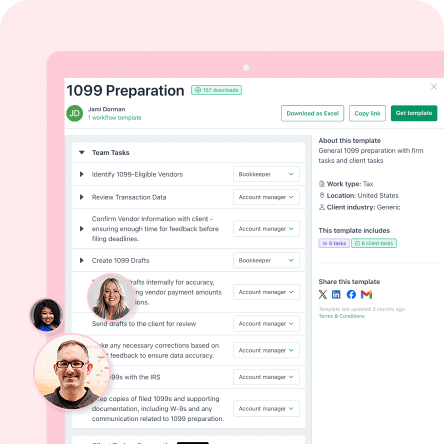
Crucially, Katie treats documentation as a living system. “It’s never in set-it-and-forget-it mode,” she said. Her team takes the time to revisit workflows when things are slow, applying lessons learned during busy seasons and adjusting as their tech stack evolves. (If you’re starting from scratch, Financial Cents’ free workflow template library is a useful on-ramp.)
Dave knows the pain of inadequate documentation firsthand. Six years into running Capovario, he realized he hadn’t built his firm to scale, because most of his processes—or at least pieces of them—lived only in his head. Reflecting on his learnings, his advice to new firm owners is to set aside dedicated time to work on the business, not just in it.
He also recommends using all the technologies at your disposal to help you document your processes and workflows.
Angela jumped in and shared a real example of how she’s leveraging AI at Mindfull Money Matters. After realizing how much of her firm’s operational structure existed solely in her brain, she started using Abacor, an AI tool, to record herself as she walks through different workflows and client files. Those recordings then get turned into projects she uploads into Financial Cents.
Dave’s team takes a collaborative approach to the same basic concept. One person talks through a workflow while another types it up, and then a third person has to complete the actual work using only what was written. “If they get stuck, then we didn’t do it correctly,” he explained.
They keep refining the workflow until it holds up for someone who has never seen it before. This process also gives his team a voice in how the work gets done—which is important, he says, because if he documents every workflow himself, “they literally will just do what I wrote and then say, ‘Well, that’s all you told me to do.’”
Create a culture of autonomy
Teaching your team to run autonomously is one thing. Giving them the space to actually do it is another, and an important of a great accounting firm culture. Backing away from the day-to-day as your firm grows can be hard—especially when the fallout from any mess-ups ultimately rests on your shoulders.
So, how did these owners get over the hump? First, they accepted that the risk of a team member making a mistake never truly goes away. Then they moved on to mitigating that risk as much as possible.
Christine, for example, started setting her team’s internal deadlines earlier than the real ones. That way, she’d have time to check their work—and fix it if needed—before anything reached the client. Eventually, she developed a tiered delegation system based on risk. She’s less inclined to hand off tasks for high-value or high-maintenance clients. But lower-stakes clients—including those who have turned out not to be the best fit anyway—are prime candidates for delegation.
“Like, I don’t even know if this client’s gonna pay this month,” she said, giving a hypothetical example of work she might pass off to a team member. “So sure, try this task, and we’ll see if it works.”
Still, she knows she’ll never actually shrug off any flubbed client work—regardless of which tier they fall into.
In some cases, letting employees fail is the best way to identify a mishire. Angela learned this lesson the hard way when she was forced to scale back her work hours after having back-to-back eye surgeries. She intentionally scheduled her downtime during the holidays, when she expected the firm’s workload to be relatively light. Instead, she became acutely aware of just how dependent her team was on her—and how much she had been compensating for a particular employee she ended up parting ways with after the second eye surgery.
The reset that followed involved locking in the right systems and staff, recognizing and acknowledging the signs that something is amiss, and getting to a place where trust can truly be the default—even when things don’t run perfectly 100% of the time.
Enable trust to enforce boundaries
Work-life balance is often one of the main reasons people leave corporate environments to build their own businesses, and every firm owner on this panel spoke to some version of that goal.
Setting and defending boundaries is crucial to making this dream a reality—which also hinges on cultivating a culture of trust within your team. At Capovario, for example, no one is held to a set work schedule. Everyone at the firm—Dave included—works the hours they want to work. This model is only possible because they all have access to Capovario’s entire client caseload, and everything you could ever need for each client is documented in Financial Cents: history, notes, and upcoming action items.
If one team member is offline, another can step in, answer a client, complete a task, and keep things moving. That kind of team-wide visibility and collaboration is what makes flexibility possible without work slipping through the cracks.
For Christine, protecting boundaries sometimes means siding with her team over a client.
The natural extension of that principle is being willing to weed out the difficult and poor-fit clients who make boundaries nearly impossible to enforce. (She’s actually planning to disengage some of those clients this summer.)
With a strong foundation of trust in place, boundaries are much easier to protect across the entire firm. For Angela, one true non-negotiable is no client-facing messages after 4:30 p.m.—and she holds her team members to the same rule. A late-night message, even from an employee working odd hours, signals to clients that they can expect responses at all hours. Her solution is two buttons she swears by.
“My favorite button is ‘send later,’” she said. “My other favorite button is ‘do not disturb.’”
Katie caps her own work at 40 hours a week (even during tax season), never schedules morning meetings (that time is reserved for Pilates and her own mental health), and is unapologetically good at saying no.
Automate to optimize
When Shahram asked the panelists what they would automate first if they were starting their firm all over again, the overwhelming consensus was client intake and onboarding. It actually ties back to the boundary conversation, because great intake helps you stop poor-fit clients from becoming downstream boundary-pushers.
That’s exactly why Katie focused heavily on this segment of the client journey from the very beginning. As a one-woman show, she knew she couldn’t manually onboard a big wave of clients all at once, so she automated her entire pipeline: leads captured on her website flow straight into Financial Cents via Zapier, with a cascade of automations behind it. Katie called this approach “transformational,” especially during the onboarding rush of her first tax season. She’s also built three key questions into her intake questionnaire that are designed to flag bad-fit clients before she ever gets on a call.
That’s huge, because many firm owners—including Angela, by her own admission—waste way too much time engaging with prospects who end up being totally wrong for them. In fact, automating the lead capture and client onboarding process is her admin’s biggest summer project—complete with a new red/yellow/green “flag sheet” to triage fit early.
If Christine could go back in time, she would automate meeting notes for every call and create tutorial videos for recurring accounting work—making it much easier to hand off tasks when she’s too overwhelmed to sit down and explain how to do something.
Protect your time (and your sanity)
Shahram closed with a lightning round: one piece of operations advice you’d give yourself on day one. Here are the golden drops the panelists shared:
- Dave: “Protect my time. Set those boundaries up right away and realize that you don’t have to be desperate.”
- Christine: “Be picky with the people you take on, no matter how big of a check they’re flagging in front of you. Just know that the right type of client is out there for you.”
- Katie: “Document, document, document. And don’t ever stop documenting, because the workflow is constantly evolving and changing.”
- Angela: “Breathe. I think sometimes we’re so engrossed in what’s happening that you don’t realize that you haven’t taken a step back and taken a breath. And when you do that, it gives you a clearer picture of what’s happening.”
Perhaps not surprisingly, their wisdom focused not on growing as quickly as possible, but on growing sustainably. And that’s what running lean is all about: implementing the systems, processes, and boundaries that allow you to take control of your time and put your energy into what’s actually important—inside and outside of the office. Some days, that means starting work before the sun and wrapping up when most people are sleeping. Others, it means answering emails for an hour or two and spending the rest of the day at the beach with your family.
As Angela perfectly summarized, “I am a strong believer of having harmony. I don’t love the word ‘balance,’ because to me, balance is static. Nothing is ever, in my opinion, fifty-fifty or always even. I feel like there’s a harmony—there are ebbs and there are flows. There are times when we work a lot, and there are times when we don’t. And everybody’s schedule is very different.”
This was the fourth and final session in the Proudly Small series, a four-part lineup of weekly conversations designed for small and growing accounting firms.
Visit the full Proudly Small hub to meet the firm owners from all four panels, and add your firm to the Wall of Small Firms. It only takes 30 seconds.
Share this article: