
Instead of building a firm from scratch, many accounting professionals choose to buy an existing practice. It’s one of the fastest ways to grow revenue, because you acquire an established client base and often a trained team.
However, buying an accounting practice carries real risk. Many buyers focus on revenue and valuation and underestimate what it takes to combine two firms operationally. Differences in workflows, technology, client communication standards, and management style can create problems during the transition.
In a January 2023 McKinsey survey of almost 1,100 M&A leaders, 44% cited a lack of cultural fit and friction between the acquiring and target companies as top reasons integrations fail. Execution during integration determines whether an acquisition succeeds.
You need a clear plan to integrate systems, standardize processes, retain clients, and support staff through the transition. If you ignore these areas, you can lose staff, clients, and revenue soon after closing.
This guide covers everything you need to know about buying an accounting practice, with a free checklist to keep you organized. If you’re on the other side of the deal, see our guide to selling an accounting practice, or take Adam Shay’s free 5-day course on building a buyer-ready practice.
TL;DR
- Why buy instead of growing organically: immediate revenue and cash flow, an established client base, a trained team with existing processes, and faster growth with less marketing.
- What you can buy: solo practices, small bookkeeping firms, niche firms (tax-only, CAS, audit), and local or remote firms, each with different revenue stability and retention risk.
- How firms are valued: revenue multiples, EBITDA or seller’s discretionary earnings (SDE), adjusted for client retention risk, owner dependency, and staff and systems maturity.
- The 12-step buying process: define your goal, evaluate, complete financial, operational, client, and legal due diligence, set valuation and deal structure, sign a letter of intent, finish final diligence, plan the transition, close, and integrate.
- Biggest mistakes: overestimating client retention, underestimating owner dependency, ignoring workflow gaps, poor communication, and having no integration plan.
Why Buy an Accounting Practice Instead of Growing Organically?
Buying a practice gives you immediate revenue, an established client base, a trained team, and faster growth with less marketing. It isn’t the right move for everyone, but for the right firm, it can accelerate growth in ways organic expansion can’t.
Immediate revenue and cash flow
One of the biggest advantages of buying a practice is immediate revenue. When you acquire a firm, you take over active engagements and recurring fees from day one, instead of investing months or years in marketing campaigns, client pitches, or sales cycles to generate the same revenue.
A reliable revenue stream improves cash flow and supports future growth.
Established client base
Winning new clients is expensive and time-intensive. In professional services, trust drives buying decisions, and trust takes time to build.
Instead of starting from zero, you begin with engaged clients who already trust the practice and value its services. That doesn’t guarantee retention, but it removes the long ramp-up needed to build credibility in a new market or service line.
Trained staff and existing processes
Hiring, training staff, and building systems that work take time and experience. Buying a practice with an experienced team saves the time and cost of recruiting, onboarding, and training.
That team also brings institutional knowledge of the firm’s services, client expectations, internal workflows, and technology. And staff retention often supports client retention: clients are more likely to stay when familiar team members remain on their work.
Faster growth with less marketing effort
Organic firm growth relies heavily on marketing, networking, thought leadership, referrals, and content. Some firms invest hundreds of hours a month in content, SEO, and relationship-building to keep the pipeline full.
An acquisition reduces that reliance because you’re buying existing demand: the firm already has clients, referral sources, and market presence. Your marketing shifts from building baseline revenue to expanding what you’ve acquired. You also gain cross-selling opportunities, because the acquired firm’s clients can now use services you already offer.
Exit opportunities from retiring owners
More practices are for sale because owners are planning their exit. In the AICPA PCPS 2020 succession planning survey, 44% of solo practitioners and sole proprietors said they plan to retire within the next five years, one reason acquisitions have become a common growth path.
For retiring owners, selling to another firm provides continuity for clients and staff. For buyers, it creates opportunities to acquire established revenue from motivated sellers willing to support a structured transition. Succession-driven deals often include seller involvement during the handoff, which can improve client retention and make integration smoother.
What Types of Accounting Practices Can You Buy?
You can buy a solo practice, a small bookkeeping firm, a niche firm, or a local or remote firm. Each model comes with different revenue stability, staffing needs, operational complexity, and retention risk, so understanding the model makes it easier to assess fit and value.
Solo practitioner practices
Solo accounting practices are run by one accountant, often with one or two support staff. They typically focus on compliance services like tax preparation, year-end filings, and basic bookkeeping. Pricing and service models are usually straightforward, and client relationships tend to be personal and direct.
Small bookkeeping firms
Bookkeeping firms maintain financial records for businesses: tracking transactions, reconciling accounts, managing accounts payable and receivable, and preparing basic financial reports. This accounting firm organizational chart guide shows the structure and roles to expect by firm size.
Niche firms
Some firms specialize in one service line rather than a full-service model: tax-only firms, client accounting services (CAS) firms, bookkeeping-only practices, or audit-focused firms. Niche firms are useful acquisition targets if you want to expand a specific offering.
Local vs. remote firms
Local firms have a physical presence in a specific community or region, focus on clients in that market, and often provide face-to-face service. They may have deep knowledge of local tax laws, business climates, and regulations, a differentiator for clients who value personal interaction.
Remote accounting firms operate virtually, serving clients anywhere through online communication, cloud accounting tools, and digital workflows. They scale more easily across regions and often appeal to clients comfortable with technology.
You may be interested in: 18 Practical Strategies for Managing an Accounting Firm
How Are Accounting Firms Valued?
Accounting firms are usually valued with revenue multiples or profit-based measures like EBITDA or seller’s discretionary earnings, then adjusted for client retention risk, owner dependency, and the maturity of the firm’s staff and systems.
Revenue multiples
One of the most common valuation methods in smaller practice transactions is a revenue multiple: annual gross revenue multiplied by a market-based factor, which gives buyers a quick estimate of market value relative to other deals.
Firms with a high share of recurring revenue (monthly bookkeeping, payroll, or ongoing CAS engagements) tend to command higher multiples because those fees are predictable. Revenue from one-time projects, irregular advisory work, or seasonal spikes is less stable and may justify a lower multiple.
EBITDA or cash-flow-based valuations
Another approach values the firm on profitability, often using earnings before interest, taxes, depreciation, and amortization (EBITDA) or a cash-flow measure. For many mid-sized firms, buyers use EBITDA multiples to see how efficiently the firm converts revenue into profit.
This approach is especially useful when two firms generate similar revenue but very different margins: a firm with stronger margins and disciplined cost management typically justifies a higher valuation. Smaller, owner-dependent firms may be valued on seller’s discretionary earnings (SDE), which includes owner compensation and discretionary expenses and shows what a new owner can expect in cash flow after the previous owner leaves.
Client retention risk
A firm’s long-term value depends on how many clients stay after the sale. If most revenue comes from clients who stay year after year, the firm is worth more. If the client base churns often, adjust the valuation down to reflect that risk.
Owner dependency
Firms where the owner does most of the technical work, holds all client relationships, and makes key decisions alone are riskier. If clients chose the firm because of the owner, they may leave after the sale, so buyers value systems and independence over owner reliance.
Staff and systems maturity
Well-run firms with stable teams and documented systems signal lower operational risk and often command higher valuations, because buyers read them as a proxy for future performance and retention.
Firms with unclear responsibilities, undocumented processes, and fragmented systems may need significant restructuring after acquisition, and that cost and risk should be reflected in the deal terms.
What Are the Steps to Buying an Accounting Practice?
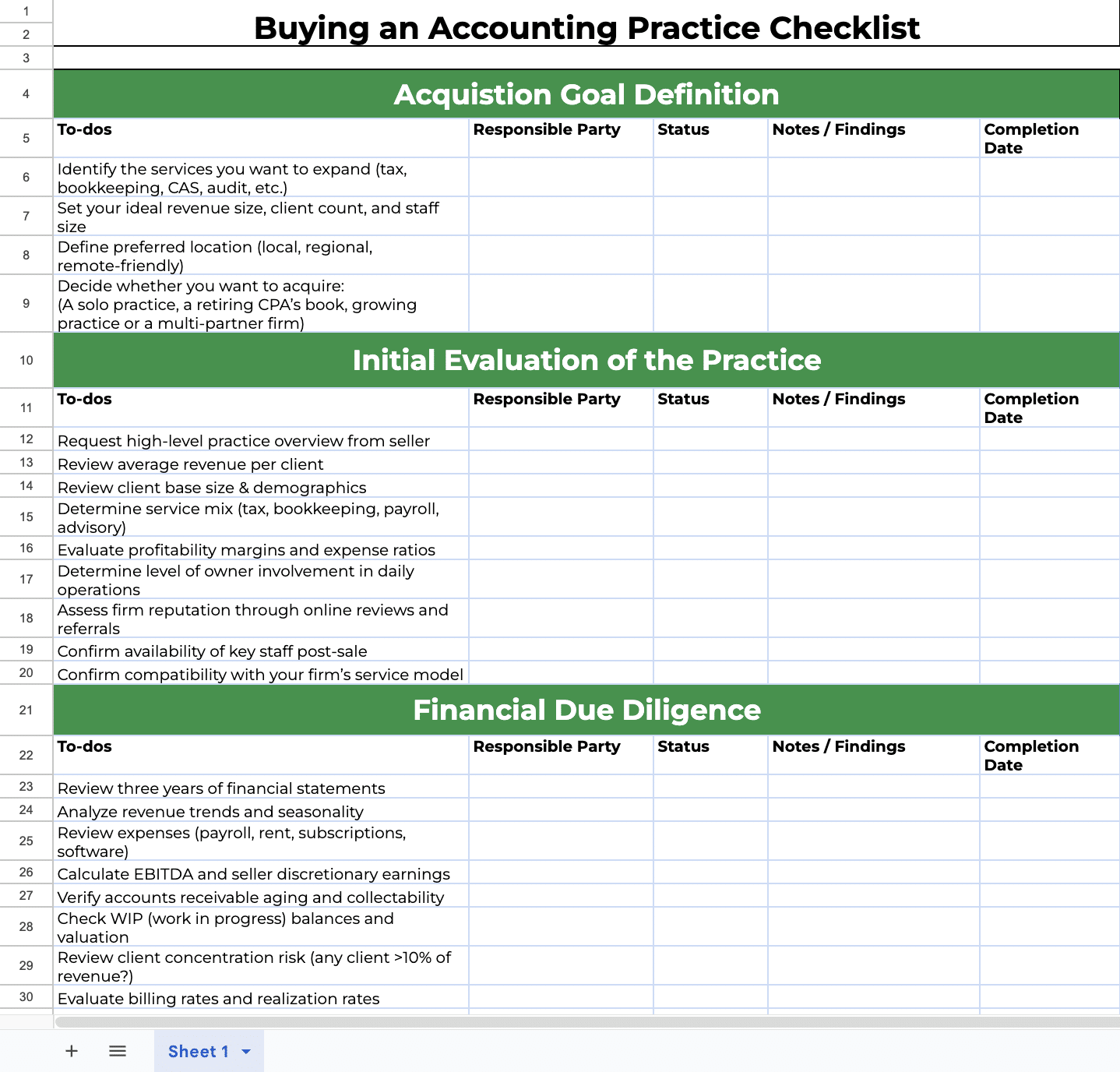
Buying an accounting practice takes 12 steps, from defining your acquisition goal through due diligence, valuation, closing, and integration. Follow them in order to avoid costly mistakes, and download the full checklist (Excel and Google Sheets) below.
Step 1: Define your acquisition goal
Before reviewing any firm for sale, clarify exactly what you want to achieve.
Are you trying to add recurring monthly bookkeeping revenue? Expand into advisory? Enter a new geographic market? Your objective determines the type of firm you pursue, the revenue size you target, and how much operational complexity you’re prepared to absorb.
Write down your criteria: minimum revenue range, client count, staff size, service mix, preferred location, and type of practice (solo, multi-partner, and so on). Then evaluate each opportunity against that framework instead of getting distracted by attractive revenue numbers that don’t fit your strategy.
Step 2: Perform an initial evaluation
Once you find a firm that matches your goals, review it before committing to deeper diligence.
Request a high-level practice overview, a breakdown of revenue by client, the service mix, profitability margins, the owner’s involvement in daily operations, the firm’s reputation, and its compatibility with your service model. If the practice doesn’t pass this evaluation, walk away; an early exit saves time and legal costs.
Step 3: Complete financial due diligence
If the opportunity passes your initial screening, move to detailed financial analysis.
Review the last three years of financial statements. Analyze revenue trends and expenses, calculate EBITDA and seller’s discretionary earnings, and verify accounts receivable aging and collectability.
Also check work-in-progress (WIP) balances and valuation, client concentration risk (does any client exceed 10% of revenue?), billing and realization rates, and the firm entity’s tax returns, if available.
Step 4: Complete operational due diligence
Strong financials don’t guarantee a smooth transition. You need to understand how the practice actually runs.
Review workflows for recurring services such as bookkeeping, close cycles, tax preparation, and payroll. Are procedures documented?
Assess the technology stack: whether client documents are centralized, how communication is managed, and whether there’s a formal accounting practice management system in place. Check cybersecurity and data security protocols to make sure sensitive information is protected.
Evaluate staff roles, productivity, utilization, and turnover, and inspect the physical office if it’s included in the sale.
Step 5: Review the client base
The real asset in an accounting practice acquisition is the client base, so study it carefully.
Analyze client industries and service types, client retention over the last three years, the share of recurring revenue, and client concentration. If more than 10–15% of revenue comes from one client, it’s risky.
Examine average client tenure, since long-standing clients with consistent service history are generally more stable, and look for upselling and cross-selling opportunities. Review engagement letters to confirm that scope, pricing, and renewal terms are documented; verbal agreements or outdated letters increase risk.
Step 6: Complete a legal and compliance review
Before you finalize value discussions, make sure there are no hidden liabilities, lawsuits, or potential claims.
Verify the firm’s licensing status and CPA credentials, confirm compliance with state board regulations, check that it’s in good standing with IRS e-file requirements, and review its insurance policies. Then inspect engagement letters, client contracts, leases, vendor agreements, and software contracts.
Step 7: Set the valuation and deal structure
After diligence, determine a reasonable purchase price and structure.
Select a valuation method and review comparable sales in your region. Decide whether the transaction will be an asset purchase, stock purchase, merger, or buy-in.
For payment, agree on upfront cash, an earn-out based on retention, seller financing, or a hybrid. Seller financing and earn-outs can align incentives and protect you if clients leave.
Step 8: Negotiate and sign a letter of intent (LOI)
Once you agree on general terms, document them in a letter of intent. The LOI outlines the purchase price, payment structure, transition expectations, how long the seller stays involved after the sale, and non-compete and non-solicit requirements.
While not always fully legally binding, the LOI sets expectations and reduces misunderstandings during final contract drafting.
Step 9: Complete final due diligence
Before closing, confirm everything one more time.
Audit client files in detail, verify major engagements and staff agreements, review all software and login access, and inspect backups, servers, and cloud environments. Reconfirm financial figures against original documents and confirm all liabilities are disclosed, with no outstanding legal issues. If new risks appear, revisit the valuation or structure before signing.
Step 10: Plan the transition
Write a transition plan covering how and when clients will be informed, how staff roles will shift, and how systems will be integrated.
Schedule knowledge transfer sessions with the seller and migrate documents and data securely. Set up access to all software, transfer licenses and subscriptions, integrate workflows into your system (Financial Cents, for example), and update engagement letters under your firm’s name.
Step 11: Close the deal
Closing formalizes the transfer of ownership. Sign the final purchase agreement, transfer funds, confirm receipt, and take operational control.
Complete legal registrations or entity updates and transition payroll and HR documents for acquired staff. Then update your website, email signatures, and branding to reflect the transition.
Step 12: Integrate after the acquisition
Prioritize early outreach to key clients. Monitor retention and revenue during the first 90 days and track financial performance against projections.
Hold regular team meetings, set expectations, and assign clear ownership for each client and service line. Watch deadlines closely in the first few months, track client retention and staff morale, and address issues quickly.
Download Your Buying An Accounting Practice ChecklistWhere Can You Find Accounting Practices for Sale?
Look for practices through brokers and marketplaces, CPA networks and associations, direct outreach to retiring owners, conferences and referrals, and internal succession. Use several channels at once rather than relying on one.
Practice brokers and marketplaces
Accounting practice brokers specialize in connecting buyers and sellers. They often keep confidential listings that aren’t advertised publicly and can help with valuation, deal structuring, and due diligence. Dedicated brokers such as Accounting Practice Sales, Poe Group Advisors, and Accounting Firm Sold focus on accounting practices across regions.
Online marketplaces such as the Accounting Practice Exchange let you search listings by revenue range, services, staff size, and work mode, and contact sellers confidentially. Using both widens your reach: brokers surface opportunities before they go public, while marketplaces show firms currently open to acquisition.
CPA firm networks and associations
Industry associations, CPA networks, and professional groups may not list practices for sale, but they connect you with practitioners who may be considering retirement or a sale soon. Start with your state CPA society and local accounting associations; many have member directories, classifieds, or partner programs that facilitate introductions.
Direct outreach to retiring owners
Direct outreach can produce the best-fit deals, but it takes patience. Many owners don’t list their practices publicly; they may be open to selling in the next year or two but haven’t started the process.
Identify firms that meet your criteria, then contact the owner with a simple, respectful introduction outlining your interest, experience, and growth plans. This works especially well with local or niche firms where acquisition activity is low.
Industry conferences and referrals
Accounting conferences are underrated for deal sourcing because they put you in the room with owners thinking about growth, succession, and exit planning. Some won’t say publicly that their firm is for sale, but many will talk openly about their retirement timeline.
Referrals happen naturally here too. Relationships with other firm owners, lenders, attorneys who serve professional services firms, and practice management consultants can lead to introductions before a listing goes live. Be specific about what you’re looking for, so others can connect you with the right opportunities.
Internal succession opportunities
Sometimes the best acquisition is a succession opportunity inside your own firm. If a senior partner or manager is ready to take ownership of part of the firm, or a buy-in is possible, you can expand capacity without the disruption of acquiring an outside practice.
Internal succession reduces integration risk because culture, systems, and client expectations are already aligned, and it strengthens leadership continuity.
What Are the Most Common Mistakes When Buying a Practice?
The most common mistakes are overestimating client retention, underestimating owner dependency, ignoring workflow and system gaps, communicating poorly with staff and clients, and having no post-acquisition integration plan.
Overestimating client retention
A frequent mistake is assuming clients will automatically stay after the sale. Buyers often underestimate how much individual relationships, service expectations, and perceived value influence that decision.
Build a retention strategy early instead. Introduce yourself to key clients before closing, explain how services will continue or improve, and show a concrete plan for ongoing support.
Underestimating owner dependency
Many sellers built their client base through personal relationships, reputation, and trust, so the practice is often inseparable from the owner. Staff and clients may leave once the owner exits if you don’t plan how those relationships will transfer to your leadership.
Assess the business’s dependence on the seller early in due diligence. Check how many people interact regularly with clients, what client communication looks like, and whether the seller will support introductions and joint meetings during the transition.
Ignoring workflow and system gaps
Buyers often spend most of their time on financial due diligence and not enough on operations, then discover after closing that the practice runs on scattered spreadsheets, email threads, inconsistent file storage, and undocumented processes.
Treat workflow and systems as part of valuation. Before signing, check how tasks flow, how deadlines are tracked, how work is reviewed, and whether tools are standardized. A firm with well-defined accounting processes and modern systems reduces onboarding risk and creates consistency for clients and staff.
Poor communication with staff and clients
When communication is poor or reactive, staff worry about job security and changing expectations, and clients fear a drop in service quality.
Develop a communication plan well before closing. Explain why and how the transition is happening, set expectations for what will stay the same, and share clear timelines. Regular updates reduce uncertainty and build trust in the new leadership.
No post-acquisition integration plan
Perhaps the biggest mistake is assuming integration will happen naturally after closing. It doesn’t. Small issues like duplicated tools, inconsistent client service, unclear task ownership, and teams operating in parallel compound quickly.
Develop an integration plan covering systems, workflows, client service consistency, staffing roles, and performance expectations. Without one, you can lose the revenue and people that made the acquisition attractive in the first place.
What Technology Do You Need After Buying a Practice?
After buying a practice, you need a technology foundation that centralizes client information, standardizes workflows across both firms, assigns clear ownership, tracks deadlines and workloads, and keeps service consistent.
Without it, disconnected systems, unclear processes, and fragmented client data quickly lead to missed deadlines, frustrated staff, and clients leaving. That’s why building that foundation should be your first priority after closing. Accounting practice management software like Financial Cents supports it by bringing tasks, communication, documents, and deadlines into one system.
Centralize client information, documents, and communication
During integration, people waste time when they can’t find information or answer basic questions. The Financial Cents client CRM keeps client tasks, documents, emails, and notes in one place, so you aren’t hunting across email threads, shared drives, chat messages, and spreadsheets. That reduces handoff errors and gives everyone the information they need.
Standardize workflows across both practices
Two firms may offer the same services but deliver them differently. If the acquired practice tracks bookkeeping close tasks one way and your firm another, your teams will struggle to collaborate, which causes mistakes.
A practice management platform should let you document how you deliver work and reuse that documentation. In Financial Cents, you can turn your processes into workflow templates that both teams use, so everyone follows the same process and service quality holds.
Assign clear ownership for transition tasks and client work
Ambiguity is one of the most common integration problems. After closing, staff want to know who’s handling what, and clients want to know who their primary contact is.
Financial Cents lets you assign owners to tasks, so team members always know what they’re responsible for, and you can step in when something is blocked. That matters even more for staff joining from the acquired firm, who need to know their responsibilities from week one.
Track deadlines, workloads, and progress during integration
Missing deadlines is one of the fastest ways to lose client trust after an acquisition. If tax returns come in late or a monthly close drifts, clients start wondering whether the firm is still reliable.
You need visibility into upcoming deadlines across all clients, who owns each deliverable, your team’s workload, and progress on ongoing projects. Financial Cents combines deadlines, task progress, and assignments in one view, so you can balance workloads and shift resources during the transition. Our free capacity planner can help you size the combined team’s workload before you integrate.
Maintain service consistency during change
Clients expect service quality to hold even when ownership changes. When both teams work in the same workflows, communication standards, and client portal, service delivery becomes more predictable while staff and clients adjust.
Build a Technology Foundation With Financial Cents
Buying an accounting practice can be a transformative move when you do it intentionally. It can fast-track growth, add recurring revenue, and expand capacity without waiting years for organic growth to catch up.
What happens after closing matters just as much. The success of an acquisition depends on execution during the transition, and disconnected systems, unclear workflows, and fragmented client data make it harder to retain clients and staff. Financial Cents helps you centralize client information, standardize workflows, assign clear ownership, and track deadlines and progress.
Build a stronger foundation for growth. Start a free trial or book a demo.
Frequently Asked Questions (FAQs)

The Financial Cents Editorial Team creates practical guides, templates, and resources for accounting, bookkeeping, and tax firms, drawing on our in-house experts and the firm owners we work with.
Share this article