The best tax practice management software puts everything your team needs for tax season in one place: workflows, client information, documents, deadlines, and team capacity.
That matters because workflow is still the biggest operational headache for accounting and tax firms. In the 2025 State of Accounting Workflow Automation Report, firms ranked workflow inefficiencies, client communication delays, and manual admin among their top pain points, and getting documents from clients remained the single biggest workflow issue.
How many of those problems software solves for you depends on the features it gives you. Pick a tool with gaps, and you’ll end up paying for (and switching between) several apps to cover your tax process.
This guide walks you through the 11 features your tax practice management software must have, with examples of how each one works in practice.
TL;DR
- Tax practice management software is a platform that helps your tax firm manage client work, documents, deadlines, communication, and team capacity in one place, especially during tax season.
- The 11 must-have features: workflow management with tax templates, client CRM, due date tracking, team collaboration, automated client and signature requests, secure document management, a client portal, capacity management, uncategorized transaction review, time tracking, and built-in billing, payments, and proposals.
- Also worth having: integrations with your general ledger, document management system, and Zapier, so the tool fits the rest of your stack.
- The deciding test: the right tool replaces apps instead of adding to them, so check how many of these features come built in versus through add-ons.
What Is Tax Practice Management Software?
Tax practice management software is a platform that helps your tax firm run its operations from one place. It organizes tax projects into repeatable workflows, tracks filing and client deadlines, collects documents and signatures from clients, centralizes client communication, and shows you how much capacity your team has.
It’s different from tax preparation software, which you use to prepare and file returns. Practice management software manages everything around the return: the requests, reminders, handoffs, and deadlines that decide whether returns get done on time.
What Are the Benefits of Tax Practice Management Software?
Tax practice management software makes your firm more efficient, improves client communication, protects client data, keeps deadlines visible, supports growth, and cuts manual work. Here’s how each benefit shows up in practice.
a. Increased efficiency and productivity
When your team has one place to onboard tax clients, access their information (and documents), and manage their work (rather than switching between different apps), it becomes easier to get work done accurately and efficiently in the busiest season of the accounting calendar.
b. Improved client communication and satisfaction
Tax practice management software integrates with email service providers, enabling you to track client communication in your workflow dashboard.
This prevents information from slipping through the cracks, helps to align expectations between your team and clients, and sets you up to meet client deliverables consistently.
c. Enhanced security and data protection
Tax practice management software uses encryption technology, access control, and regular security updates to protect the information you exchange between your firm (especially in remote work systems) and your clients.
d. Track client and tax deadlines
Most tax practice management software has workflow dashboards that provide visibility into client work. These dashboards allow you to see where each tax client’s work stands and when to allocate more resources to get work done more quickly and meet tax deadlines.
They also enable you to track your team’s time and workload to ensure everyone completes their tasks as expected.
e. Scalability and growth
The time tracking feature in tax practice management solutions helps you bill your clients more accurately and get adequate value for your team’s time.
Moreover, using a single tool in place of several others helps you to cut costs and save money, which you can reinvest in the business.
f. Reduces time spent on manual tasks
Tax practice management software automates tasks to reduce the time your team spends on their daily operations.
For example, Financial Cents’ automated reminders follow up with your clients for the additional information you need or the forms they need to sign, so your team doesn’t have to.
The 11 Features Your Tax Practice Management Software Must Have
| Feature | What it does | Why it matters in tax season |
|---|---|---|
| 1. Workflow management & templates | Organizes every tax project into repeatable checklists with assignees and due dates | Keeps returns consistent and stops steps from being skipped |
| 2. Client CRM | Stores client details, logins, emails, and activity in one profile | Your team finds client context without digging through inboxes |
| 3. Due date tracking | Shows deadlines, reminders, and internal due dates on one dashboard | Surfaces what’s urgent before it becomes late |
| 4. Team collaboration | Keeps comments, @mentions, and client notes on the project | Cuts back-and-forth across Slack and email |
| 5. Automated client & signature requests | Sends document and e-signature requests with automatic reminders | Collects missing documents without manual chasing |
| 6. Secure document management | Protects files with access control, encryption, backups, and MFA | Safeguards sensitive taxpayer data |
| 7. Client portal | Gives clients a passwordless place to upload, sign, and chat | Clients respond faster when access is easy |
| 8. Capacity management | Shows each team member’s workload and lets you reassign work | Prevents burnout during peak season |
| 9. Uncategorized transactions | Resolves unclear QBO transactions with clients in one place | Clean books before tax work starts |
| 10. Time tracking | Tracks time against tax work with budgets and effective hourly rates | Shows which clients are profitable |
| 11. Billing, payments & proposals | Sends engagement letters, invoices, and collects payments | Gets you paid without another tool |
1. Workflow management (and tax workflow templates)
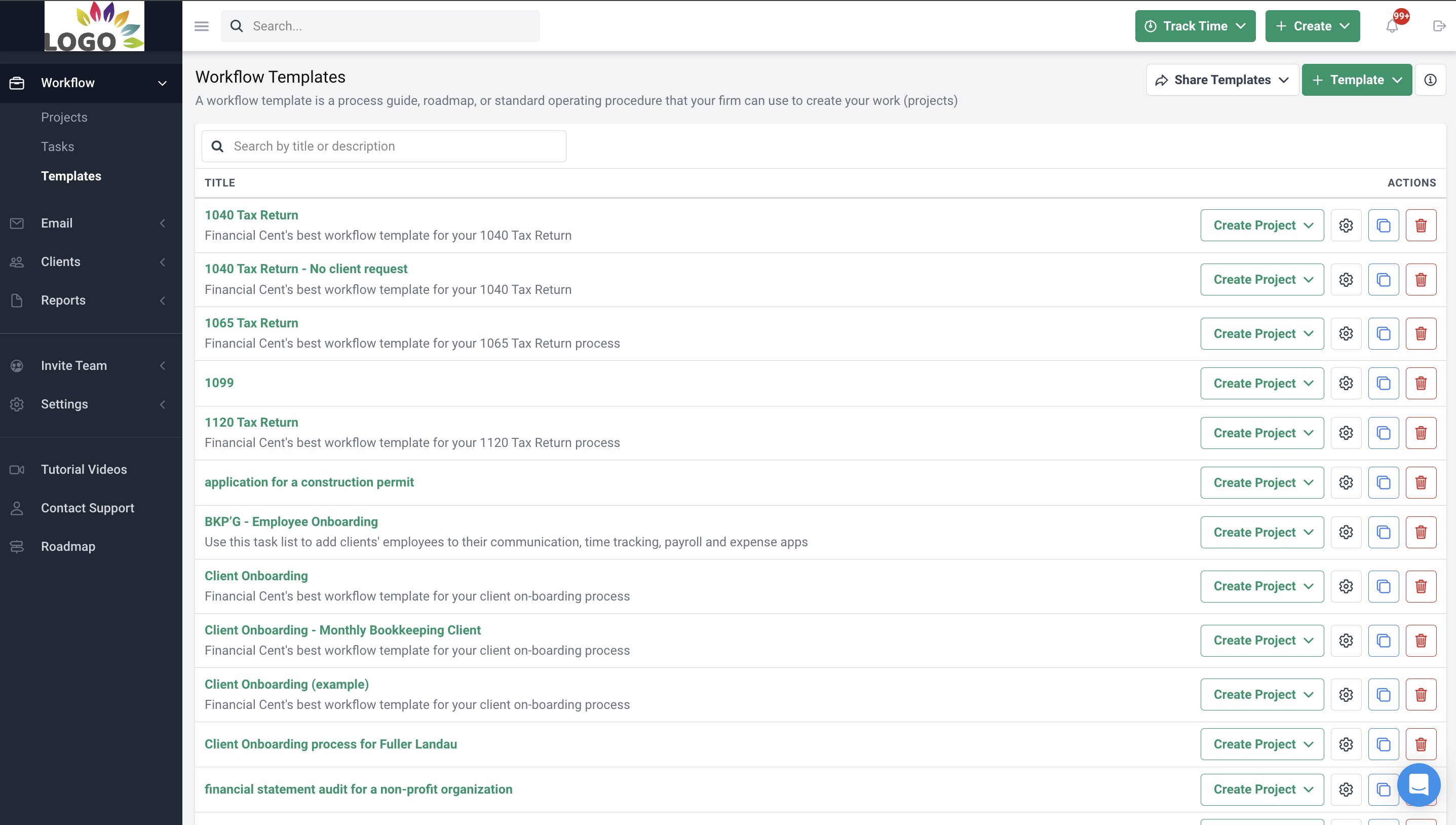
Each tax project represents a set of forms to be signed, a series of conversations, and a set of tasks to manage. This process becomes disorganized and unwieldy when managed in spreadsheets and sticky notes.
A solid workflow management feature gives visibility over these moving parts of a tax workflow by bringing all tax projects, assignees, and relevant documents into one central place. This keeps your firm organized and your priorities aligned during the busy season.
Without it, you will struggle to understand who’s assigned what, where each tax project is, and what is needed to complete it.
Tax practice management software also smooths workflow management by providing free templates. Templates are checklists of steps needed to complete every tax project, which keeps your team from missing critical steps so that your work quality can stay consistent.
With these templates, you can assign tasks to your team members without worrying about accuracy because they have a step-by-step guide for your tax work.
Not to mention the gains in productivity because they don’t have to second-guess themselves while doing the work.
2. Client relationship management (CRM)
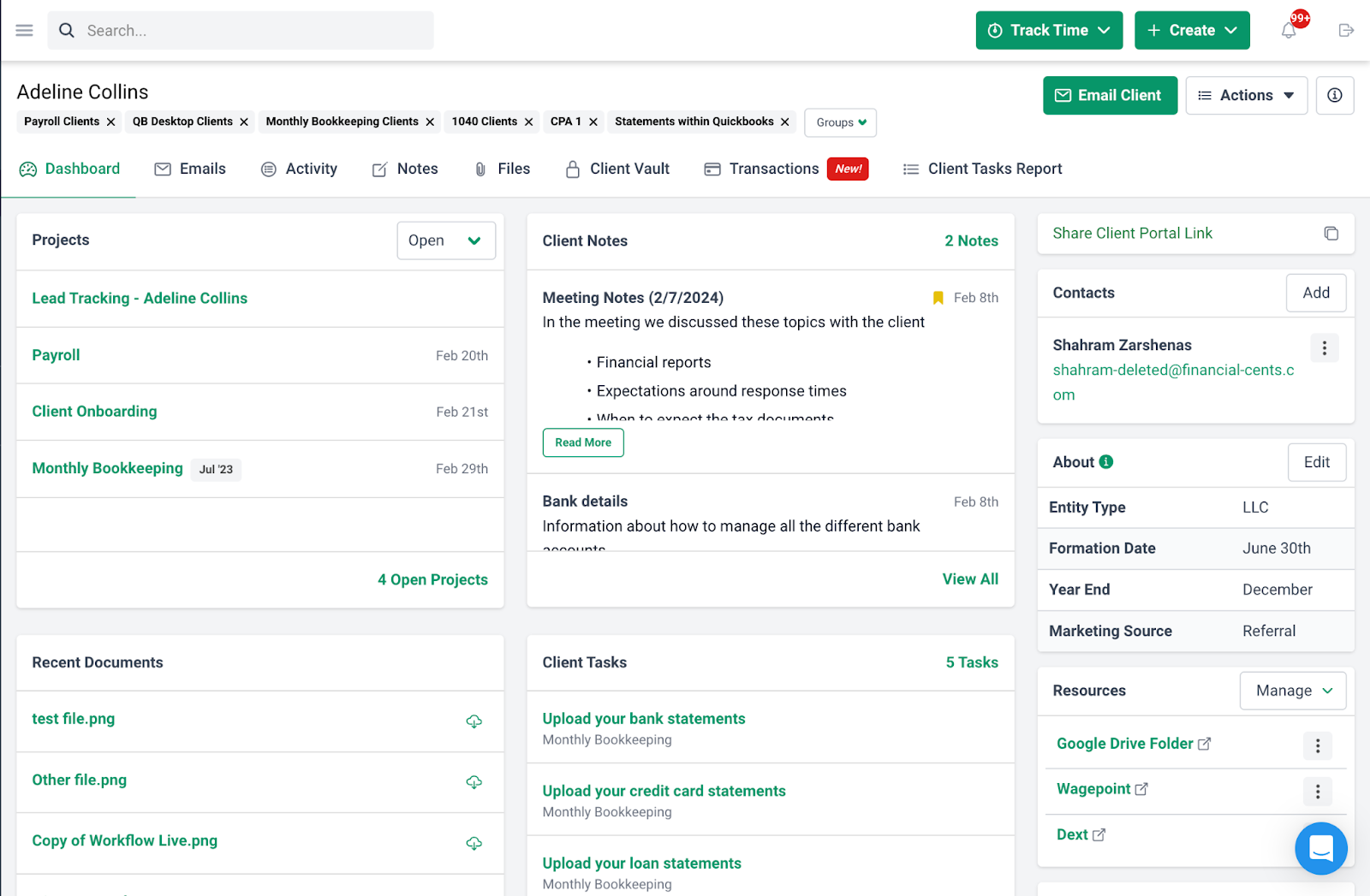
Efficient client relationship management encompasses everything a tax firm does to manage its client relationships, giving clients a good impression of the firm.
The best tax practice management solutions come with the ability to store and manage client information (and interactions), which empowers your team to provide more personalized client services.
This matters because client communication delays rank among firms’ biggest pain points in the 2025 State of Accounting Workflow Automation Report. Part of the problem is using separate tools for clients and workflow, which makes it slow to find client information while you’re doing the work.
With solutions like Financial Cents, client and workflow management happens in one platform.
For Financial Cents users, this feature includes:
- Client Profile (and Vault): For storing all client information (such as contact information, logins, EINs, and SSNs).
- Activity Feed: To understand when your team last interacted with a client, by whom, and about what.
- Client Emails: To access all emails between your team and clients from Financial Cents.
- Effective Hourly Rate: To measure which client is taking more of your time than their fee allows.
3. Due date & deadline tracking

The due date feature enables you to manage project deadlines by creating a visual timeline of your projects to prevent your team from forgetting important details.
With the due date feature, your tax workflow tool will show all your due dates alongside the respective tax projects. This makes it easy for your team to see at a glance when they should complete the tasks assigned to them.
Otherwise, they will struggle to remember the due dates of their assigned tasks and know which one is most urgent. When used well, the due date feature will save you from last-minute rushes that result in errors.
For example, Financial Cents’ due date features include:
- Due Date Reminders: Automatically remind your team about upcoming deadlines according to a predetermined number of days.
- Internal Due Dates: Set shorter deadlines for your team before the actual due date for the project. This helps your team complete the project sooner, meet deadlines, and move on to other projects.
4. Team collaboration and communication
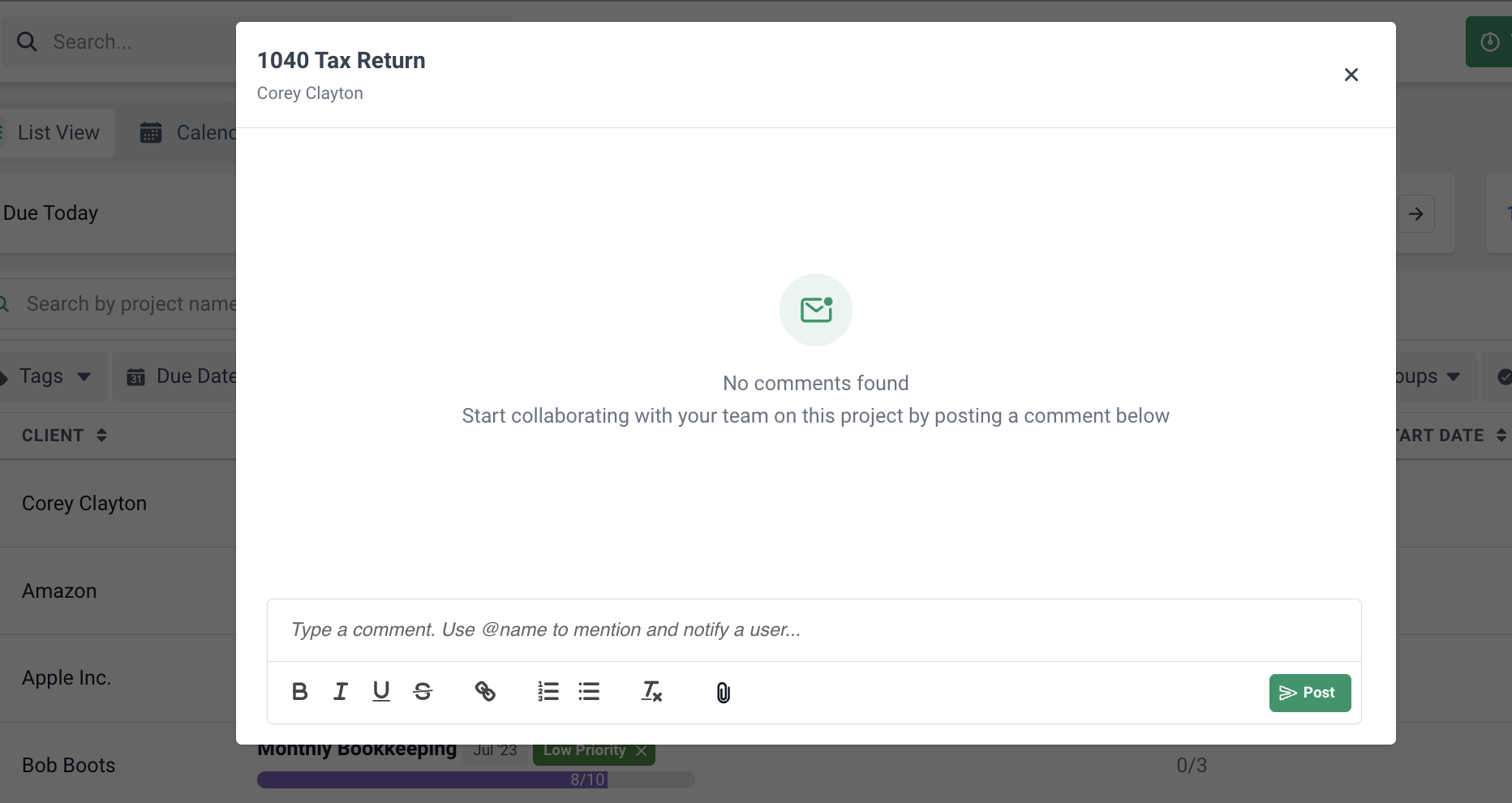
Team collaboration thrives when your team can ask questions, share files, and get clarity on tax work without leaving the project. That helps them get work done to your client’s satisfaction.
You may be using Slack, email, and Microsoft Teams to manage internal communication. But these tools increase the number of apps your team uses for work, not to mention the additional cost you will have to bear and the login information you will have to manage.
Tax practice management software uses cloud-based file-sharing technology to enable your team to share and collaborate on documents in real time.
In Financial Cents, team communication and collaboration work with these features:
- Team Chat: For sharing information with your team as comments on the client’s project.
- @Mention: To tag team members in your comments in Team Chat.
- Client Emails tab: Helps to centralize your email communication with your clients in the client’s profile.
- Client Notes tab: For sharing important client updates on the client’s profile.
5. Automated client (signature) requests

Automated client tasks are the answer to tax client data collection. They save you the time and additional work of chasing clients for the information you need to complete their tax returns.
In a survey of over 600 accounting firms, Financial Cents users reported saving an average of 14 hours per employee each week.
Here’s how this works in Financial Cents.
After onboarding your tax client, Financial Cents allows you to set up a list of the information and documents you will need from them to file their taxes.
Depending on the time you choose to send the requests, your client will receive an email (and text) notifying them of the requests.
This feature also works for client signatures. With Financial Cents’ built-in e-signatures, you can attach a document such as an engagement letter or tax return to a client task, and your client signs it in the same task list. The task completes itself once every signer is done, and standard signature requests are free and unlimited on every plan. For extra assurance, optional knowledge-based authentication (KBA) verifies US signers’ identities. Firms that already use Adobe Sign can keep using that integration instead.
This feature comes with automated reminders that follow up with clients until they complete your request (usually with a click).
6. Secure document management
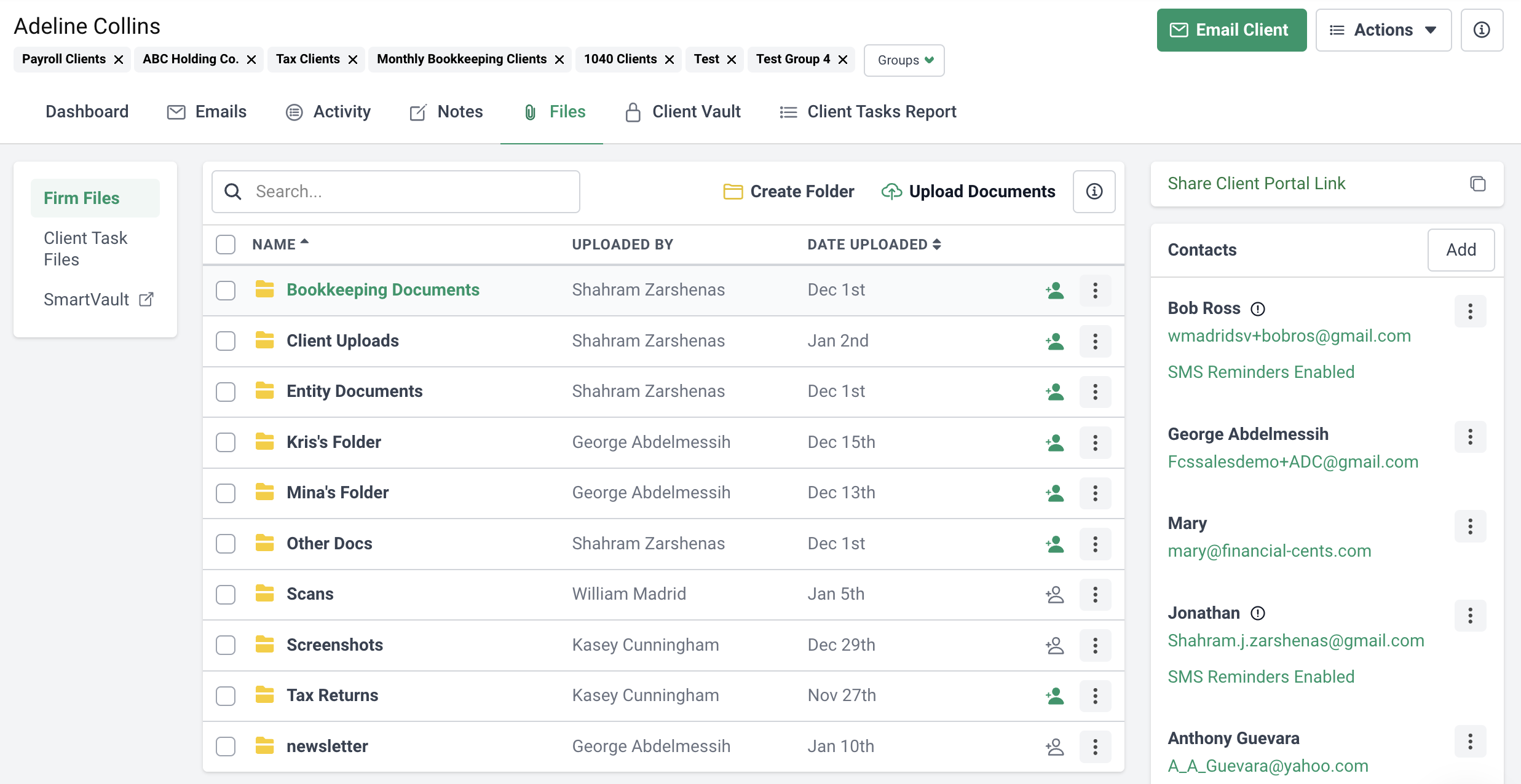
A secure document management feature protects your client’s information from unauthorized access. Tax practice management software uses some or a combination of the following measures to protect your clients’ data:
- Access Control: Empowers you to control the client information your staff can access. Firm owners and managers usually use the need-to-know principle to restrict their employees’ access to only the information they need to complete client tax projects.
- Data Encryption: Makes your clients’ data useless to unauthorized persons. It turns data into cryptic information that requires a passcode to be legible.
- Storage Backup: Protects your client information in the case of a security threat.
- Regular Security Updates: Tax practice management tools are regularly updated to fix emerging security vulnerabilities.
- Multi-factor Authentication: Requires alternate means of verification to give access to information from new devices.
With these security measures, you can organize your clients’ documents and tax information into folders without worrying about their safety.
For example, any document a tax client sends in Financial Cents is automatically added to the client’s profile so your team can access it on demand.
You can also sync client uploads with a third-party document management system. Financial Cents integrates with SmartVault, Google Drive, and OneDrive.
Recommended: The best accounting document management software
7. Client portal
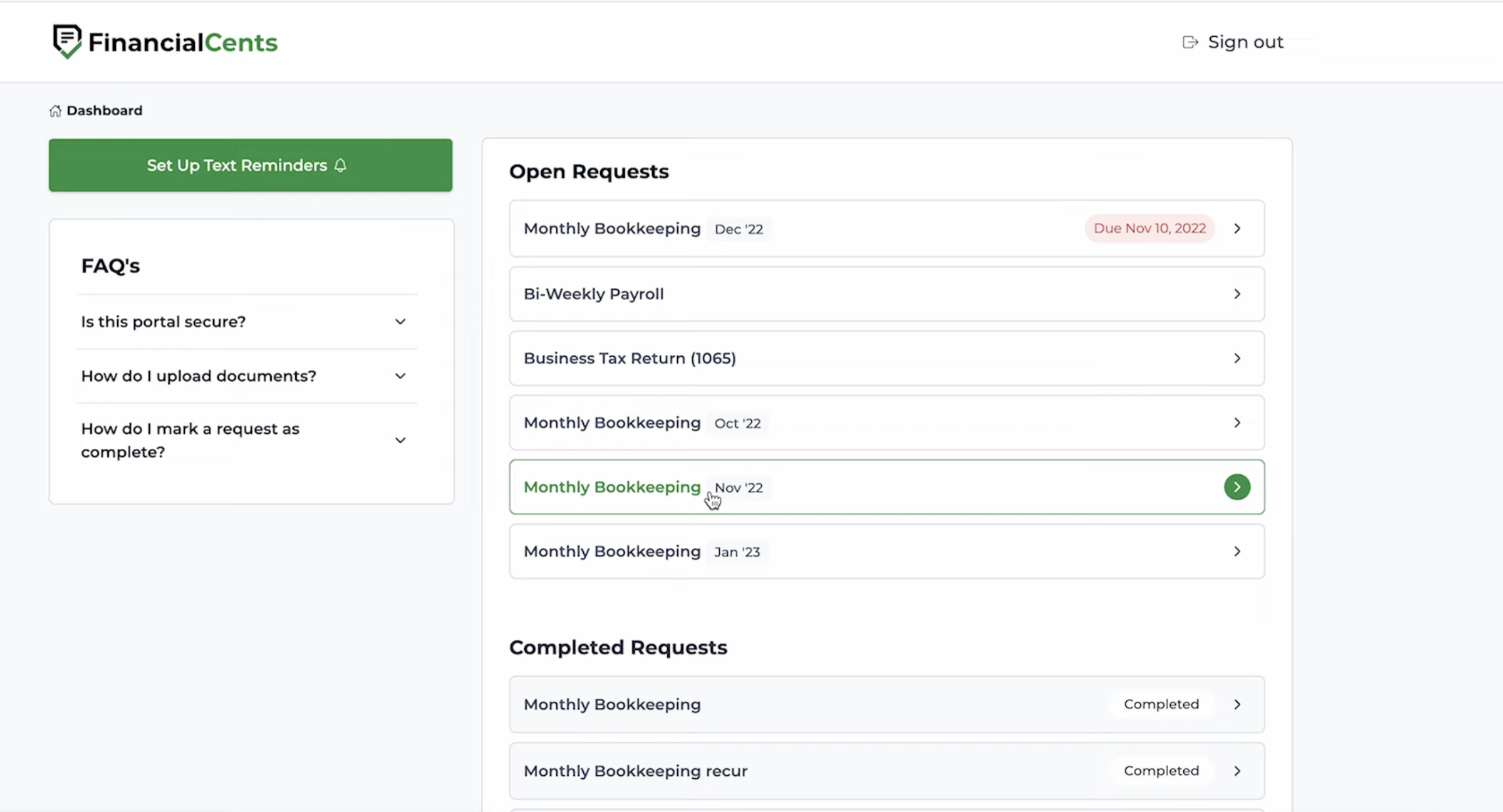
The client portal is a platform for receiving and collaborating with clients on tax documents. By uploading a tax return into the portal, the client can sign the document in seconds (without downloading and scanning it).
With the Financial Cents client portal, clients do not need to create or manage a password and username. Its client portal uses secure magic link technology to verify clients’ identities before granting access.
Clients are already overwhelmed with numerous passwords for their other apps. This passwordless access improves their chances of responding to your request for information and documents.
When your client needs help understanding what you need from them, they can use the chat feature to ask for clarity instead of leaving the portal without completing your request. Once a client uploads the documents you requested, your team will receive an email notification.
On Financial Cents’ Scale plan, you can also customize your client portal to look and feel like your firm by adding your logo, colors, and other brand assets.
8. Capacity management
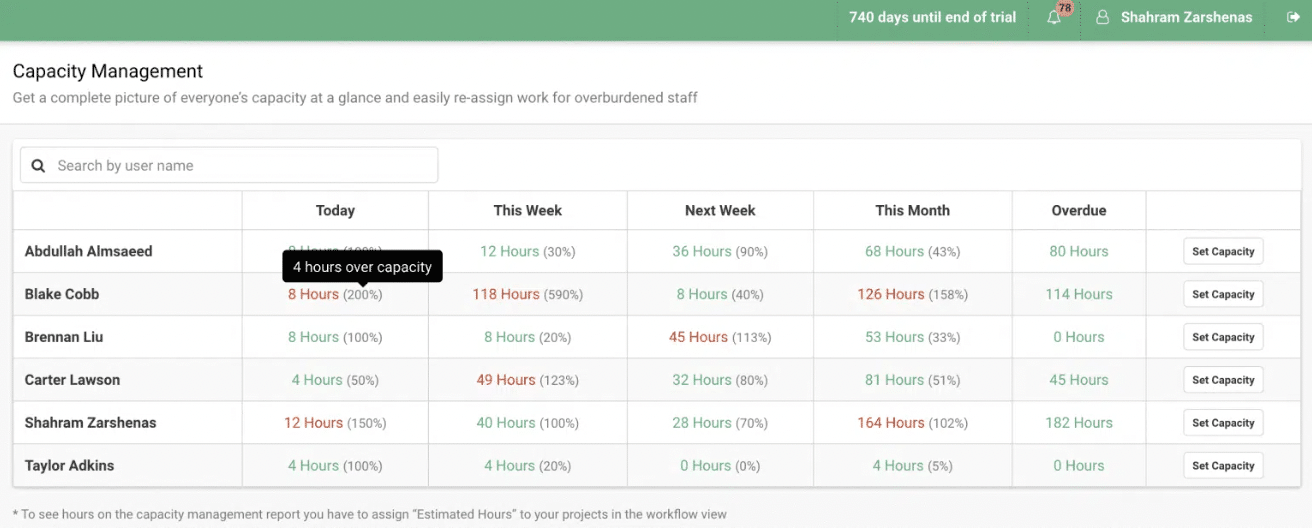
The capacity management feature helps you understand your team’s workload and who has enough room for more work. It helps to ensure that your resources are well managed to meet increasing client demands during the busy season.
Without this feature, some of your employees will be:
- Underworking: you’re paying them for work they are not doing.
- Overworking: this can lead to employee burnout and turnover.
With Financial Cents’ capacity management feature, you have all the data you need to maximize your employees’ skills and time. It gives you the ability to:
- View your team’s workload in a dashboard to see their capacity for more work.
- Set capacity limits to ensure no staff member works more than a certain number of hours in a week.
- Reassign work from overworked employees to other employees to maintain balance in your team.
9. Uncategorized transactions
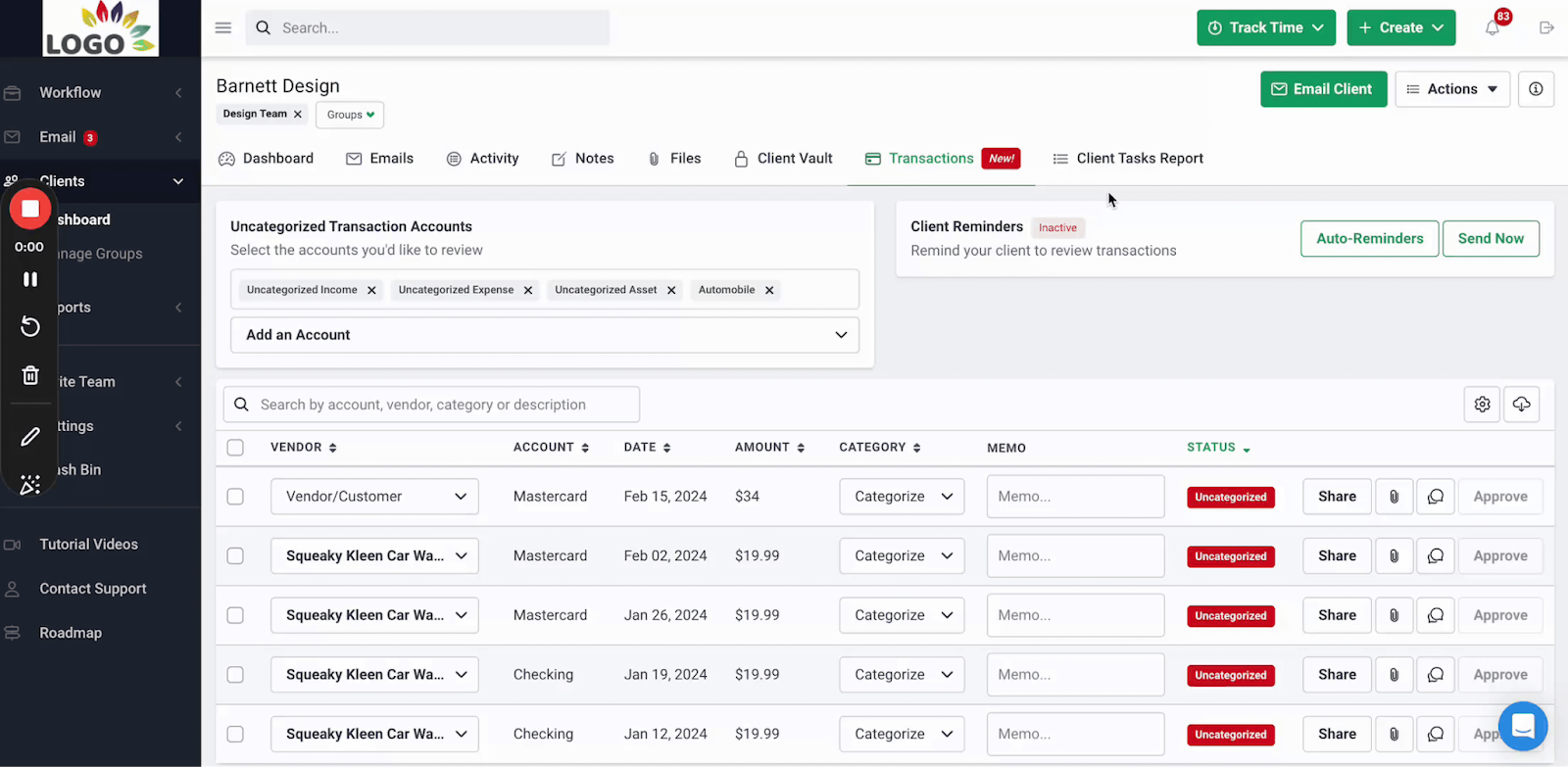
This feature lets you collaborate with clients from your practice management tool instead of downloading uncategorized transactions into spreadsheets.
Called Month-End Close in Financial Cents, this feature includes reminders that keep your requests for information in front of the client, leaving little room for them to forget.
If your tax firm also offers bookkeeping services, here’s how the Month-End Close tool can help:
- Auto-pull uncategorized transactions from QBO: Access all uncategorized transactions in QBO from Financial Cents instead of exporting the data to a spreadsheet.
- Categorize uncategorized transactions: Financial Cents uploads transaction categories, notes, and related files to QBO directly, so you can recategorize with just a click.
- Collaborate on details with clients: The Financial Cents client portal allows you to receive transaction descriptions, notes, and documents from clients.
10. Time tracking

The time tracking feature helps you manage your team’s time and bill clients adequately to stay profitable.
It shows you where your team is spending its time so that you can cut time leakages, get more work done, and find accurate data to justify your rates.
When you track time in a separate tool from your workflow tool, you give your team more reasons to switch between apps and contexts, which kills productivity.
In Financial Cents, the time tracking feature sits side-by-side with the workflow tool, enabling firms to track time on the go:
- QuickBooks integration: Export your time entries into QBO, bill your clients quickly, and improve your chances of getting paid on time.
- Effective Hourly Rate: Shows how much you charge your clients versus how much time your team spends on their tax work. This helps you adjust your rates to stay profitable.
- Time Budgets: Estimate the time a tax project will take and see when you’ve exceeded it. They’re great for identifying and fixing time-wasting activities.
11. Billing, payments, and proposals
Tracking time is only half the job. Your tax practice management software should also turn that work into invoices and get you paid without a separate billing tool. In Financial Cents, billing and payments and proposals and engagement letters are built in, so you can:
- Send proposals and engagement letters: Get clients to agree to scope and sign before work starts.
- Invoice from tracked time: Bill unbilled time or send recurring and one-time invoices from the same platform.
- Collect payments: Let clients pay online, with automated payments to improve cash flow.
Bonus: Integration with other software
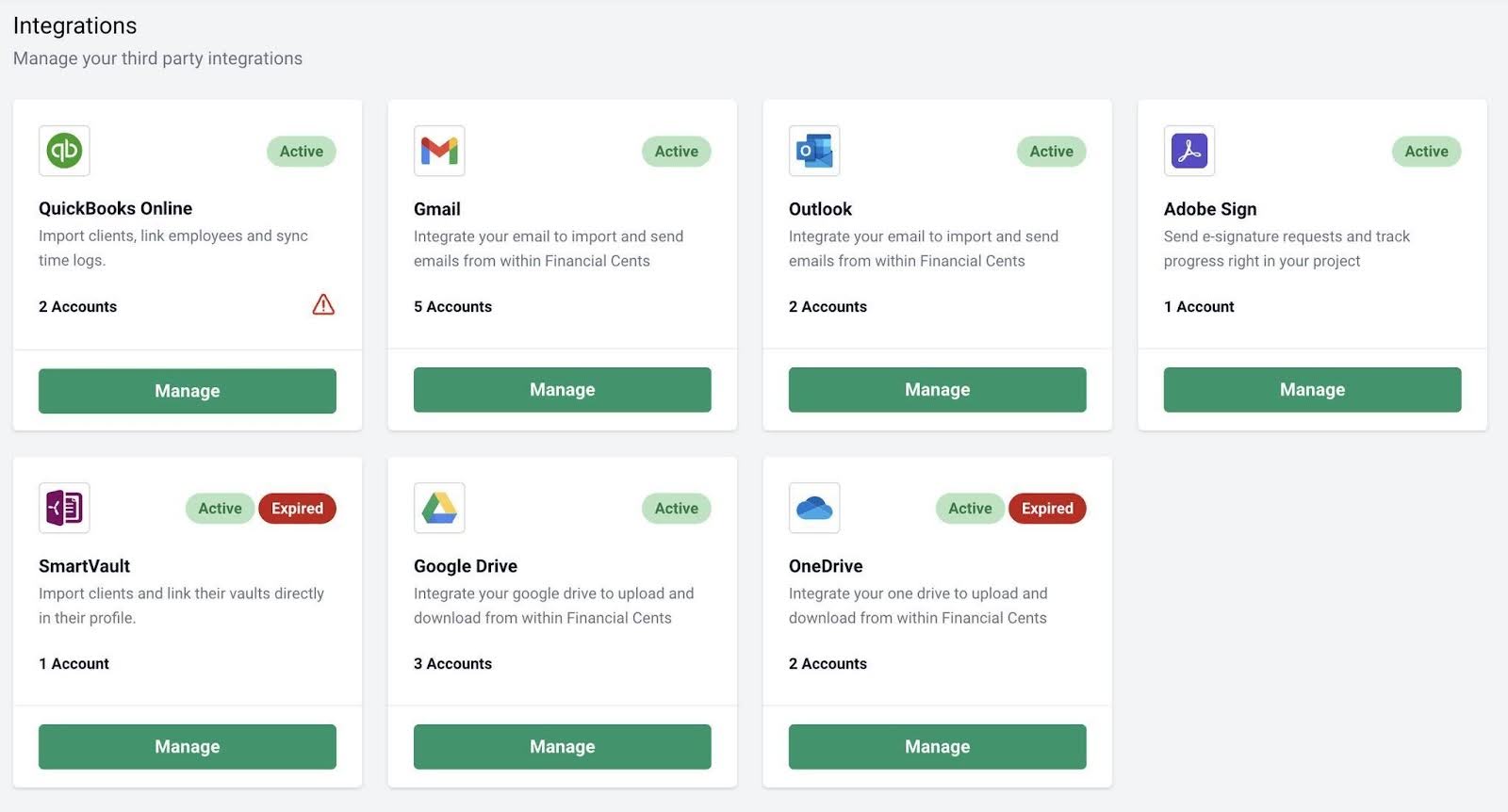
No software solution can meet all the tax practice management needs of every tax firm.
The right software will connect you with other relevant solutions so that you do not need to purchase (and learn, and manage logins for) more apps. Any software worth considering should integrate with accounting and tax-relevant software like:
- Your general ledger accounting software.
- Proposal software.
- A document management system.
- Zapier, to connect to 5,000+ other apps you may need now or later.

With integrations, you can link clients and transactions and automate manual tasks across your mission-critical tools from one platform.
Financial Cents: One Place for All Your Tax Workflows, Client Information, and Team Workload
Technology should buy you time to focus on the work that counts the most.
If you spend a lot of time managing your tax processes across different apps, your tax practice management software may be the problem.
With the features above (and a handful of integrations), your tax practice management solution will bring all your work and client information into one place.
With Financial Cents, your team members can access the same information anytime (and from anywhere) to hit client deadlines.
Use Financial Cents to manage your tax practice. Book a free demo or start your free trial.
Frequently Asked Questions (FAQs)

Wesley Armstrong is the Customer Onboarding Manager at Financial Cents and a former Technical Support Specialist at SmartVault. He helps accounting and bookkeeping firms set up workflows that fit how they actually work, and writes about choosing, comparing, and switching practice management software.
Share this article