So you’re a bookkeeper who wants to leave full-time employment and start your own firm. Or you already own a firm that grew mostly by referrals, but now you’re over capacity and unsure whether to hire or raise your prices.
In both these scenarios, what you need is a business plan. It’ll help you decide what to sell, who to sell it to, what to charge, and when to hire, so you’re not stuck or guessing. Not a 50-page document you’ll write once and file away, but a working document you’ll reopen and use.
We share how to write a bookkeeping business plan section by section, a free template you can start using immediately, and common mistakes to avoid.
This guide is written for bookkeeping firms. If you offer tax, advisory, or full-service accounting, our accounting firm business plan guide covers the specifics for your practice.
TL;DR
- A bookkeeping business plan defines who your firm serves, what it sells, how it prices, how you’ll do the work, and where it’s headed.
- Keep it lean. A few pages at most. Save the longer, traditional version for when a lender or investor requires it.
- A complete plan has 10 sections: an executive summary, company description, target market and niche, competitive analysis, services and pricing, a marketing and sales plan, an operations and technology plan, a team and capacity plan, financial projections, and your goals.
- Forecast revenue and capacity together. You can’t project income you don’t have the hours to deliver.
- Treat it as a living document. Revisit it at least quarterly and update it when anything changes.
What Is a Bookkeeping Business Plan (and Do You Really Need One)?
A bookkeeping business plan is a document that outlines your firm’s goals, your target clients, the services you’ll offer, your pricing, how you’ll deliver work, and your financial projections.
Do you need one? Yes. Ideally, you should create one before you start a bookkeeping business, so you can test your idea and see whether the firm can turn a profit before you spend cash. Lenders and investors often require it too.
But if you didn’t write one prior, you can still do it after you’ve launched. Use what you’ve already learned about your clients, your pricing, and your costs to build a realistic plan.
Still deciding on a name for your business? Try the free bookkeeping firm name generator for ideas.
Lean Plan or Traditional Plan: Which One Do You Need?
Your plan can run a few pages. It can also run 40-50 pages. Your choice depends on whether it’s just for you or for a lender and what you want to use it for. However, in many cases, it’s often better to start lean. Write the short version first, use it, and when need be, expand to a traditional plan.
Here’s a decision table so you can see how the two compare:
| Lean Plan | Traditional Plan | |
|---|---|---|
| Best for | Solo or side-hustle owner validating a niche, usually self-funded | Owner seeking a bank loan, investor, acquisition, partner buy-in, or office lease 30-50 pages |
| Length | One to a few pages | Detailed market and competitor analysis |
| Research depth | High level, only the essentials | Column |
| Financial statements | Simple projections on revenue, costs, and break-even | Detailed multi-year projections with income statement, balance sheet, and cash flow statement |
| Update cadence | Revisit and update quarterly | Update annually or at a major milestone that calls for it |
| Time to write | A few hours to a day | Days to weeks |
5 Things To Do Before You Write a Business plan for Bookkeeping Business
Determine Your Niche & Ideal Client
First, decide exactly who you’re going to serve, down to industry, size, and the funding stage. As Richard Roppa-Roberts, founder of Quasear Cowboy Consulting, says,
This decision affects everything from your bookkeeping pricing to your marketing and services, so be specific. For instance, don’t just say you serve “small businesses.” Instead, say something like B2B SaaS companies making up to $2 million in annual revenue. The narrower your focus, the more of an expert you appear and the more you can charge for your services.
Decide Whether You’ll Work Solo, Use Contractors, or Hire a Team
Next, specify how you want to structure your firm. You can either work as a solo bookkeeper or hire staff full-time or part-time. Each has its pros and cons, and your choice depends on how many clients you want to serve, how much you want to earn, and how much of managing you’re willing to do.
Determine Your Service Mix
Now choose what you’ll sell and what you won’t. This could be monthly bookkeeping, one-off bookkeeping cleanup projects, advisory work, payroll, accounts payable and accounts receivable, etc. When starting, it’s better to offer a few high-demand, high-margin services, get good at them, then add more as you grow.
Financial Cent’s firm revenue report found that bookkeeping drove the profit margin for 31.8% of firms in 2023, followed closely by tax returns for 30.7% of firms and accounting for 12.3% of firms. Use the full data in this report to determine your service mix.
Choose a Pricing Model
Define how you want to price your bookkeeping services whether hourly, project-based fee, monthly retainers, etc. You can have a mix of different pricing models depending on the project. For instance, retainer fees for recurring monthly bookkeeping work, hourly rate for advisory calls, and project-based fee for one-off cleanup projects,
Determine Whether You’ll Run Remote, In-Person or Hybrid
You can run your firm virtually, in-person or even hybrid. In our revenue report bookkeeping firms are evenly split between fully remote and hybrid working at 42.9%, with only 14.6% working on-site.
A remote firm can help you save overhead costs and hire from anywhere but there may be communication challenges and firm culture issues. An in-person firm has better team-bonding and good communication but higher overhead costs and limiting talent pool. A hybrid firm blends the two, but it can be harder to coordinate and manage. Choose one, and account for it in your financial plan.
Read: Bookkeeping Automation Examples That Actually Save Time
How to Write Your Bookkeeping Business Plan, Section by Section
A standard bookkeeping business plan has 10 sections consisting of:
- An executive summary
- A company description
- A target market and niche
- A competitive analysis and positioning
- A services and pricing section
- A marketing and sales plan
- An operations and technology plan
- A team and capacity plan
- A financial plan and projection
- A goals, risks, and milestones section
Now let’s get into detail for each:
Executive Summary
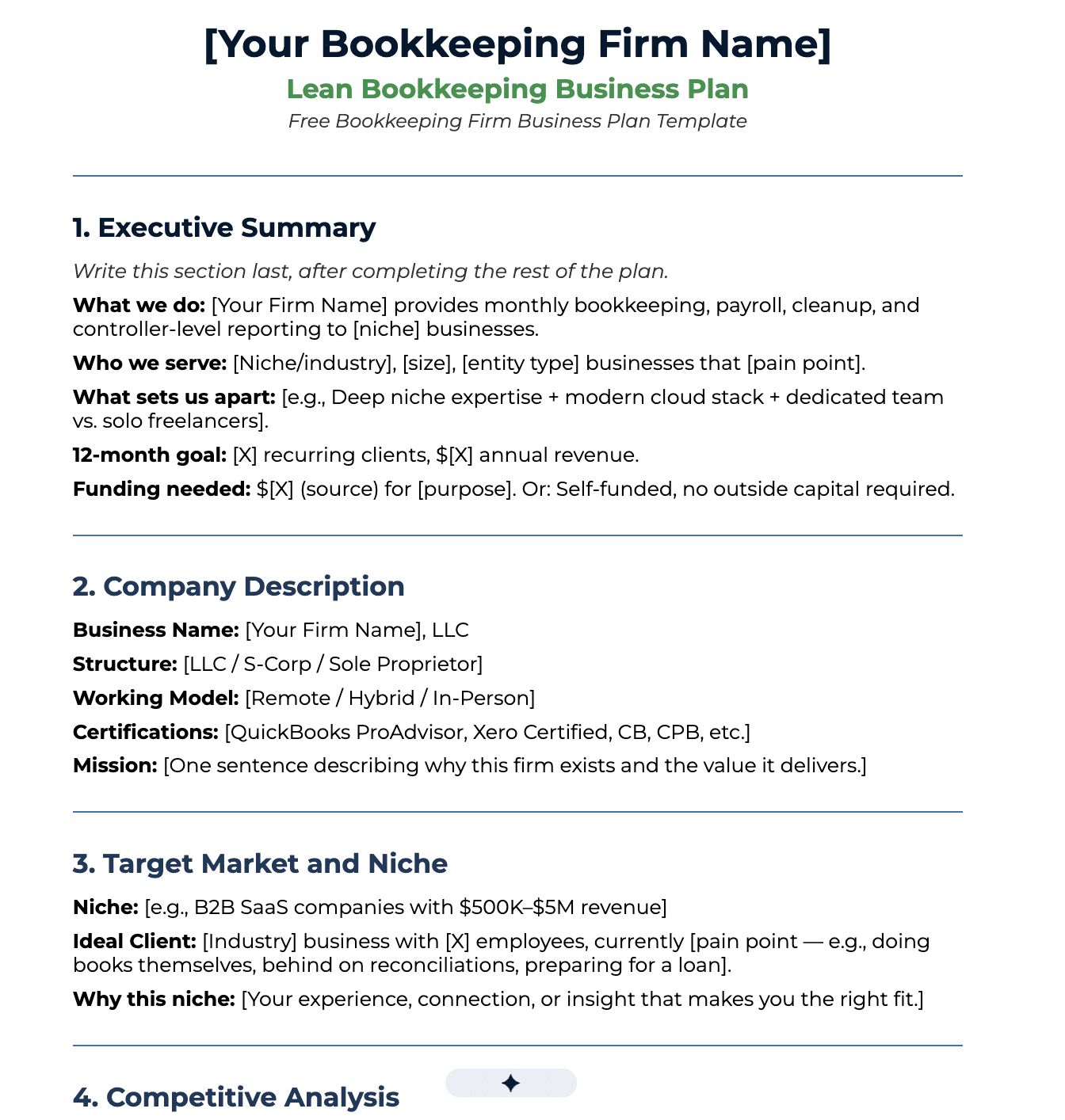
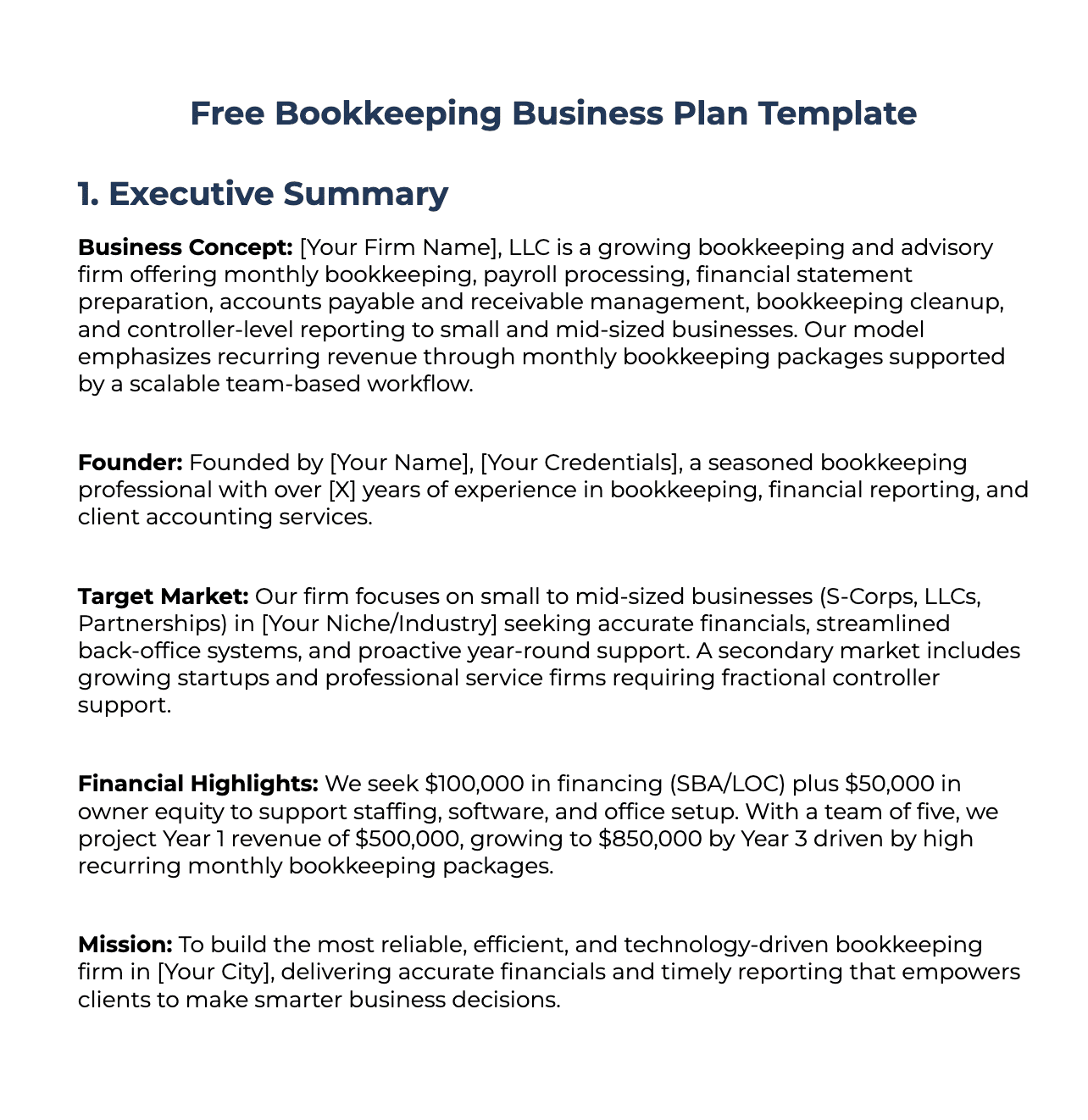
This appears on the first or second page of the plan, but it’s what you write last because by the end you have a complete view of what you want to build and can summarize it succinctly. Include what the firm does, its services, its target audience, what sets it apart, goals for the next 12-36 months, and whether or not you need funding (and if so, how much you need). Don’t make this section too long. It’s a summary, so keep it to the essentials.
Company Description
Give an overview of your company. Provide every detail someone needs to know, like its legal structure, ownership, working model (in-person, remote, or hybrid), bookkeeping certifications, and milestones. Personalize it even further by detailing your founder story, your mission and vision.
Target Market and Niche
Hone in on your target customer and niche and share details. Build an ideal client profile consisting of name, industry, pain point, geography, buying trigger, and budget.
You can also gather Total Addressable Market (TAM) data if you want big-picture numbers, but don’t plan around it since you won’t serve every business in the market. Use your Serviceable Addressable Market (SAM) and Serviceable Obtainable Market (SOM) to guide your plan instead. Pull all of this from real prospect interviews, competitor research, and the industry-specific communities where your target clients gather.
Competitive Analysis and Positioning
Conduct competitor research to identify the gap, then position yourself to fill it. Compare your firm to other competitors like other bookkeeping firms, freelance bookkeepers, CPA firms, and DIY software. Weigh each on niche expertise, service depth, responsiveness, technology, price, and client experience and look for a gap you can own.
Services and Pricing
Choose the services you’ll offer from monthly bookkeeping, cleanup, payroll, accounts payable and receivable, reporting, and controller or advisory work, then document it in your plan. For every service, note its scope, timeline, and what the client gets. Include the services you’re not offering and formalize it with a bookkeeping engagement letter so the boundary is clear from the start. Then add your rates and your pricing model. This section will change as you grow, so document your starting services and rates and update them later.
Once your service scope is defined, formalize it in a bookkeeping engagement letter before starting any work. It sets expectations on both sides and protects your firm if scope creep surfaces later.
Want to see what your pricing would look like depending on your rates or pricing model? Use our bookkeeping pricing calculator.
Marketing and Sales Plan
Dedicate 1-2 pages on how you’ll get bookkeeping clients and grow your firm. Some effective marketing strategies include SEO, AEO & content marketing, referral partnerships, local networking, paid ads, personal branding, etc. You can add sales outbound strategies like cold calling and cold emailing, but ensure you only reach out to the ideal leads you’ve defined.
Once you get bookkeeping leads, take them through a funnel and nurture them till the convert. Pick just 1-3 of these strategies at first, and add others once you have more resources. For instance, a solo firm can start with personal branding on LinkedIn and local networking, since one person can handle both, then scale from there.
When a lead is ready, close them with a professional bookkeeping proposal that outlines your services, pricing, and terms..
Operations and Technology Plan
Don’t forget your bookkeeping workflow and tech stack as it’s very important. State exactly how your firm handles projects, from onboarding clients to collect documents, closing the books, reviewing the work internally, submitting to the client, billing, and offboarding when needed. If your workflow is broken or clunky, it’ll affect operations and client satisfaction.
Then list all the tools you’ll be using. The fewer and more integrated, the better. 88% of firms surveyed in the Financial Cent’s Bookkeeping Firm Tech Stack Report said they want 4 tools or fewer as too many tools drains time and money.
So plan for integration and consolidation of tools from day one. An all-in-one bookkeeping practice management software like Financial Cents reduces the need for many tools and increases bookkeeping efficiency.
Team and Capacity Plan
Even if you’re a solo firm today, still account for how you’ll handle growth. Start with what you, the founder, are responsible for, then define the point where you bring in help and what kind (full time or contract).
Know your team’s capacity and state them clearly. No vague “we hire as we grow”. State the exact conditions that trigger a hire like client count or working hours. For instance, “we’ll hire a part-time bookkeeper at 15 monthly bookkeeping clients”
A capacity plan should explain not only when to hire, but also how bookkeeping firms scale through standardized workflows, workload visibility, and clear team ownership.
Financial Plan and Projections
In 2-3 pages, share the numbers and prove the firm can make money. Show your startup costs, monthly fixed and variable expenses, revenue by service and client count. Also share projected average monthly revenue, churn, payroll costs, owner pay, taxes, cash reserve, break-even point, and 12-month cash flow. Include best, base, and worst case scenarios, so you know how to act in each.
Goals, Risks, and Milestones
Conclude with a section detailing where you’re going and what could go wrong. Set goals at 90 days, 12 months, and three years. This gives you a near-term target to act on immediately, a yearly target to work towards, and a long-term direction to guide the firm.
Also share KPIs you’ll track, when you’ll review them, likely risks you’ll face as you grow, like client concentration, underpricing, cybersecurity, capacity issues, founder dependency, seasonality, and how you’ll mitigate them.
Free Bookkeeping Business Plan Template [word and Google docs]
Below is the free bookkeeping business plan template as promised (traditional and lean plans), it is available in Word and Google Docs format. It contains all 10 sections, so all you have to do is fill them out in order, but with the summary last. Delete all prompts and placeholders, then schedule your first quarterly review to measure progress and update the plan.
Build the Financial Model: Clients, Price, Capacity, Cash
The numbers section is where the plan proves the firm can make money. Here’s how to build it from the ground up.
Start with your packages and your average monthly fee. Say, on average, you charge $800/month for bookkeeping, estimate how many clients you win each month and how many you lose, then use that to calculate recurring monthly revenue. Factor in one-off or QuickBook cleanup projects separately since they’re not recurring revenue and so not predictable.
Here’s how it looks:
| Service | Clients | Rate | Monthly revenue |
|---|---|---|---|
| Monthly bookkeeping | 16 | $800/month | $12,800 |
| Payroll | 9 | $200/month | $1,800 |
| Advisory | 3 | $1,200/month | $3,600 |
| Cleanup (one-time) | 2/month | $3,000/project | $6,000 |
| Total | $24,200 |
But that’s not all. Check that figure against your team capacity. If it takes 10 hours a month to close a client’s books, and you have 120 billable hours a month, you can ideally handle 12 clients before you’re full. Less if you add other services like payroll and advisory. Always consider capacity when projecting revenue. You can’t project what you can’t deliver.
Remember to subtract all operational costs like software, insurance, marketing, contractors/payroll, taxes, and owner draws. What’s left tells you your break-even point, the client count where the firm covers itself, and your cash runway.
To see how much time and revenue a practice management tool could save your firm, run the numbers through Financial Cents’ ROI calculator.
Common Mistakes Bookkeeping Firm Owners Make
Choosing “All Small Businesses” as Your Target
This is a common mistake many owners make. Niching down feels risky, so they cast the widest possible net expecting a bigger market to mean more clients. It does the opposite. When you serve everyone, you end up without a differentiating factor and eventually compete on price. Instead pick one lane, and be the go-to there so you can attract better-fit clients and command higher rates.
Reza Hooda, Founder, Capture Accounting shares that one of the core ways his second firm made £100,000 mark in nine months was by specialization and positioning.
Listing Services Without Scope or Delivery Standards
When listing out your services, state what it includes, excludes, and how you’ll deliver to the client. Failure to do this can cause scope creep or confusion down the line.
Pricing Without Capacity or Margin
Don’t set rates without accounting for capacity and margin. You’ll undercharge, or set targets you can’t hit because you don’t have the hours to deliver them.
Forecasting Revenue Without Planning How You’ll Win Clients
A few clients might come from word of mouth, but for the most part, you have to be intentional about getting clients. So before writing revenue forecasts, factor that in and ensure they go hand in hand.
Ignoring Software and Security Costs
Tech costs often tend to fly under the radar, but they add up quickly as you add more seats and get more tools. So always budget for that, including security measures you’ll have to take.
Copying Generic or AI-Generated Market Data
Never use numbers from templates or AI to make decisions. They’re often vague, dated, or wrong for your situation. Instead, do your own research and get your data from real sources to make data-backed choices.
Never Reopening the Plan
Another common mistake is abandoning the plan after writing it. It’s not a one-time document. Revisit it from time to time to ensure everything is going as planned, and update it as you learn more.
Recommended: Complete month-end close checklist for bookkeeping firms
Build the System That Lets You Deliver Consistently
We’ve established that your plan defines what your firm intends to deliver, your workflow is what delivers it, and delivery is only consistent when your workflow and system are. A messy or manual process causes missed deadlines, client chasing, and late filings.
For an efficient workflow, you need software specifically built for accountants and bookkeepers like Financial Cents. Here’s what the software does:
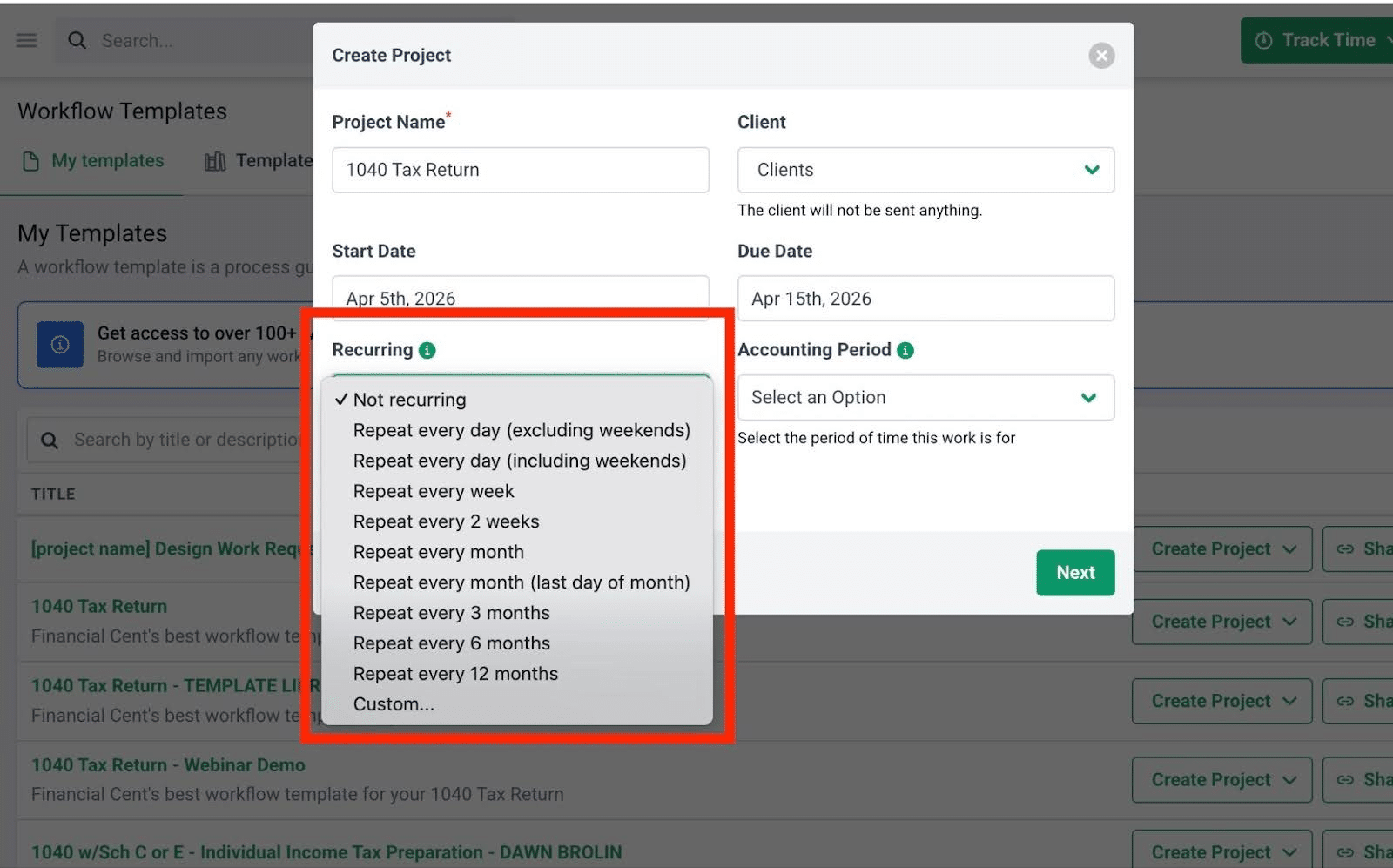
- It automates recurring bookkeeping tasks, so a monthly bookkeeping engagement for instances recreates itself on schedule each month instead of rebuilding it by hand. You can also turn projects into reusable bookkeeping workflow templates so work is always consistent no matter who does it, or use any of the 400+ pre-built templates in our template library.
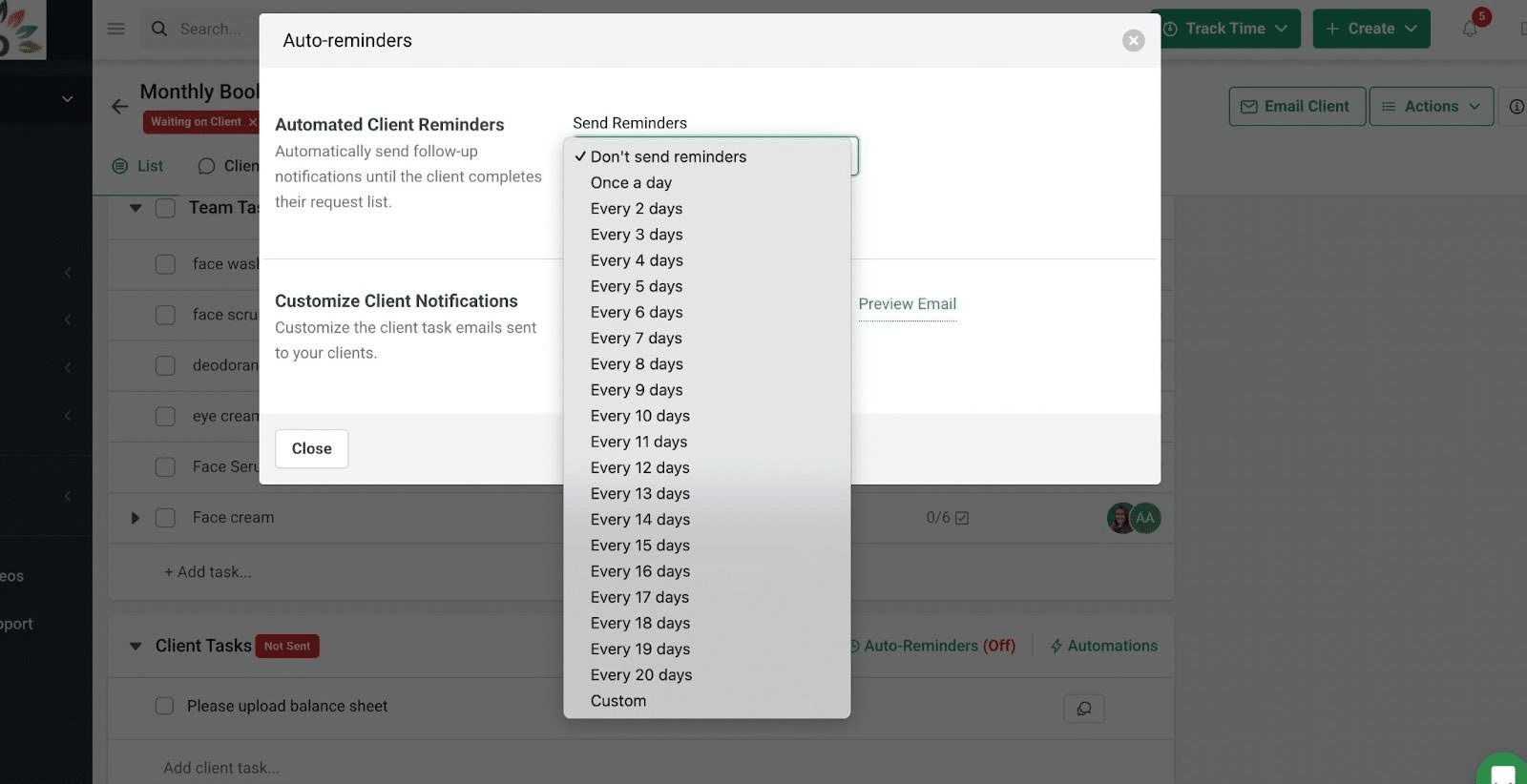
- It automates client requests and reminders so you collect documents without chasing anyone. As Terri Evans, Owner, Safe Harbor Bookkeeping, testifies,
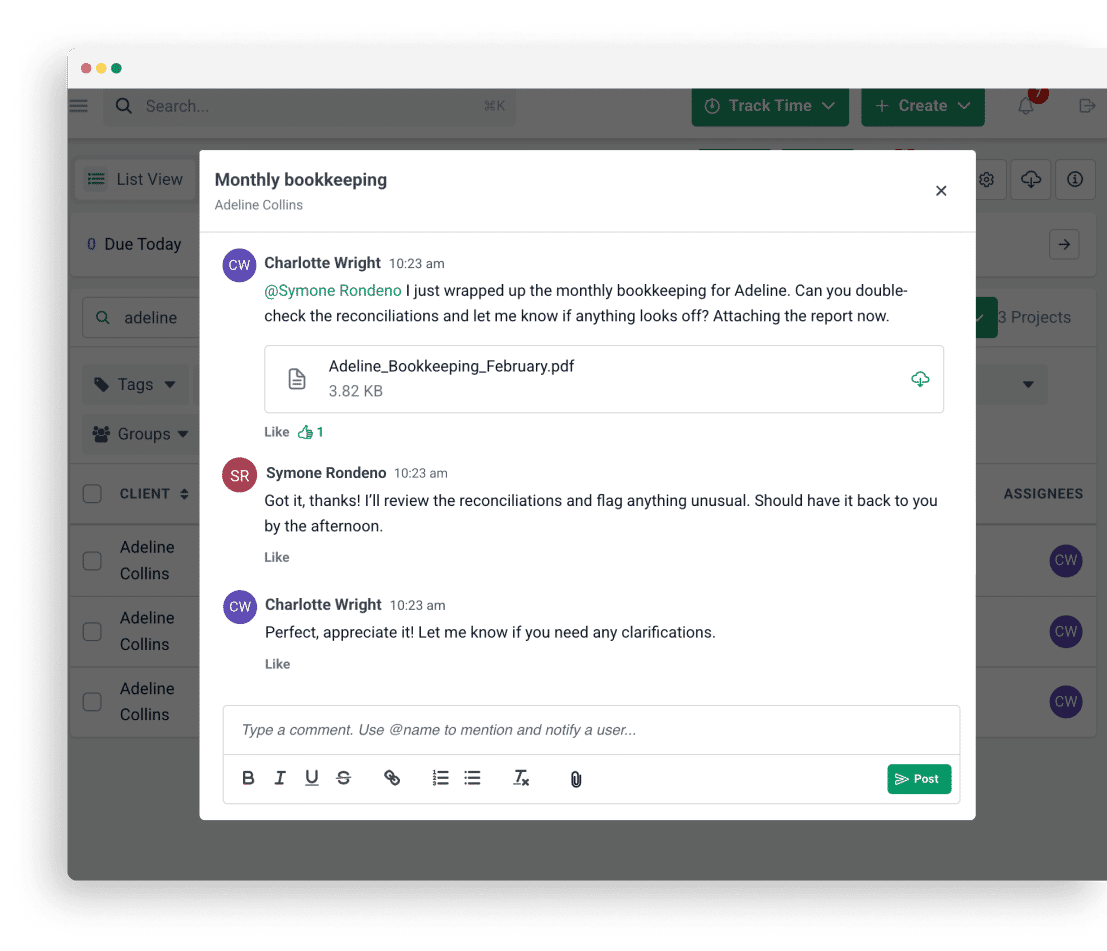
- It lets you assign work with due dates and clear handoffs and tag team members:
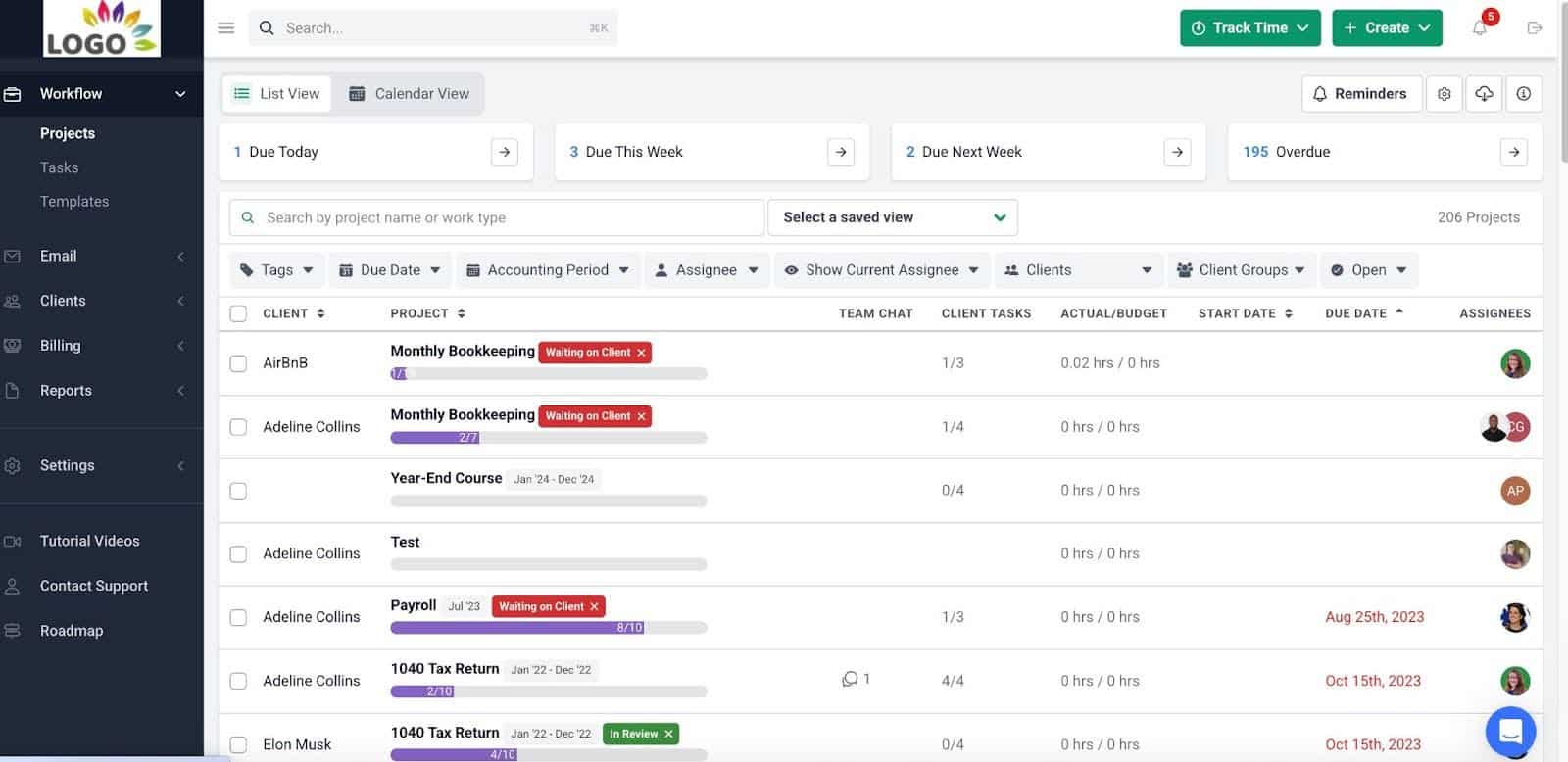
- You get a live view of everything going on in the firm, and even see workload and capacity to reassign work as needed. Stacey Feldman, CPA, Chief Operating Officer at Full Send Finance, loves this feature:
- It allows you to track time, send invoices, and automate payments with Financial Cents’ integrated billing software:
“The time tracking feature of Financial Cents and how it ties into the billing has literally brought my billing down from an entire day to about an hour and a half,” says Terri Evans, Owner, Safe Harbor Bookkeeping.
Ready to build the system that allows you to deliver work consistently? Try Financial Cents 14-day free trial
Frequently Asked Questions
Share this article: